PROLOGUE · INTO OUR OWN AGE
We have come a very long way.
In the fifteenth century, tarot was a card game played in Italy. In the eighteenth century, divinatory meanings were added to it. In the nineteenth century, it became connected with Kabbalah, astrology, magic and many other forms of Western esoteric thought.
Then came the twentieth century. Waite and Smith created the RWS deck, filling the cards with human stories. Crowley and Harris created the Thoth Tarot, condensing colour, form and esoteric symbolism into its imagery.
So what happened next? Why did tarot not simply become a curious historical relic once used by occultists of the past?
Why, six hundred years later, are new decks still being created? Why do new people continue to pick up the cards—to divine with them, think with them or simply enjoy their artwork?
This time, we will follow the reasons tarot has
survived all the way into our own age.
01 · PUBLISHING AND DISTRIBUTION
First, the cards became
easier to obtain
Any culture can disappear if there is nobody left to use it. For tarot, one very important factor was something quite practical: publishing and distribution.
The RWS deck was first published in 1909. But that does not mean people all over the world immediately began using it. Its spread on the scale we know today came decades later.
In the 1960s and 1970s, interest was growing in Europe and the United States in Eastern philosophy, meditation, astrology, esotericism and the search for the self. It was the era that would become associated with what we now call New Age culture. Tarot became part of that world as well.
Around 1970, Stuart R. Kaplan played a particularly important role in wider distribution. The company he founded, U.S. Games Systems, brought affordable tarot into mainstream bookstores and later secured worldwide distribution rights for the RWS deck.[1]
Histories of tarot likewise describe a modern resurgence and the lasting influence of RWS imagery on decks that followed.[2]
No matter how fascinating an idea may be, people cannot use a deck they cannot get hold of. One reason tarot survived is surprisingly down-to-earth.
That change mattered more than we might imagine.
TAROT WITHIN REACH
A modern three-card spreadFrom the late twentieth century onward, tarot increasingly became something ordinary people could buy, learn and try for themselves.
Photo: Nosferattus / Wikimedia Commons / CC0 1.0View the image and rights statement02 · OPEN KNOWLEDGE
The knowledge was
no longer secret
In the days of the Golden Dawn, correspondences between tarot, Kabbalah and astrology were the sort of material people might learn step by step within an esoteric order. By the second half of the twentieth century, things had changed.
Knowledge that had once circulated mainly within particular organisations or teacher–student relationships was becoming open to many more people through publishing.
Of course, something was lost as well. Ideas could be simplified. Historically dubious stories could spread alongside better-researched ones. But you no longer needed to join a secret society to begin learning tarot.
Buy a deck. Read a book. Then draw a card for yourself. Little by little, tarot ceased to be something you could only approach if someone initiated or instructed you.
03 · MORE THAN PREDICTION
Tarot became more than a way
to “predict the future”
Another important change took place in the second half of the twentieth century. More people began to look at tarot as something other than simply a tool for predicting the future.
You could look at a card and think about how you felt. You could look at a problem from another direction. You could use an image as a starting point for talking about something you had not yet been able to put into words.
Tarot could become a tool for self-understanding and reflection. One name often mentioned in this context is the psychologist Carl Gustav Jung.
04 · JUNG AND LATER TAROT
Was Jung a
Tarot researcher?
This is a point where we need to be careful. Modern tarot books often place “Jungian psychology” and tarot side by side.
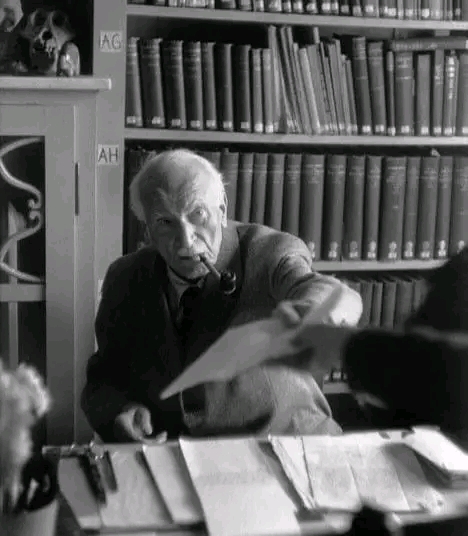
A NEW WAY TO THINK ABOUT SYMBOLS
Carl Gustav JungJung did not create the modern system of “psychological tarot,” but his work on archetypes and symbols gave later tarot readers a new way to approach the cards.
Kairos Film Foundation photo / Wikimedia Commons / CC BY 4.0View the image and licenceJung studied archetypes and the symbols that appear in the human mind. Tarot is full of figures that seem to fit remarkably well with that way of thinking: the Emperor, maternal figures, the Hermit, Death, the Sun and the Fool.
Later writers therefore developed ways of reading tarot as a collection of symbols that speak to shared patterns in human experience and the psyche. A 2023 review of psychological approaches to tarot likewise found Jungian analytical psychology among the main frameworks used in later scholarship.[3]
But Jung himself did not build the modern system sometimes called “psychological tarot.” It would be going much too far to say that “Jung proved tarot has psychological effects.”
05 · IMAGE AND PROJECTION
Looking at a card, yet
talking about yourself
So what does it mean to approach tarot psychologically? Imagine looking at one card. The Fool is walking near the edge of a cliff.
The card is the same. What changes is what each person sees in it. Into those differences can enter the viewer’s own experiences and emotions.
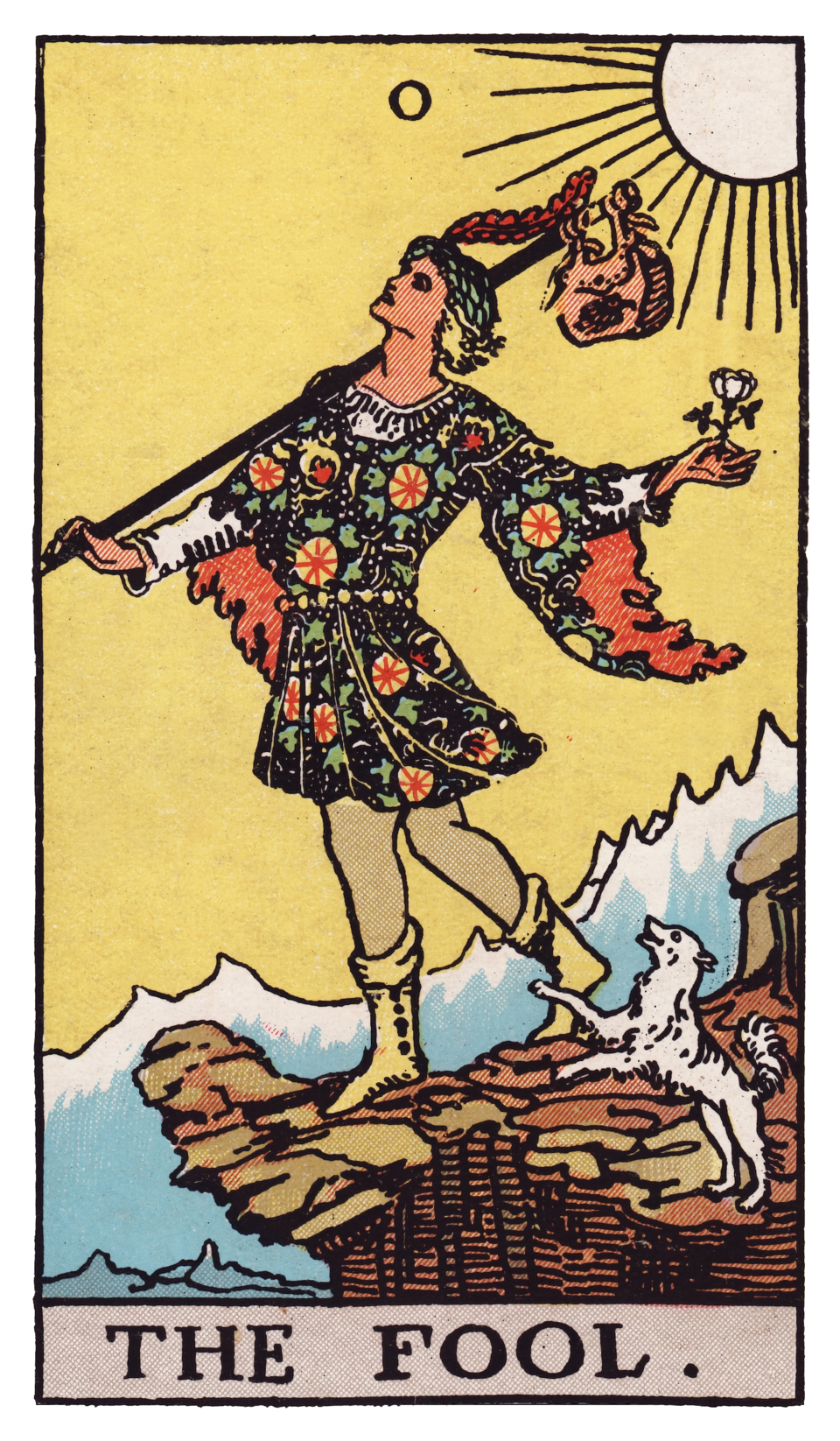
ONE IMAGE, DIFFERENT RESPONSES
The Fool from the RWS TarotThe same image can feel dangerous to one person, liberating to another, or like the beginning of a new journey to someone else.
Pamela Colman Smith, The Fool, RWS Tarot (1910) / Public domain / Wikimedia CommonsView the image and rights statementIn psychology, the idea of “projection” is sometimes used to describe the way a person may place aspects of their inner world onto an ambiguous stimulus. Researchers have explored whether tarot might be used in a similar projective way, as an aid to counselling or self-expression.
A 2006 paper examined tarot as a projective technique.[4] Counselling research published in 2024 also discussed its possible use not as a diagnostic instrument, but as a supplementary tool that can encourage expression and conversation.[5]
But here too, caution is necessary.
06 · WHAT RESEARCH CAN SAY
Psychology has not proved
that “Tarot works”
There is still not a large body of psychological research on tarot. A review published in 2023 pointed out how limited the academic literature connecting tarot and psychology remains.[3]
So we cannot say, “Tarot has a scientifically established therapeutic effect.” Nor can we say that the cards can accurately diagnose the unconscious.
But researchers can study what happens when a person looks at a card, begins to think, starts talking, connects the image with personal experience or imagines the future from a different angle.
A small qualitative study published in 2025 involved six high-school students using tarot in career counselling. The participants were reported to have reflected more deeply on their future paths by relating the cards to their present and possible future selves. It was a very small study, so its results cannot simply be generalised to everyone.[6]
For now, perhaps the most accurate way to put it is: it is not that “the psychological effects of tarot have been proved.” Rather, we are increasingly able to ask psychological questions about why tarot can become a starting point for dialogue with oneself.
07 · CHANCE AND THOUGHT
Can the cards still “work”
without a mysterious power?
This connects with a question that has appeared again and again throughout this series. When you draw a card, why does it sometimes seem to fit your situation so perfectly? Did something choose that card, or was it simply chance?
We do not need to settle that question here. Even if the card was chosen entirely by chance, many things can still happen in the mind of the person looking at it.
You think, “Maybe there is another way to see this.” In other words, whether or not the card knows the future, the person looking at it can begin to think. That is an important distinction.
08 · THE FEELING OF ACCURACY
Psychology also has something to say
about a reading that “came true”
We can also look at tarot from the opposite direction. Sometimes a reading feels astonishingly accurate. Part of that experience may, in some cases, relate to psychological effects such as the Barnum effect or confirmation bias.
The Barnum effect is our tendency to feel that a broad description, one that could apply to many people, is a uniquely accurate description of ourselves. Confirmation bias is our tendency to notice and remember information that supports what we already believe while overlooking information that does not.[7][8]
Psychological research has long examined these kinds of processes in relation to divination and claims of paranormal experience. “I felt that the reading was accurate” and “the future was supernaturally predicted” are not the same statement.
But that does not mean everything a person experiences through tarot must therefore be dismissed as worthless.
From “Was it accurate?” to “What did it make me think about?”
Suppose you read a card as saying, “Maybe this is a time to rest.” We do not know whether that message was somehow delivered by the universe.
But if, at that moment, you think, “Come to think of it, maybe I really have been pushing myself too hard lately,” then a new question has already appeared.
“Do I actually need to give myself some rest?”
The card did not decide the answer. But the card created a question. That is a way of using tarot that is different from predicting the future.
09 · MORE IMAGES, MORE WORLDS
And so, the pictures
became more diverse
As more people began using tarot as something they could think with and talk to themselves through, another change followed. People wanted images that felt right for them.
Some people love RWS. Some prefer Marseille. Some prefer Thoth. Others want more nature, more contemporary people, animals, abstract art, images closer to their own culture, or people who look more like themselves inside the cards.
That desire, together with the creativity of artists, helped the number and variety of tarot decks grow rapidly from the second half of the twentieth century onward. Modern decks now draw on an enormous range of themes, cultures and representations of people, while many still retain structures and scenes inherited from RWS.[2]
Redrawing the same cards into our own worlds
Take the RWS Fool: a young traveller, a cliff, a dog, a bundle and the Sun. Keep the basic composition, but change the main character. Change the era and culture. Make the traveller an animal. Send them into space. Make them a cat.
And yet the feeling of stepping into the unknown can remain.
Tarot has never been a culture in which a single finished set of pictures had to remain unchanged forever. For six hundred years, the cards have continually been redrawn.
It was able to change in the modern age precisely because it had always been changing. The countless decks around us today are not a break from tarot history. They are part of its continuation.
10 · TAROT ONLINE
The internet spread
Tarot even further
Then came the twenty-first century. The environment around tarot changed once again.
Individual artists could create their own decks and share them with people around the world without necessarily going through a major publisher. Accounts of the modern revival likewise show how independent production and crowdfunding enabled new kinds of decks in the 2010s.[9]
Books were no longer the only way to learn to read the cards. You can learn through video, see a daily one-card draw on social media, draw cards online, read tarot through a smartphone app and now talk about the cards together with AI.
Someone from the fifteenth century would probably stare at all of this and ask, “What on earth is that?” And yet look at the skeleton of the deck: seventy-eight cards. Something six hundred years old is still there.
11 · A TOOL FOR QUESTIONS
From a tool that decides the future
to a tool that creates questions
Of course, many people still use tarot to ask about the future: love, work, money, relationships. “What is going to happen?” Those questions have not gone away. There is no need to reject them.
As we saw in Part 4, the human desire to know the future is one of the forces that carried tarot this far.
But today another way of using the cards has also become clearly visible: drawing a card not to receive an answer, but to think.
The card does not have to become the answer itself. It can become a card that deepens the question. Across six hundred years, tarot has become a tool that can be used in that way too.
12 · ROOM FOR MYSTERY
And it is fine for Tarot
to remain a little mysterious
We have talked about psychology, projection, association, the Barnum effect and confirmation bias. Learning about these ideas might make you wonder, “Does psychology explain away everything mysterious about tarot?”
Not necessarily. Psychology can help us think about how people feel and how people create meaning.
But there is no need to strip all the wonder from the experience of having a question, drawing a card one day and feeling, “For me, right now, it was this card.”
Why this card today? Did it mean something? Was it chance? We do not know.
But
we can think without first solving that mystery.
Perhaps tarot is particularly well suited to that.
EPILOGUE · TOWARD THE FINAL PART
Toward the end of our
six-hundred-year journey
In Part 1, we began here: Tarot was not born as a form of divination.
In the fifteenth century, people were playing cards. From there: six hundred years.
Someone tried to see the future. Someone tried to find ancient secrets. Someone searched for an invisible order behind the world. Someone filled the cards with symbols. Someone turned those symbols into illustrated stories. Someone else drew an entirely different tarot around a different philosophy.
And now we can even draw those cards on a smartphone screen. A great deal has changed. But perhaps the most important part has not changed very much at all.
For centuries, people have placed those wishes onto tarot cards.
So, at the end of our journey through six hundred years of history, let us return once more to the question that has been with us from the beginning.
What, in the end, is Tarot?
A tool for seeing the future? A system of esoteric symbols? Art? A psychological mirror? A game? Or all of them?
SOURCES & IMAGE RIGHTS
Sources and image rights
The modern history of tarot was checked against publisher and museum material. Claims about psychology were checked against papers and university repositories. Because this remains a limited body of research, the article does not claim an established therapeutic effect or diagnostic ability. Images are CC0, CC BY 4.0 or public domain.
- 1
U.S. Games Systems
Stuart R. Kaplan on affordable tarot distribution and securing worldwide distribution rights for RWSRead the interview - 2
Victoria and Albert Museum
A history of tarot, the publication and visual legacy of RWS, modern online communities and artistic reinterpretationRead the history - 3
Korea Citation Index
Kyung-Hee Choi, “A Proposal for the Psychological Application of Tarot Cards” (2023)—a review of twenty-eight studies and the limited literatureRead the abstract - 4
Wiley
Inna Semetsky, “Tarot as a projective technique” (2006)See the paper record - 5
James Madison University
Eileen Clinton, “Divining the self: Applying tarot as a projective technique in counseling” (2024)—an expressive rather than diagnostic proposalSee the research record - 6
RISS / Journal of Education & Culture
Hye-Kyung Baek and Ki-Seop Jung, “A Study on Career Counseling Using Tarot Cards” (2025)—a qualitative study with six high-school studentsSee the research record - 7
Encyclopaedia Britannica
The Barnum effect: accepting broadly applicable descriptions as uniquely personalRead the definition - 8
APA Dictionary of Psychology
Confirmation bias: emphasising evidence that confirms pre-existing expectations while dismissing contradictory evidenceRead the definition - 9
Kickstarter Magazine
Independent tarot production through crowdfunding and the expansion of themes represented in modern decksRead the examples - 10
Wikimedia Commons
Nosferattus, Tarot cards - 3 card spread (2021)—CC0 1.0View the image and rights statement - 11
Wikimedia Commons
Carl Gustav Jung in his home library, Kairos Film Foundation photo—CC BY 4.0, uncroppedView the image and licence - 12
Wikimedia Commons
Pamela Colman Smith, The Fool, RWS Tarot (1910)—public domainView the image and rights statement