PROLOGUE · ONE ROOT, TWO BRANCHES
Over the last few parts, we have met Arthur Waite and Pamela Colman Smith: the symbols Waite conceived, the stories Smith drew, and the Rider–Waite–Smith Tarot—the RWS that appeared in 1909.
Human figures and events entered even the Minor Arcana. A reader could look at a card and wonder, “What is this person feeling?” or “What will happen from here?” It became one of the great roads leading into Tarot as we know it today.
But it was not the only road to grow out of the Golden Dawn. Another member learned within the same order and then travelled in a very different direction from Waite.
Together they made the Thoth Tarot. RWS and Thoth look astonishingly different, yet if we follow their roots, both lead back to the same Golden Dawn.
How did the same soil grow
two Tarots so unlike each other?
01 · ALEISTER CROWLEY
Who was
Aleister Crowley?
Magician. Poet. Mountaineer. Mystic. Famous, too, for provocative words and acts, he is one of the most conspicuous figures in twentieth-century occult history, for better or worse.
Born in Britain in 1875, he entered the Hermetic Order of the Golden Dawn in 1898, while still in his early twenties. It was the same organisation to which Waite belonged. The young Crowley studied the same world: Kabbalah, astrology, Tarot, ritual magic and elaborate chains of symbolic correspondence.[1]
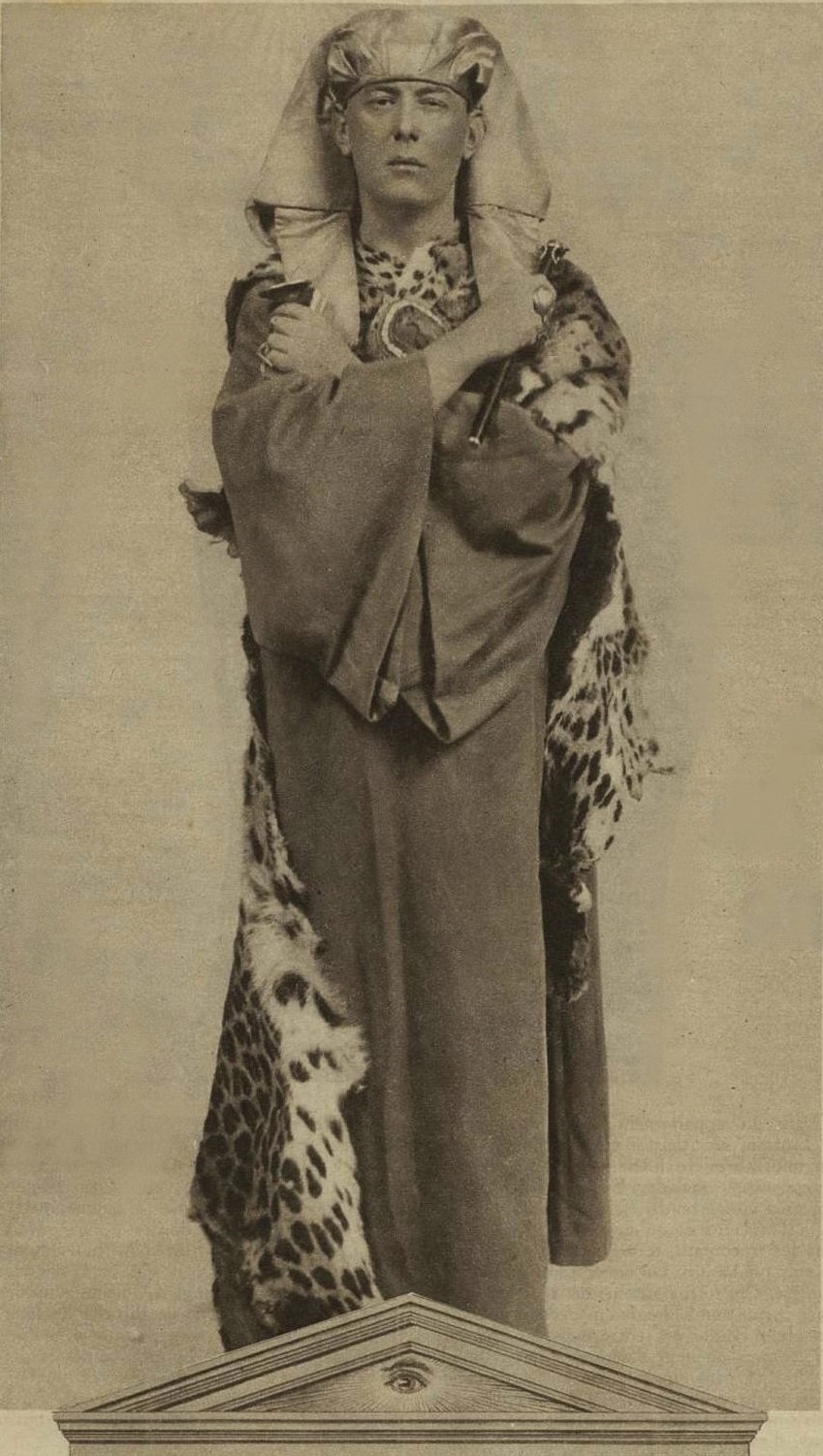
AROUND THE TIME HE JOINED THE GOLDEN DAWN
Aleister Crowley1875–1947Dated 1899, this photograph shows Crowley costumed as Osiris, a year after his initiation.
Unknown photographer / Wikimedia Commons — Public domainView the image and rights statementWhat he did with those teachings, however, was markedly different from what Waite did.
02 · DIFFERENT AIMS
Waite and Crowley were not
seeking the same thing
To simplify considerably, Waite sought to approach something spiritually and religiously higher through mystical symbols. At times he kept his distance from magical technique as an end in itself.
Crowley, by contrast, moved toward studying and practising magic, then remaking it as a system of his own thought. After the Golden Dawn divided, he continued developing an independent magical philosophy.
toward the spiritual
toward a new system
At its centre was the philosophy called Thelema. Crowley’s famous phrase “Do what thou wilt” may sound like permission to follow every whim. Within his thought, however, it points toward a harder question: what is one’s true and most fundamental will?[2]
Following that question in detail would take us a long way from Tarot. For now, it is enough to say that Crowley inherited the Golden Dawn’s system and built a mystical philosophy of his own from it.
03 · CROWLEY AND HARRIS
Then Crowley met Frieda Harris
and set out to make a Tarot
By the late 1930s, roughly thirty years had passed since the appearance of RWS. Crowley now set out to create a Tarot that embodied his own magical thought.
The artist he met was Frieda Harris. Their work together, from about 1937 to 1943, produced the paintings that became the Thoth Tarot. The originals are now held by the Warburg Institute in London, where they formed a major part of the Institute’s 2025 exhibition on Tarot history.[3]
Harris was not simply “the person who painted it”
To say only that Harris painted Crowley’s Tarot greatly diminishes what their collaboration actually involved.
Recent scholarship has re-evaluated her as a co-creator who helped not only to make and develop the work, but also to exhibit, promote and materially realise it through funding and social connections. A 2024 Oxford University Press study treats their work explicitly as a partnership.[4]
The Warburg Institute’s Yorke Collection preserves Harris’s correspondence, working notes, exhibition materials and documents connected with attempts to publish the deck.[5]
As Waite had Smith, Crowley had Harris. Yet neither partnership was simply a thinker issuing orders and an artist obeying them.
04 · TWO VISUAL LANGUAGES
Nothing like RWS
The Thoth Tarot layers figures, geometric forms, intense colour, stars, circles, lines, wings, serpents and plants within a single card.
happening herePEOPLE · PLACE · TIME · STORY
embodies a forceCOLOUR · FORM · STAR · ELEMENT · CORRESPONDENCE
Both draw on the Kabbalistic and astrological correspondences inherited from the Golden Dawn. Their ways of giving those ideas visual form, however, are profoundly different.
05 · THE MINOR ARCANA
The difference becomes clearest
in the Minor Arcana
In RWS, the Five of Cups shows a grieving figure, the Seven of Swords a person carrying swords away, and the Ten of Pentacles a family and buildings. Meanings appear as human events.
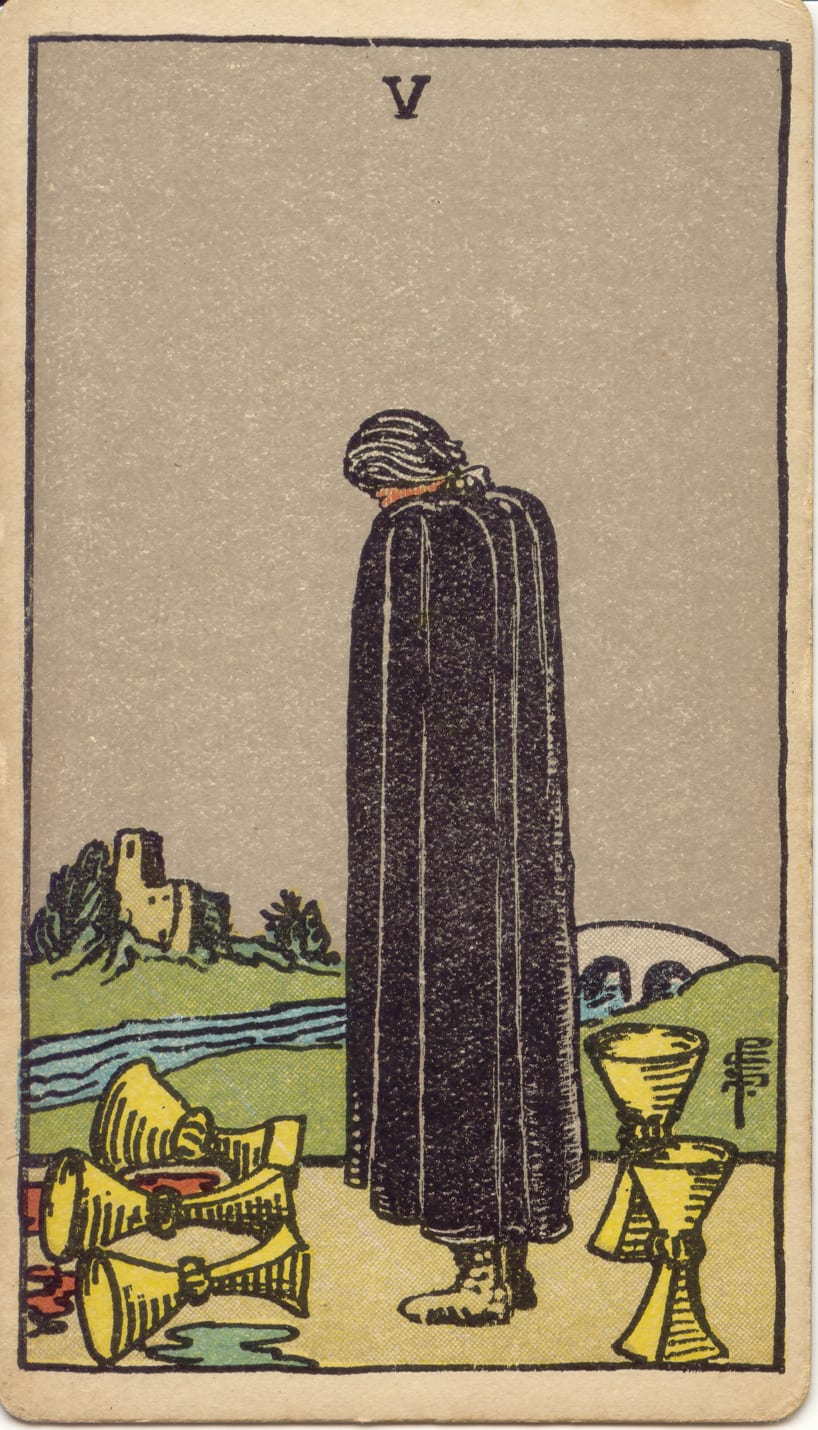
ENTER THROUGH A HUMAN STORY
RWS Five of CupsPamela Colman Smith, 1909A grieving person, spilled cups, cups that remain and a distant bridge turn meaning into a scene.
1909 “Roses & Lilies” deck / Wikimedia Commons — Public domainView the image and rights statementThe numbered Minor cards in Thoth generally contain no comparable narrative scenes. Cups, Swords, Wands and Disks are combined with colour, form, arrangement and astrological signs to make abstract compositions.
The pip cards also carry titles like these, naming the quality of each card. Although Thoth came after RWS, it did not continue along the road of turning the Minor Arcana into human stories. It became instead a set of images that concentrate symbols.
Two ways into the act of reading
With RWS we can enter through a scene and ask, “Why is this person grieving?” With Thoth we may enter through colour, form, title, element, planet, zodiacal sign and number.
Readers are not bound to one method. RWS can support deep esoteric study, and Thoth can be read from one’s immediate response to the image. Yet the designs themselves clearly prepare different doors.
06 · REWRITING THE DECK
They even changed
the names of the cards
Crowley and Harris did not merely redraw an inherited Tarot. They made bold changes to the names of the Major Arcana.
These are not merely alternative labels. They reorganise what each card is understood to express in keeping with Crowley’s own philosophy.
Among the suits, what RWS calls Pentacles becomes Disks in Thoth. The court is not King, Queen, Knight and Page, but Knight, Queen, Prince and Princess. The skeleton of seventy-eight cards remains, while much within it is rebuilt.
07 · THE BOOK OF THOTH
Is “Thoth” the same Thoth
we met before?
If you have followed the whole series, the name may sound familiar. We encountered it in Part 4.
In the eighteenth century, writers who connected Tarot with ancient Egypt called the cards the “Book of Thoth.” Thoth was an Egyptian god associated with wisdom and writing.
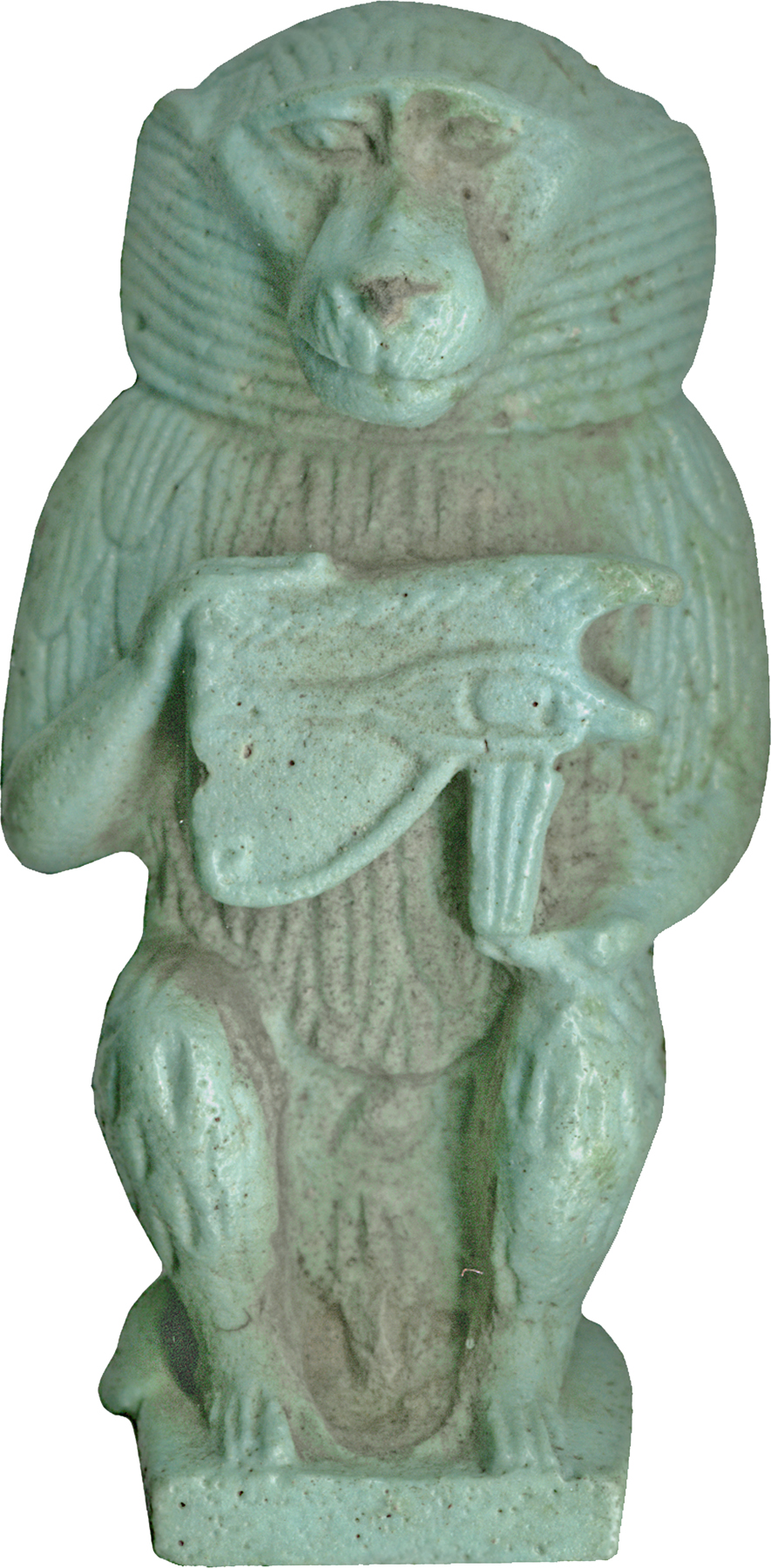
GOD OF WISDOM, WRITING AND THE MOON
Thoth in Baboon FormLate Period, ancient EgyptThe Udjat eye in his hands represents the moon. This object does not prove an Egyptian origin for Tarot; it explains the name Thoth.
Walters Art Museum / Wikimedia Commons — Object PD; photograph CC BY-SA 3.0View the image and licenceAbout 160 years later, Crowley titled his own Tarot book The Book of Thoth. Published in 1944, it explained Harris’s paintings and Crowley’s system. Scholarship treats the discussions that began in 1937 and the publication of 1944 as parts of a single collaborative process.[6]
As Part 4 explained, there is no evidence that Tarot truly descended from the Egyptian god Thoth. Even so, a story invented in the eighteenth century survived into the name of a twentieth-century Tarot.
08 · A DECK AFTER ITS MAKERS
Years in the making, yet neither maker
saw the finished deck reach the public
Smith drew all seventy-eight RWS cards in 1909, and they appeared as a pack that same year. Thoth followed a different course.
Harris produced the paintings in the late 1930s and early 1940s. They were exhibited, and Crowley’s Book of Thoth appeared in 1944. But the complete pack did not circulate widely until much later.
The Warburg Institute even preserves proofs from an unrealised attempt to publish the cards. Neither Crowley nor Harris lived to see the work on which they had spent years used around the world.
Different though their circumstances were from Pamela Colman Smith’s, here again we find a strange gap between an artist’s life and a work’s later destiny.
09 · TWO COLLABORATIONS
Two different answers
from the same Golden Dawn
Waite and Crowley both learned Kabbalah, astrology, Tarot and symbolic correspondences within the Golden Dawn. Up to that point, their ground was shared.
Waite sought spiritual and mystical meaning within symbols. With Smith he made a Tarot that could be felt as human story.
Crowley recast the Golden Dawn’s system to include his own Thelemic thought. With Harris he made a Tarot that concentrated colour, form, astrology, Kabbalah and magical philosophy.
It is rather like two people leaving the same school and making entirely different works. The point is not to decide which is the “true Tarot.” Perhaps it shows instead that Tarot was capable of receiving such different systems of thought.
And two artists
Without Waite, RWS would not have taken its familiar form. Without Crowley, neither would Thoth. Yet Waite alone could not have made RWS look as it does, and Crowley alone could not have made Thoth look as it does.
Waite had Pamela Colman Smith. Crowley had Frieda Harris. In each pair, a thinker met an artist capable of making thought visible. Each encounter produced something that neither person could have made alone.
That is why recent research no longer treats Harris as merely an “artist executant.” If we erase the artists and remember only a “Waite deck” and a “Crowley deck,” we may lose sight of half the history of Tarot.
10 · TWO LIVING BRANCHES
Are RWS and Thoth rivals?
Both are major decks still used today, so it is natural to ask which is better. History offers another way to see them.
RWS and Thoth were not born to compete for victory. They are different answers to “What is Tarot?”, given by people who inherited the same late nineteenth-century esoteric world.
One can enter through human figures and stories. One can enter through colour, symbol and webs of correspondence. Tarot refused to fit inside a single answer.
RWS becomes a common language
The narrative pictures of RWS passed into countless later decks. Artists could change the people and the imagined world while retaining the structure and the way meanings were shown.
Whether a deck is populated by cats, fairies or people in a modern city, we often glimpse RWS beneath it. RWS became something like a common language of modern Tarot.
But it never became the only language. Marseille traditions remain. Thoth remains. Each continues along its own road into the present.
Six centuries ago, Tarot began as cards for a game. It became a mirror of human stories, and it also became a means of picturing the symbols of a universe.
Placed side by side, these two decks show how Tarot was never sealed inside one form. In every era, new people added answers of their own.
SOURCES & IMAGE RIGHTS
Sources and image rights
The Crowley–Harris collaboration was checked against scholarship published by Oxford University Press and public material from the Warburg Institute. Because the Thoth paintings remain protected by copyright, they are linked but not reproduced here. Every image displayed on this page is public domain or carries an explicit reuse licence.
- 1
Oxford Academic
Crowley’s initiation into the Golden Dawn on 18 November 1898 and its influence on his later magicRead the research abstract - 2
Oxford University Press Blog
Crowley, the Golden Dawn, Thelema and the idea of willRead the introduction - 3
The Warburg Institute
Tarot: Origins & Afterlives—Frieda Harris’s original Thoth paintings of 1937–43See the exhibition material - 4
Oxford Academic
Deja Whitehouse, The Lady and the Beast—the Crowley–Harris work reconsidered as a partnership extending through art, promotion, exhibitions and social supportSee the book record - 5
The Warburg Institute
The Yorke Collection—Crowley papers, Harris correspondence, notes and exhibition and publishing materialsSee the collection guide - 6
Oxford Academic
The chapter on The Book of Thoth—from the discussions of 1937 to first publication in 1944, including Harris’s exhibitions and publishing workRead the chapter abstract - 7
Wellcome Collection
Etteilla, The Tarot, in the form of leaves of the book of Thoth…, 1780s — Public Domain MarkView the object and rights statement - 8
Wikimedia Commons
Aleister Crowley as Osiris, 1899, unknown photographer — Public domainView the image and rights statement - 9
Walters Art Museum / Wikimedia Commons
Thoth in the Form of a Baboon with Udjat Eye—object public domain; photograph CC BY-SA 3.0View the image and licence - 10
Wikimedia Commons
1909 Five of Cups by Pamela Colman Smith — Public domainView the image and rights statement