Last time, we met Arthur Edward Waite.
He was sharply critical of poorly supported legends such as the Egyptian-origin theory, yet believed that Tarot held a profound world of symbols through which people could contemplate humanity and the world.
Then, in 1909, Waite decided to make a new Tarot based on his ideas. But Waite was not an artist.
He needed someone who could place people on seventy-eight cards, give them expressions, build landscapes around them and make stories happen there. That work went to Pamela Colman Smith.
The deck now called the Rider–Waite–Smith Tarot—RWS for short—carries her name in that final initial.
This time, we will ask why, after cups had stood in rows for more than five hundred years, a grieving person suddenly appeared in the Five of Cups.
01 · BEFORE TAROT
She was an unusual artist
before she was “the Tarot artist”
Pamela Colman Smith was born in Pimlico, London, in 1878.
Her childhood moved among Britain, the United States and Jamaica. In 1893 she began studying art at the Pratt Institute in New York. Pratt’s own exhibition history presents this as the beginning of her artistic career.[1]
ARTIST AND STORYTELLER
Pamela Colman Smith1878–1951She moved among painting, illustration, theatre, publishing and folklore.
Photographed by Gertrude Käsebier, 1912 / Wikimedia Commons — Public domainView the image and rights statementYet her work was never limited to “making pictures.” It encompassed illustration, stage design, costumes, books, poetry, a magazine, folklore, recitation and publishing.
She would have an enormous effect on Tarot history, but Tarot was only one part of her creative life.
02 · STORIES FROM JAMAICA
Turning Jamaican stories
into words and pictures
Her earlier work shows that, long before Tarot, she was already committed to making stories visible.
In 1899, while still in her early twenties, Smith published Annancy Stories, a collection of Jamaican Anansi tales for which she supplied both the telling and the illustrations.[2]
In 1905 she followed it with Chim-Chim: Folk Stories from Jamaica. A copy remains in the Library of Congress.[3]
She was not merely an illustrator who transcribed someone else’s instructions. She listened, absorbed a tale and remade it as figures and settings. She had practised that art for years before Tarot entered the picture.
03 · THE LITTLE STAGE
Each card became
a little stage
Smith was also deeply involved in theatre. She moved among theatre people, including the celebrated actress Ellen Terry, and worked on costume, scenery and illustration. Pratt likewise lists set and costume design among her major activities.[1]
The National Trust collections still preserve Smith’s pictures of Ellen Terry and humorous records of life on tour with a theatre company.[4]
Look at the later RWS cards and people stand, meet, walk, offer something, slump, struggle or gaze into the distance. A posture and a few props are enough to make us wonder what is happening.
For an artist formed in the theatre, turning each card into a little stage may have felt entirely natural.
04 · MUSIC PICTURES, 1907
When she heard music,
pictures appeared
One body of work is especially revealing. Smith made pictures while listening to music.
In 1907, photographer and gallerist Alfred Stieglitz exhibited her work at his famous New York gallery, 291. Pratt describes Smith as the first non-photographer to show there. The show comprised seventy-two symbolic watercolours, including the images prompted by music that came to be called her “music pictures.”[1][9]
A PICTURE BORN FROM MUSIC
Overture. “Egmont” Beethoven1907Rather than diagramming the sound, Smith transformed what she received from it into figures and landscape.
Smithsonian American Art Museum / Smithsonian Open Access — CC0View the artwork recordThe Smithsonian American Art Museum preserves a 1907 watercolour that arose from Beethoven’s Egmont overture.[5]
She did not render sound as notation. She turned what she received from sound into another story. That resembles the Tarot task of making an invisible “meaning” into a visible scene.
05 · THE FIVE OF CUPS
She did not explain “loss.”
She made it felt
Write only the word “loss” and it may not remain in the mind.
Instead, draw a person bowed beneath a black cloak. Three cups lie spilled in front. Behind, outside the figure’s sight, two remain upright. In the distance are a river, a bridge and a building.
FROM WORD TO SCENE
RWS Five of CupsPamela Colman Smith, 1909What has been lost, what remains, and a bridge onward all share a single picture.
1909 “Roses & Lilies” deck / Wikimedia Commons — Public domainView the image and rights statementThis is no longer only a label. Someone grieves and looks only at what has gone. Yet something remains, and a bridge reaches the farther bank. A single look at the card releases several possible stories.
What Smith did was to give meaning
a place, a person and a moment.
06 · ONE CARD, THREE ERAS
Return to the Five of Cups
from Part 1
The Visconti–Sforza Tarot had a Five of Cups more than five centuries ago. It showed five cups and little else. In the Marseille pattern from Part 2, cups still form the design.
Then, in 1909, the card reached Smith’s hand and became a scene.
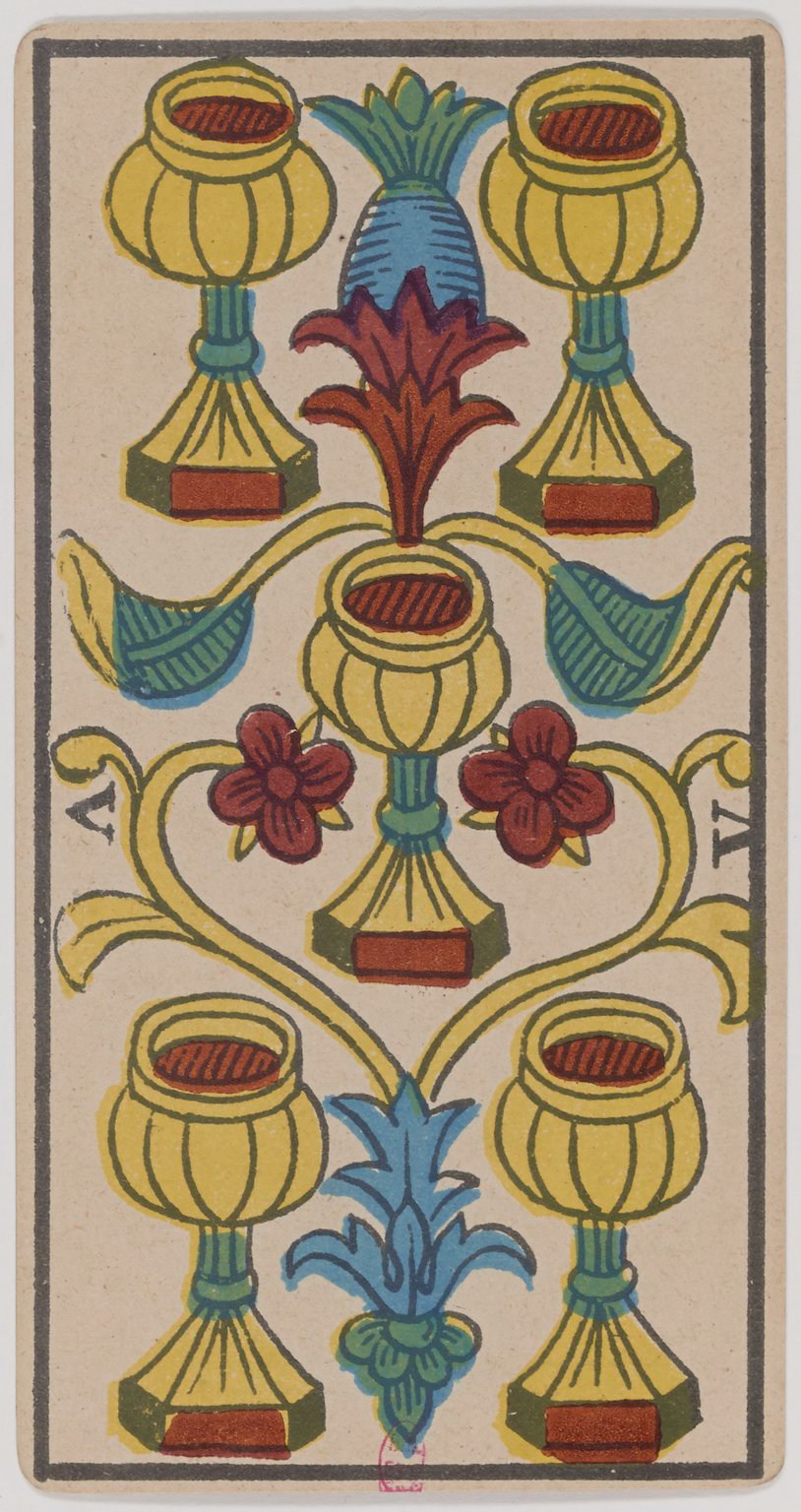
The title stayed the same, but what the viewer encountered had changed: from five objects denoting a number to a human scene into which we can project ourselves.
07 · AN IMPORTANT CAUTION
She was not the first.
The work was still revolutionary
One historical caution matters here. Smith was not the first person ever to give the Minor Arcana pictured scenes.
In late-fifteenth-century Italy, the remarkable Sola Busca Tarot did just that. Its Minor Arcana contain specific figures and actions. The British Museum records a complete set of seventy-eight prints from about 1491, while the Metropolitan Museum describes it as the earliest complete example to survive.[6][7]
In countless decks today, the Five of Cups still inherits a grieving figure, spilled cups and cups left standing. The V&A likewise notes that many later decks continue to use Smith’s symbolism.[8]
Her work was revolutionary not because no one had pictured the minors before, but because her pictures became a shared visual vocabulary for those who came after.
08 · WAITE AND SMITH
How much did Waite tell her
to do?
Was a card Waite’s idea or Smith’s? The two contributions cannot be divided perfectly.
Waite supplied detailed directions for the symbolism and composition of the Major Arcana. For the Minor Arcana, Smith had far greater freedom. The V&A describes her as receiving a “blank slate” there.[8]
The stance of the figure in the Five of Cups, its landscape, atmosphere and implied story therefore contain a great deal of Smith’s own imagination.
Waite handed over ideas; Smith built a world. Seen this way, the familiar name “Waite deck” cannot be quite enough.
09 · THE BIG JOB, 1909
Seventy-eight pictures:
a big job for little money
In 1909, Smith worked through twenty-two Major Arcana and fifty-six Minor Arcana: seventy-eight cards in all, almost every one an independent picture.
On 19 November, having finished, she wrote to her old friend Alfred Stieglitz and called it:
“a big job for very little cash!”
Those seventy-eight pictures would spread around the world, be imitated beyond counting and become the groundwork for new decks. At the time, however, they were for Smith a large task that paid very little.
10 · THE NAME RETURNS
The missing name,
and a life larger than Tarot
For years, her name commonly disappeared from the name of the deck, which was usually called the Rider–Waite Tarot.
publisherWaite
conceptionSmith
78 pictures
Increasingly, people now say Rider–Waite–Smith or Waite–Smith to acknowledge the work she performed. That is why this series has used RWS from the beginning.
The Whitney Museum library catalogue likewise records the deck as the Rider-Waite-Smith tarot deck.[10]
The S is not an optional extra. It names the person who made this Tarot into a world we can see.
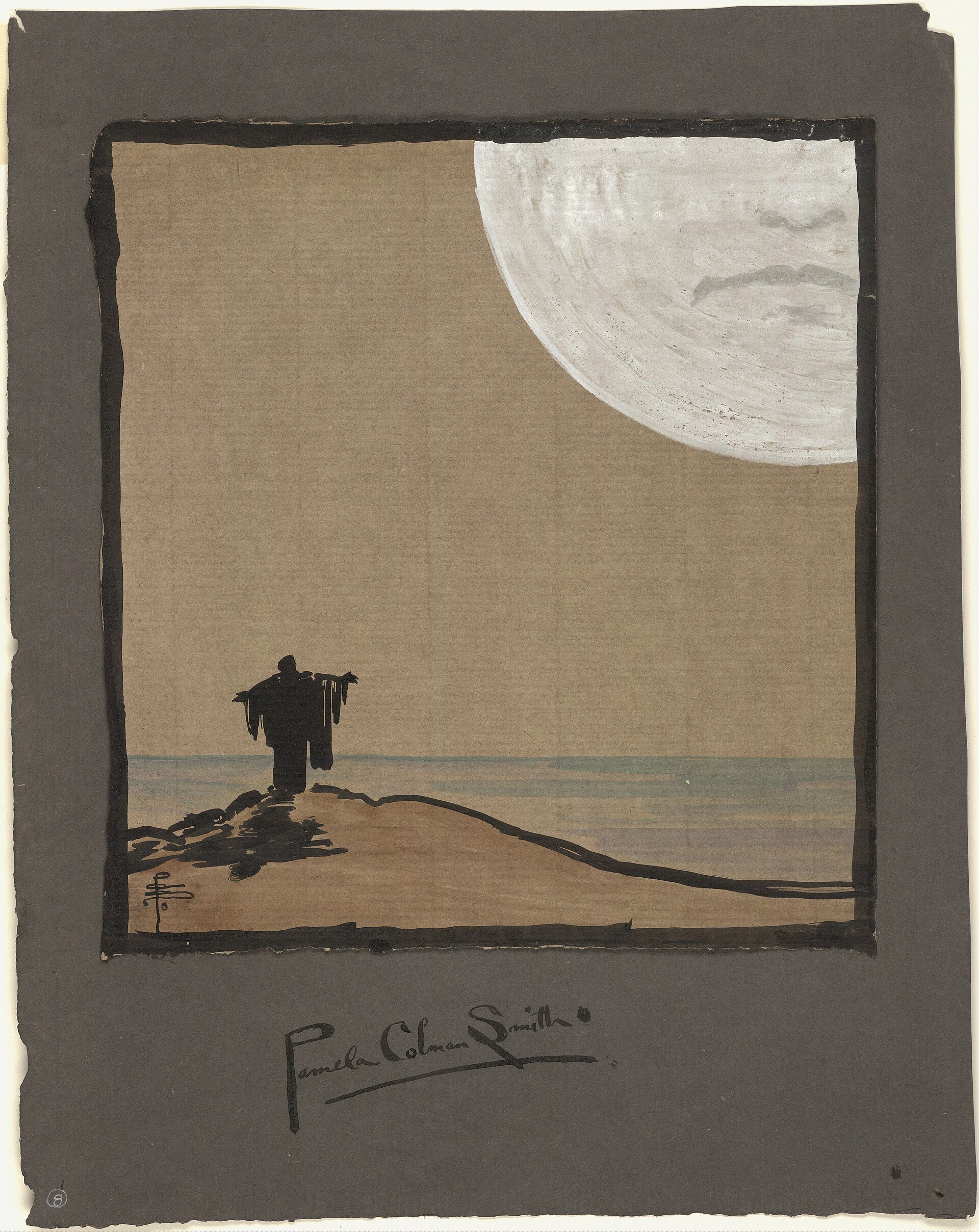
BEYOND TAROT
Untitled (often called Addressing the Moon)1907A figure, a gesture and a great field of space invite us to imagine what came before and after.
Beinecke Library, Yale University / Wikimedia Commons — Public domainView the image and rights statementSmith did not draw a Tarot and then cease to create. She made books, published a magazine, worked in theatre, supported women’s suffrage and continued to paint. No single title contains her work.[1][9]
She died in 1951 in Bude, Cornwall, aged seventy-three. For many years her name remained in Tarot’s large shadow. In recent decades museums, universities, scholars and Tarot users have begun to look at her again.
11 · MEANING BECOMES STORY
The person who turned
“meaning” into “story”
Throughout this series, we have met people who gave Tarot meaning.
Smith turned those currents into scenes that human beings could see and feel.
Grief, doubt, conflict, rest, encounter, departure, joy, loneliness and hope entered the Minor Arcana as parts of everyday human life.
That means we can look before we know every doctrine. We can think, “That person feels like me just now,” and begin from there. For Tarot, this was an enormous change.
SOURCES & IMAGE RIGHTS
Sources and image rights
Smith’s life and creative range were checked against Pratt Institute; artwork records against the Smithsonian; and her place in Tarot history against the V&A and Metropolitan Museum. Every reproduced image is CC0 or a work whose copyright term has expired.
- 1
Pratt Institute
Pamela Colman Smith: Life and Work — her studies from 1893 and work across painting, illustration, theatre, publishing and folkloreView the exhibition record - 2
University of Pennsylvania
Pamela Colman Smith, Annancy Stories (1899) — bibliography and digitised editionsView the bibliography - 3
Library of Congress
Chim-Chim: Folk Stories from Jamaica (1905) — catalogue recordView the catalogue record - 4
National Trust Collections
Pamela Colman Smith’s pictures of Ellen Terry and theatrical lifeView the collection results - 5
Smithsonian American Art Museum
Pamela Colman Smith, Overture. “Egmont” Beethoven, 1907, watercolour, ink and pencilView the artwork record - 6
British Museum
Sola Busca — a complete set of seventy-eight prints, about 1491View the collection record - 7
The Metropolitan Museum of Art
Sola Busca — the earliest complete surviving seventy-eight-card deckRead the account - 8
Victoria and Albert Museum
The making of RWS — Waite’s directions for the majors, Smith’s freedom in the minors and her continuing influenceRead the history - 9
JSTOR / Clemson University Press
Elizabeth Foley O’Connor, Pamela Colman Smith: Artist, Feminist, and Mystic — Smith’s letter to Stieglitz of 19 November 1909 and her wider lifeView the book record - 10
Whitney Museum of American Art Library
Catalogue record for the “Rider-Waite-Smith tarot deck”View the record - 11
Wikimedia Commons
Pamela Colman Smith, photographed by Gertrude Käsebier, 1912 — Public domainView the image and rights statement - 12
Smithsonian Open Access
Overture. “Egmont” Beethoven, 1907 — CC0View the Open Access policy - 13
Wikimedia Commons / Yale University
Untitled (often called Addressing the Moon), 1907 — Public domain, author dead more than seventy yearsView the image and rights statement - 14
Wikimedia Commons
Five of Cups, Pamela Colman Smith, 1909 — Public domainView the image and rights statement