In the previous part, we reached the Hermetic Order of the Golden Dawn.
At the end of the nineteenth century, Kabbalah, astrology, alchemy, ritual magic and Tarot drew students of many esoteric traditions into one place.
One of those people was Arthur Edward Waite.
Anyone who uses Tarot today may have heard “the Waite deck,” “Rider–Waite” or “RWS.” His name survives in one of the world’s best-known Tarots.
So what did Waite actually do? Was he a famous diviner, a magician or the man who drew the cards?
Each answer is slightly wrong. A closer description is a writer and mystic who read, translated and investigated a vast body of esoteric literature, always searching for what lay behind it.
This complicated figure would help transform twentieth-century Tarot.
01 · BROOKLYN TO LONDON
Born in America,
raised in Britain
Arthur Edward Waite was born in Brooklyn, New York, in 1857.
He moved to London with his family as a child and spent most of his life in Britain. Religion and mysticism interested him from an early age, and he later studied and wrote across an extraordinary range: alchemy, Rosicrucianism, Freemasonry and Kabbalah among them.[1]
Brooklynchildhood
to Londonlifetime
research and writing
He also helped introduce the writings of Éliphas Lévi to English-speaking readers. Waite himself therefore stands like a bridge between Lévi, the Golden Dawn and modern Tarot.
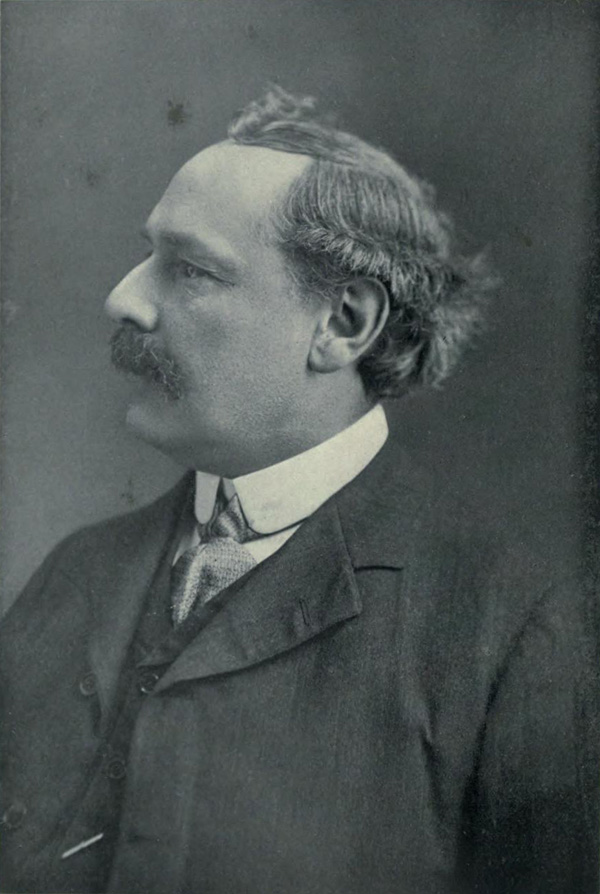
WRITER AND MYSTIC
Arthur Edward Waite1857–1942He studied Western esotericism as both history and spiritual tradition, leaving an immense body of writing.
J. Russell & Sons, 1911 / Wikimedia Commons — Public domainView the image and rights statement02 · THE GOLDEN DAWN, 1891
He joined the Golden Dawn.
But...
Waite entered the Hermetic Order of the Golden Dawn in 1891.[2]
That does not mean he happily accepted every kind of magic practised there. What he sought most strongly was not making things happen through magic, but bringing the human being closer to the divine.
As the Golden Dawn fractured, Waite tried to reshape part of it around mysticism rather than magical practice. Amid its disputes he sought to preserve its legacy and later founded a more thoroughly mystical Rosicrucian order.[1]
The man behind one of the most famous “occult Tarots” was himself wary of turning everything into magic. Waite refuses to fit a simple label.
03 · PILLARS OF SAND
He was sharply critical
of old Tarot legends
In Part 4, Court de Gébelin proposed that Tarot might be a secret book inherited from ancient Egypt. The story travelled through occult circles for generations.
Did Waite believe it? No. He rejected it in remarkably cutting terms.
In The Pictorial Key to the Tarot, first published in 1910, he tried to sort through the fantasies and conjectures that had accumulated in occult writing about Tarot.[3]
He reviewed Gébelin’s supporting points one by one and called the ten pillars of the theory “pillars of sand.”
When considering attempts to derive the word Tarot from ancient Egyptian, he added that the proposal had been made before the Rosetta Stone was discovered, when the Egyptian language could not yet be read.[4]
More than a century ago, Waite was already applying a cool eye to the problem we met in Part 4.
04 · UNIVERSAL SYMBOLS
Then did he reject
Tarot’s mystery?
This is where Waite becomes especially interesting.
He rejected the Egyptian-origin theory, criticised unsupported occult histories and could speak dismissively about fortune-telling. Yet he believed Tarot itself carried profound meaning.
For Waite, value did not depend on proving that the cards had truly descended from ancient Egypt.
He saw value in the possibility that such figures expressed something universal and long present within human beings.
The Pictorial Key describes Tarot as symbolic presentations of “universal ideas.” The “secret” behind them need not mean a document excavated from a buried temple. It could be something present in human consciousness but not ordinarily put into words—the kind of truth religion, alchemy, Kabbalah and mysticism had tried to express.[5]
Waite denied Gébelin’s history without concluding that Tarot therefore contained nothing. He found depth in the symbols themselves as a way of thinking about humanity and the world.
05 · TOWARD MODERN TAROT
We are moving closer
to modern Tarot
The cards need not be a machine for predicting the future. Yet looking at a picture can make us think about ourselves.
Why does this figure wear that expression?
Where does this road lead?
Where would I stand in this scene?
Symbols can turn attention inward. This does not mean Waite had already invented modern psychological Tarot reading. He remained an intensely mystical thinker.
Yet his refusal to place Tarot’s whole value in prediction would matter greatly to its future.
06 · A NEW TAROT
Why make a new Tarot?
Tarot de Marseille already existed, and the Golden Dawn had its own elaborate Tarot system. Why did Waite want a new deck?
He sought to inherit earlier symbols while making the inner meanings he perceived more legible in the pictures themselves.
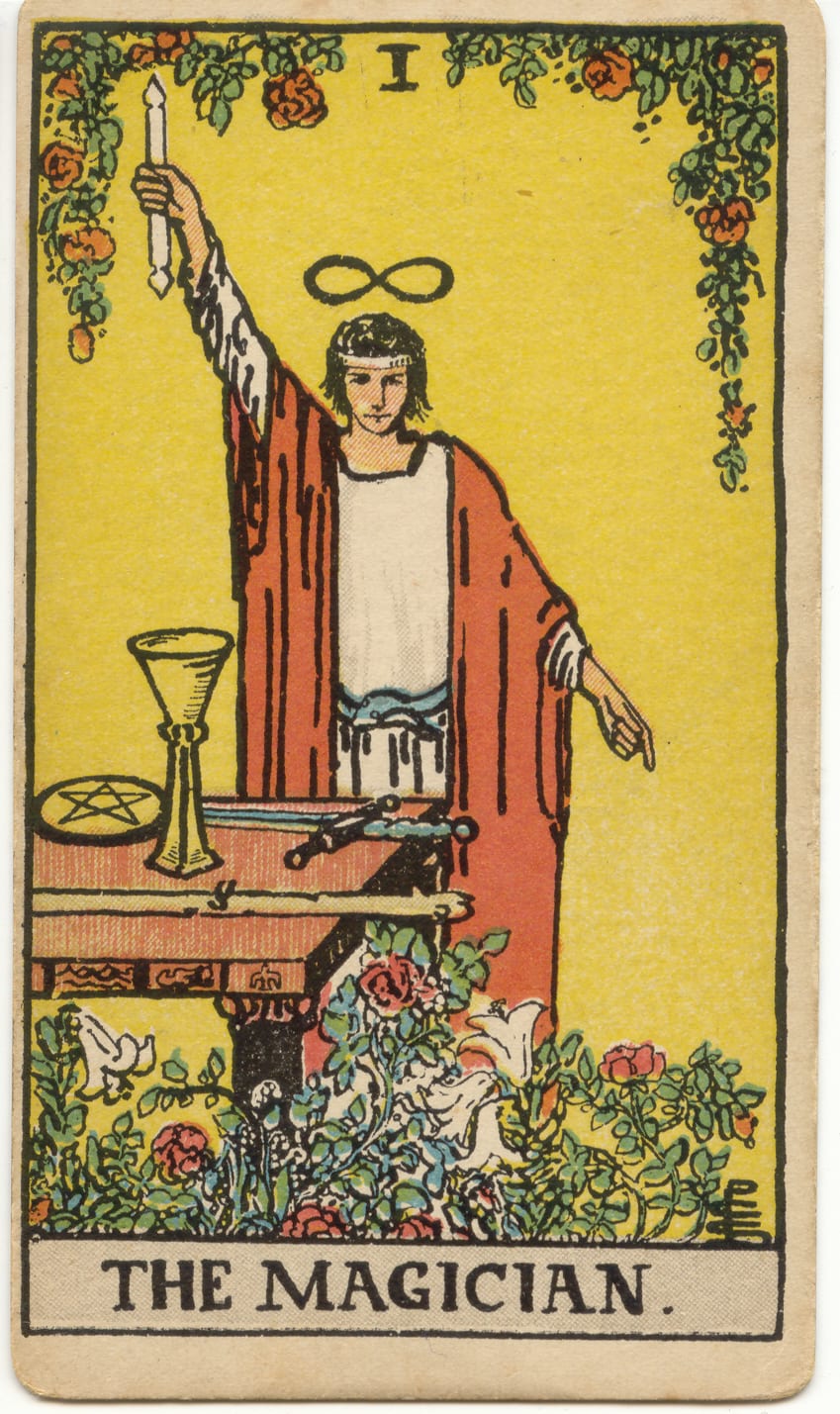
One hand points upward, the other down. Wand, cup, sword and pentacle meet on the table.
Pamela Colman Smith, 1909 / Wikimedia Commons — Public domainView the image and rights statementConsider the Magician. In Waite’s account he is no longer merely a street performer. An infinity sign appears above his head. One hand points to heaven and the other toward earth. All four suits—wand, cup, sword and pentacle—rest on the table.
Waite gave the figure the mystical role of bringing what is above into the world below. The Bagat that we met in Part 3, once the weakest trump in a game, had travelled an extraordinary distance.
07 · THE ARTIST
But Waite could not draw
There was a problem. Waite was a researcher and writer, not a painter.
A new Tarot required someone who could actually draw all seventy-eight cards. An artist was chosen from the network around the Golden Dawn.
08 · ALL SEVENTY-EIGHT CARDS
Pictures on all
seventy-eight cards
The most consequential change in the new deck concerned the Minor Arcana.
Remember the Five of Cups from more than five hundred years ago in Part 1: little more than five cups appeared. Marseille-pattern cards followed the same basic approach. Five swords made the Five of Swords; five cups made the Five of Cups.
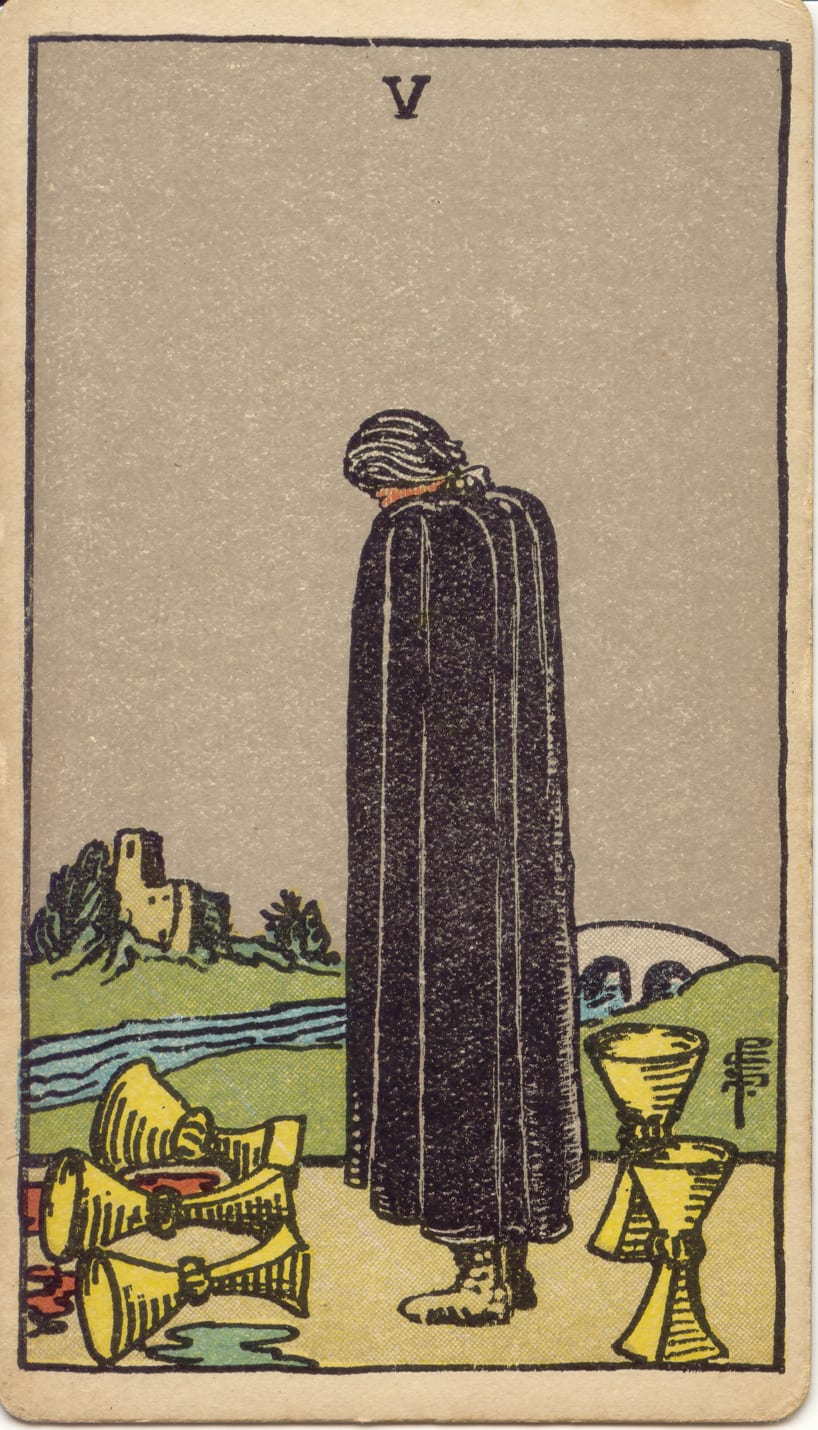
A QUESTION LEFT FROM PART 1
When did the Minor Arcana become pictures with stories?Here there is a person, a place and an event. Pamela Colman Smith stands at the centre of the answer.
Pamela Colman Smith, 1909 / Wikimedia Commons — Public domainView the image and rights statementIn the Tarot made by Waite and Smith, the Minor Arcana now had people, places and events.
The question preserved since Part 1—when, and through whom, did the Minor Arcana become narrative pictures?—is approaching its answer. At the beginning of the twentieth century, Pamela Colman Smith stood at its centre.
09 · THREE NAMES
The “Waite deck”
was not drawn by Waite
This point will matter again and again. For many years the deck was commonly called the Rider–Waite Tarot.
Waite did not draw it. Pamela Colman Smith drew all seventy-eight cards.
Nor was Rider a person involved in the design. William Rider & Son was the publisher. The first-edition information for The Pictorial Key identifies its seventy-eight plates as Smith’s designs and names the London publisher.[3]
Waite’s conception, Smith’s pictures and Rider’s publication brought the Tarot into the world in 1909. That is why Rider–Waite–Smith, or RWS, has become an increasingly familiar name.[6]
We will look much more closely at this next time.
10 · BEYOND DIVINATION
He disparaged fortune-telling,
yet explained how to do it
Waite could write as though simple tests of whether a prediction “came true” deserved little respect. Yet The Pictorial Key contains divinatory meanings for the cards and methods for laying them out.
He did not dismiss divination and throw it all away.
For him, Tarot may have had an outer use in divination while opening onto a much deeper symbolic world, where he located its greater value.
The book’s subtitle speaks of fragments of a secret tradition beneath the veil of divination. Divination was not the destination. It was an entrance to what lay beyond.
11 · BETWEEN HISTORY AND MYSTERY
He rejected a false legend
and preserved the mystery
Waite occupies an unusual position in this history.
He did not accept Gébelin’s Egyptian theory. He criticised occultists who built convenient histories. Yet he did not believe that everything in the world could be exhausted by what the eye could see.
Tarot, he thought, held universal symbols about human beings and the world. Something not yet put into words waited behind them.
He separated legend from history without surrendering symbolic mystery. Waite seems to have occupied that difficult middle ground.
Now, to the person who drew the pictures
But if we finish by saying only that Waite made modern Tarot, someone essential disappears.
Whatever conception he supplied, one artist transformed seventy-eight cards into the world we recognise today. Her life was completely different from Waite’s.
She was also known for describing how music made her see pictures. She turned Waite’s “meanings” into images with stories.
SOURCES & IMAGE RIGHTS
Sources and image rights
Waite’s biography and mystical work were checked against SRIA London and Encyclopedia.com; his critique of Tarot history and his symbolic theory against the text of The Pictorial Key to the Tarot; and the publication of RWS and Smith’s role against Morgan Library exhibition material.
- 1
SRIA London
Arthur Edward Waite — his Brooklyn birth, writing career and work in mystical ordersRead the biography - 2
Encyclopedia.com
Arthur Edward Waite (1857–1942) — his 1891 entry into the Golden Dawn and scholarly workRead the entry - 3
Wikisource
Arthur Edward Waite, The Pictorial Key to the Tarot — publication history, Smith’s seventy-eight designs and William Rider & SonRead the text - 4
Wikisource
The Pictorial Key, Part I — Gébelin’s “pillars of sand” and the Rosetta Stone argumentRead the text - 5
Wikisource
The Pictorial Key, Part II — Waite’s account of Tarot as symbolic presentations of universal ideasRead the text - 6
The Morgan Library & Museum
Tarot! Renaissance Symbols, Modern Visions — the Rider–Waite–Smith Tarot, first published in 1909View the exhibition record - 7
Wikimedia Commons
Portrait of Arthur Edward Waite, J. Russell & Sons, 1911 — Public domainView the image and rights statement - 8
Wikimedia Commons
The Magician, Pamela Colman Smith, 1909 — Public domainView the image and rights statement - 9
Wikimedia Commons
Five of Cups, Pamela Colman Smith, 1909 — Public domainView the image and rights statement