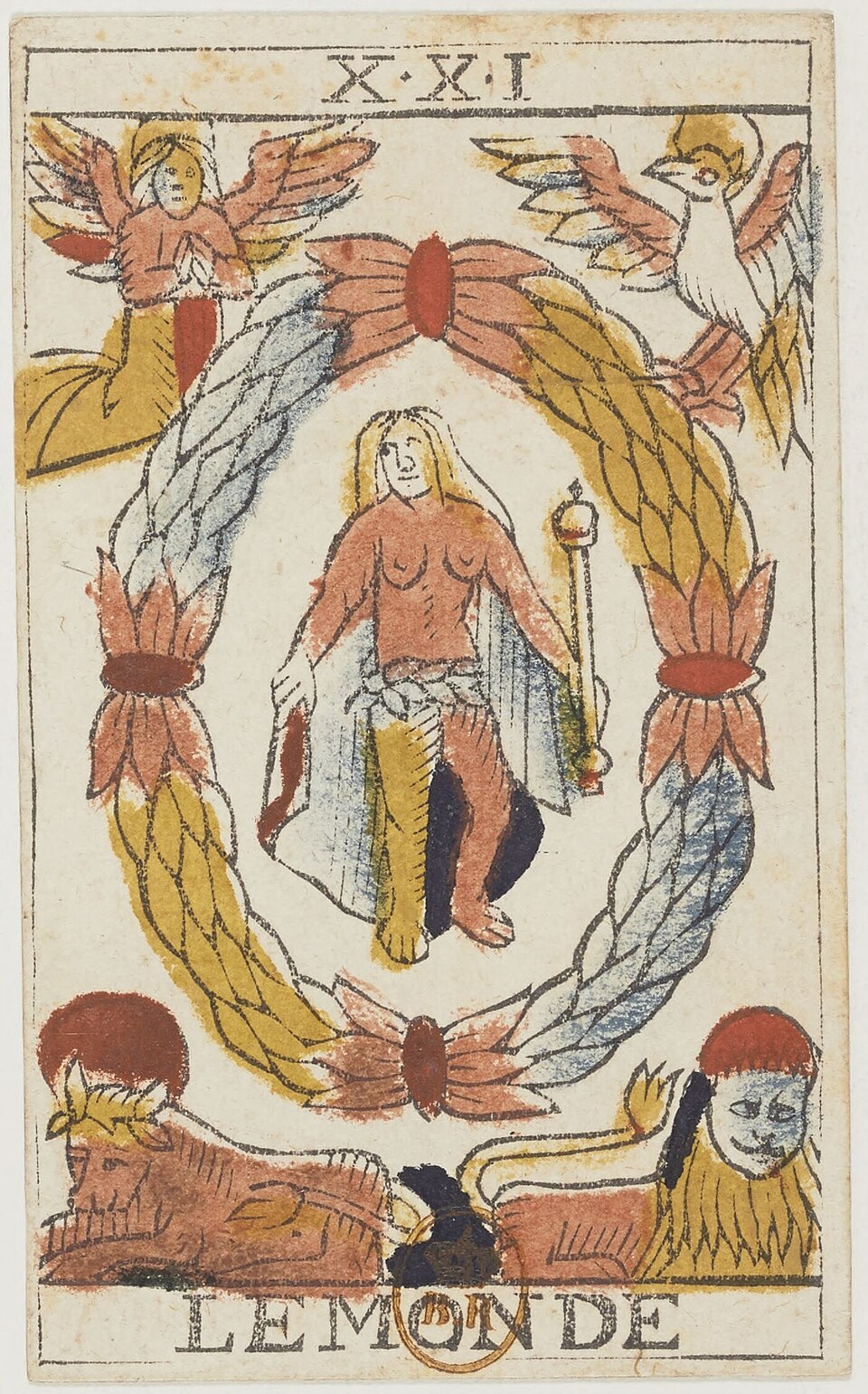
Until now, every Tarot in our journey has been a game.
Tarot was born in fifteenth-century Italy, spread into France, developed the visual tradition later called the Tarot de Marseille, and by the seventeenth century even had printed rulebooks explaining how to play it.
The Emperor. Death. The Star. The World. None of them was telling the future yet.
Then, near the end of the eighteenth century, the way people looked at Tarot began to change abruptly.
“Is this really nothing more than a card game?”
“Could these strange pictures conceal a much older secret?”
In 1781 a book appeared that would become one of the great turning points in Tarot’s six-hundred-year history.
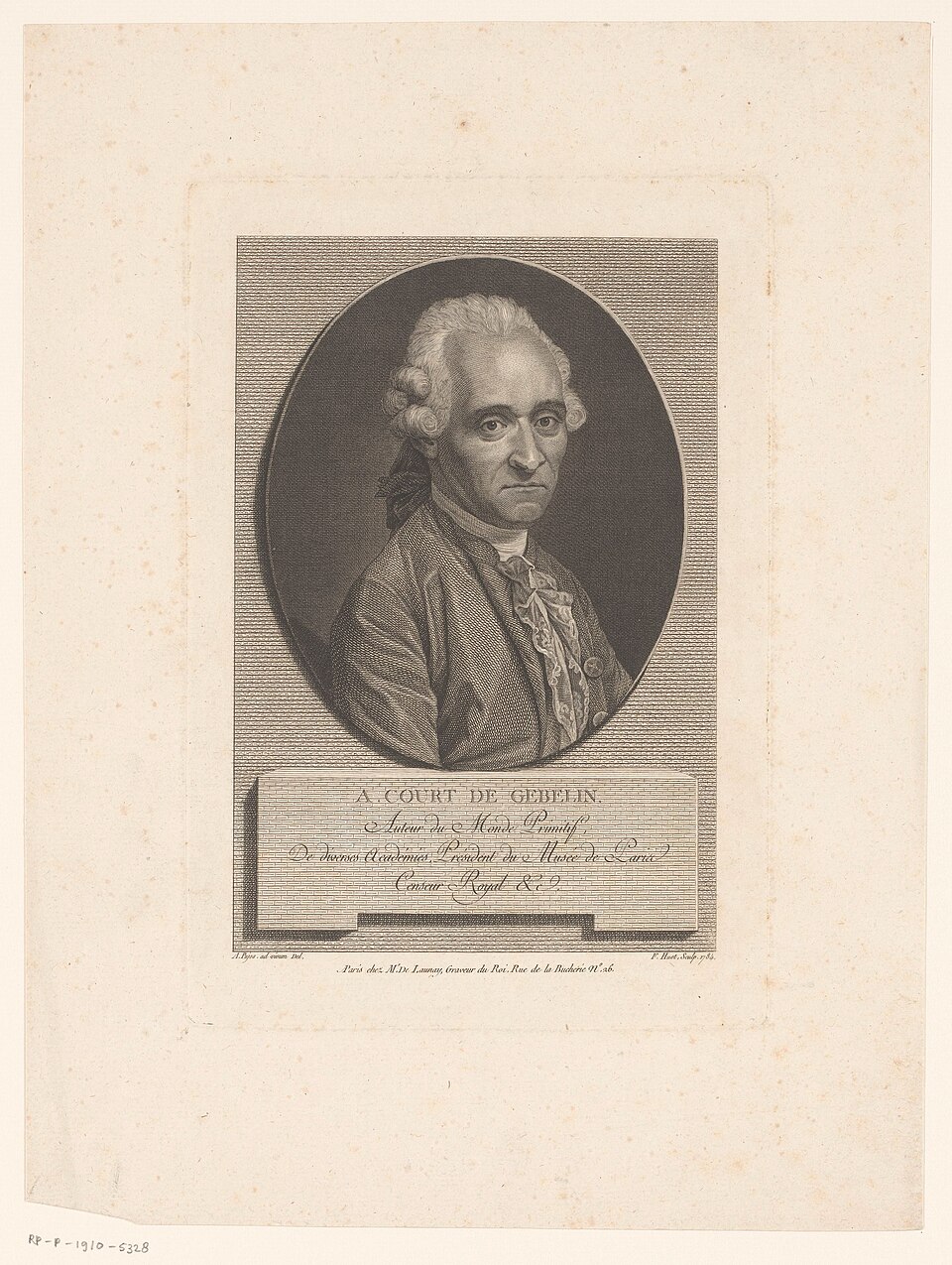
At the centre of the story was a French scholar named Antoine Court de Gébelin.
01 · BEFORE TAROT DIVINATION
Divination with cards
already existed
First, we need to separate two things.
Divination with cards was not suddenly invented in 1781.
A culture of telling fortunes with ordinary playing cards already existed. Jean-Baptiste Alliette, who will soon become a central figure in this story, had published a book on the art of reading cards in 1770.
At that stage he was still discussing ordinary cards, not Tarot.[2]
So the culture of reading cards already existed. What was new was the idea that the 78-card Tarot itself carried ancient secrets and could be made into a system of divination.
That distinction is the key to this part of our journey.
02 · 1781
What did Court de Gébelin
see in Tarot?
THE SCHOLAR
Antoine Court de Gébelin François Huot after André Pujos, 1784A French scholar who wrote broadly on theology, myth and language. In volume VIII of Le Monde primitif, he connected Tarot with ancient Egypt.
Rijksmuseum / Wikimedia Commons — CC0 View the image and rights statementIn 1781, Court de Gébelin discussed Tarot in volume VIII of his immense work Le Monde primitif—The Primitive World.[1]
He is said to have encountered a Tarot game at the home of an acquaintance and to have been captivated by its strange images.
He concluded that the cards could not have been created merely for a game. They must be much older.
HIS ANSWERThe answer he reached was
ancient Egypt.
03 · THE BOOK OF THOTH
Could this be a secret book
from ancient Egypt?
Court de Gébelin believed that Tarot’s pictures were fragments of sacred knowledge handed down from ancient Egypt.
By changing form and surviving as playing cards, he thought, the secret had escaped destruction for thousands of years.
The same volume also included an essay by another writer, the Comte de Mellet. Mellet connected Tarot with the Book of Thoth.
Thoth is an ancient Egyptian god associated with writing and wisdom.
In their eyes, an ordinary card game began to look like a secret book preserved by the sages of ancient Egypt.
The story had become remarkably grand.
04 · WHAT THE EVIDENCE SAYS
But did Tarot really
come from Egypt?
If you have followed the series this far, you may already feel that something does not fit.
Part 1 placed Tarot’s beginnings in fifteenth-century northern Italy. We looked at Visconti-Sforza cards and at images—the Emperor and the Pope among them—that reflect the culture of late-medieval and Renaissance Europe.
No evidence of a transmission from ancient Egypt appeared.
Modern historical research likewise finds no evidence that Tarot was created in ancient Egypt and carried into Europe.[3]
So why did the idea seem persuasive?
05 · BEFORE DECIPHERMENT
Hieroglyphs could not yet
be read correctly
Putting the dates beside one another reveals something fascinating.
Court de Gébelin published his Egyptian theory in 1781. The Rosetta Stone was found in 1799. Champollion publicly announced his breakthrough in deciphering hieroglyphs in 1822.[4]
In other words, in 1781 no one could yet read ancient Egyptian writing correctly.
For Europeans, ancient Egypt was enormously attractive and still filled with unknowns.
That left a wide space in which mysterious, old and symbolic things could be imagined as pieces of “lost Egyptian wisdom.”
We can now see that the theory was wrong. At the time, however, ancient Egypt itself remained a vast mystery.
06 · A PRODUCTIVE ERROR
It was wrong.
It was also enormously important.
If we remember Court de Gébelin only as “the person who got it wrong,” we miss the most interesting part of the story.
His historical claim is unsupported. Yet it changed the way people looked at Tarot.
in a card game
ancient meanings?
Death. The Wheel of Fortune. The Sun. The Moon. The World. Cards that had ranked power inside a game began to be reread as symbols that might carry meaning.
A historically mistaken theory genuinely changed the history that followed.
But Gébelin did not complete “Tarot divination” by himself
Court de Gébelin did not single-handedly invent the form of Tarot reading practised today.
The Comte de Mellet’s essay in the same volume also discusses a method of divination with Tarot.
Several currents were beginning to meet around 1781:
- an existing culture of divination with cards;
- Court de Gébelin’s ancient Egyptian theory;
- the Comte de Mellet’s divinatory interpretation of Tarot.
Almost immediately, another person would turn these ideas into a system people could actually use.
07 · ENTER ETTEILLA
Enter Etteilla
That person was Etteilla.
His real name was Jean-Baptiste Alliette. “Etteilla” is Alliette written backwards—a small piece of wordplay.
As we have seen, he had been writing about card divination since 1770, before Court de Gébelin’s book appeared.
He was, in other words, already a practitioner and system-maker of cartomancy.
Then a new vision arrived, joining Tarot to ancient Egypt. Etteilla entered that world in earnest.
08 · A WORKING SYSTEM
He made Tarot into something
people could actually read
Between 1783 and 1785, Etteilla published Manière de se récréer avec le jeu de cartes nommées tarots, a multi-part work devoted to Tarot.[5]
Tarot was no longer merely something over which one speculated about ancient secrets. It became a set of cards whose meanings could be read and used in divination.
Etteilla did more than use an existing Tarot pack. He began to create a Tarot designed primarily for divination and reshaped around his own esoteric ideas.
09 · DESIGNED TO DIVINE
One of the earliest Tarots
designed to tell fortunes
Recall the Visconti-Sforza and Tarot de Marseille packs. Both were originally made for games and only later used in divination.
Etteilla’s deck was different.
It was conceived from the beginning with divination and esoteric philosophy at the centre of its design.
Appearing at the end of the eighteenth century, Etteilla’s deck is among the earliest surviving Tarots known to have been created primarily for divination. The British Museum holds a complete 78-card Etteilla pack for cartomancy together with an instruction booklet.[6]
to play
to divine
After roughly three centuries, Tarot had acquired an entirely new purpose.
Is this really Tarot?
Etteilla’s cards can look startlingly different from the Marseille-style packs we have followed so far.
He did not simply write divinatory meanings onto a Marseille deck. He rearranged names, order, imagery and interpretation to fit his own esoteric system.
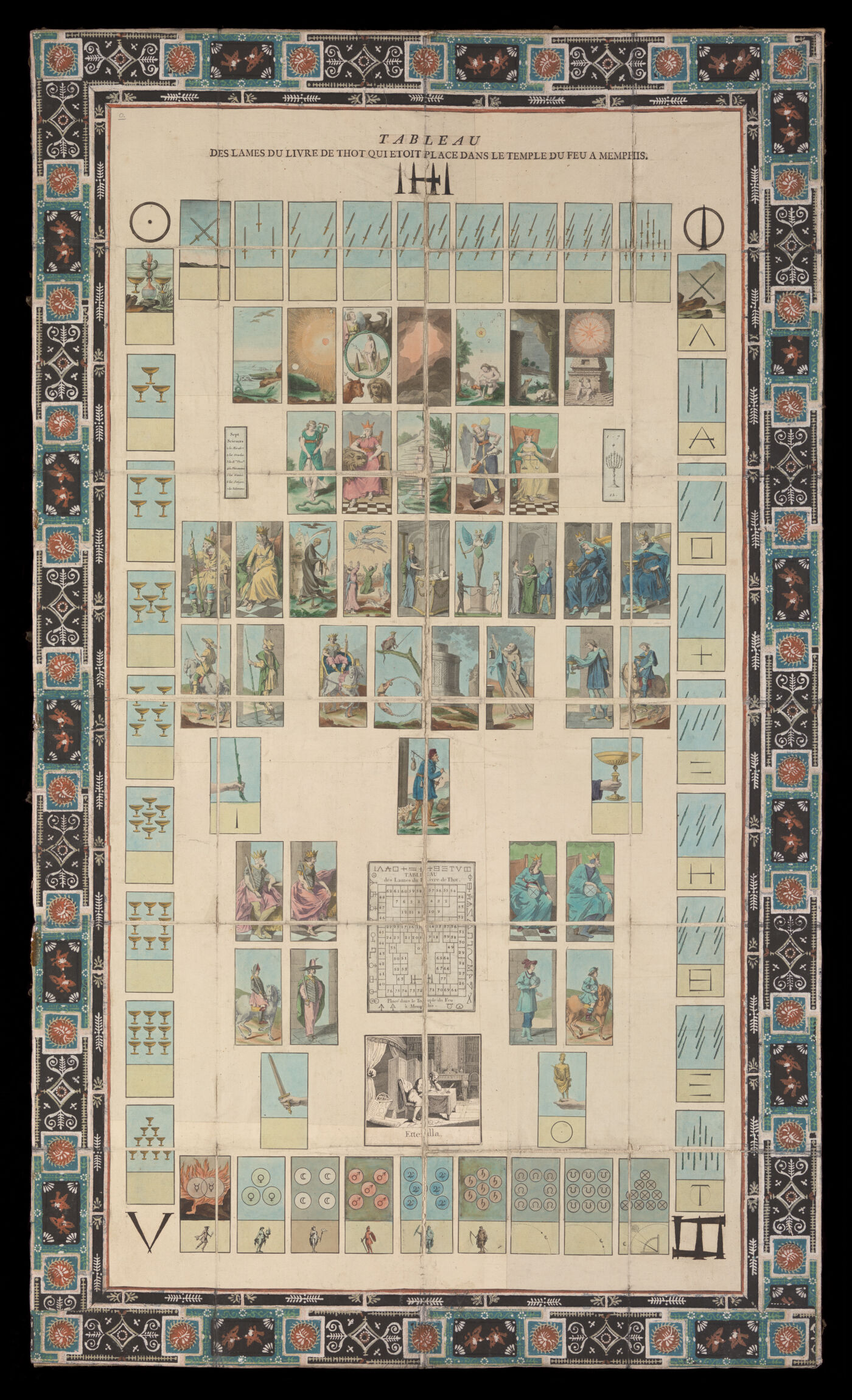
Etteilla treated Tarot as the Book of Thoth—the secret knowledge of ancient Egypt.
This work from the 1780s arranges the cards as “leaves of the Book of Thoth” supposedly placed in the Temple of Fire at Memphis.[7]
No such Tarot had actually stood in an ancient Egyptian temple.
But these writers and card makers built that story inside Tarot. The story would exert an enormous influence on everything that followed.
10 · NOT A SINGLE BIRTHDAY
From game to divination—but
not in a single night
It is tempting to call 1781 the birthday of Tarot divination. History is less tidy.
Divination with ordinary cards came earlier. Etteilla wrote about it in 1770.
In 1781, Court de Gébelin and the Comte de Mellet joined Tarot to ancient secrets and divinatory possibilities. From 1783 onward, Etteilla developed a working system of Tarot divination. By the end of the decade, Tarots designed primarily to tell fortunes had appeared.
Rather than saying that a game became divination on a single day, it is more accurate to see several ideas converging over a decade or two until the Tarot game acquired a second use.
The game did not disappear
When Tarot began to be read for divination, it did not stop being played. In France and elsewhere, Tarot remains a card game today.[8]
PLAYTarot to playthe game continues
READTarot to readdivination develops
Tarot did not completely transform from game into divination. It may be more helpful to say that the road divided in two.
The same family of cards that began six centuries ago set off along different paths.
11 · WHEN IMAGINATION BECOMES HISTORY
A history that began
with an error
Tarot was not born in ancient Egypt. There is no evidence that the god Thoth left a pack of 78 Tarot cards. The history imagined by Court de Gébelin and his contemporaries is not the history supported by modern evidence.
Yet without that act of imagination, the Tarot we know might have been entirely different.
THE PARADOXThe claim was not historically true.
But the fact that people believed it became part of history.
When people believe an idea, they write new books, create new meanings, design new cards and begin new practices. Eventually the imagination itself becomes a real culture.
At this point Tarot may have changed from cards that were simply handed down into cards to which people would continually add new meanings.
SOURCES & IMAGE RIGHTS
Sources and image rights
The 1781 bibliography was checked against the Bibliothèque nationale de France. Etteilla’s books and surviving images were checked through Wellcome Collection and the British Museum; the hieroglyphic-decipherment dates through the British Museum. Reproduced images carry either a CC0 dedication or a Public Domain Mark.
- 1
Catalogue collectif de France / BnF
Antoine Court de Gébelin, Monde primitif, volume VIII, Paris, 1781View the catalogue record - 2
data.bnf.fr
Jean-Baptiste Alliette (Etteilla) — bibliography from 1770 onwardView the bibliography - 3
The Metropolitan Museum of Art
Before Fortune-Telling: The History and Structure of Tarot CardsRead the historical overview - 4
The British Museum
How Egyptian hieroglyphs were decoded — 1799 / 1822 timelineView the decipherment timeline - 5
Wellcome Collection
Etteilla, Maniere de se récréer avec le jeu de cartes nommées Tarots, 1783–1785View the work - 6
The British Museum
Complete tarot pack with 78 playing-cards for cartomancy (Etteilla)View the collection record - 7
Wellcome Collection
The Tarot as leaves of the Book of Thoth, J. B. Alliette, 1780s — Public Domain MarkView the work and rights statement - 8
Fédération Française de Tarot
Règlement officiel — official rules of modern French TarotRead the official rules - 9
Rijksmuseum / Wikimedia Commons
Portrait of Antoine Court de Gébelin, François Huot after André Pujos, 1784 — CC0View the image and rights statement