Our journey has established two things about Tarot so far.
Tarot was born in fifteenth-century Italy not as divination, but as a card game.
Those cards travelled to France and eventually became part of the visual tradition now called the Tarot de Marseille.
But one question remains.
We know it was a game, but
how did anyone actually play it?
What did players do with 78 cards—with the Emperor, Death and the World?
This time we will look inside the game itself. Fortunately, a written set of rules for early Tarot play really does survive.
01 · THE PRINTED RULES
In 1637, the rules of Tarot
were put into print
Our setting is France in 1637, near the beginning of Japan’s Edo period.
That year, in the French city of Nevers, a small eight-page pamphlet was printed: Règles du jeu des Tarots—“Rules of the Game of Tarot.”
It survives today in the Bibliothèque nationale de France. Its author is identified as Michel de Marolles, a clergyman and writer. It is considered the earliest known printed set of rules for the game of Tarot.[1][2]
DU JEU DES TAROTS 8 pages · attributed to Michel de Marolles
One caution is important. Tarot was born in fifteenth-century Italy. These rules come from seventeenth-century France, roughly two centuries later.
We therefore cannot claim that the first Tarot players of the fifteenth century used exactly these rules. Tarot games varied by region and period.
Even so, the pamphlet is precious evidence of what people really did with Tarot before it became divination.
02 · WHY IT SURVIVED
The reason these rules survived
is interesting, too
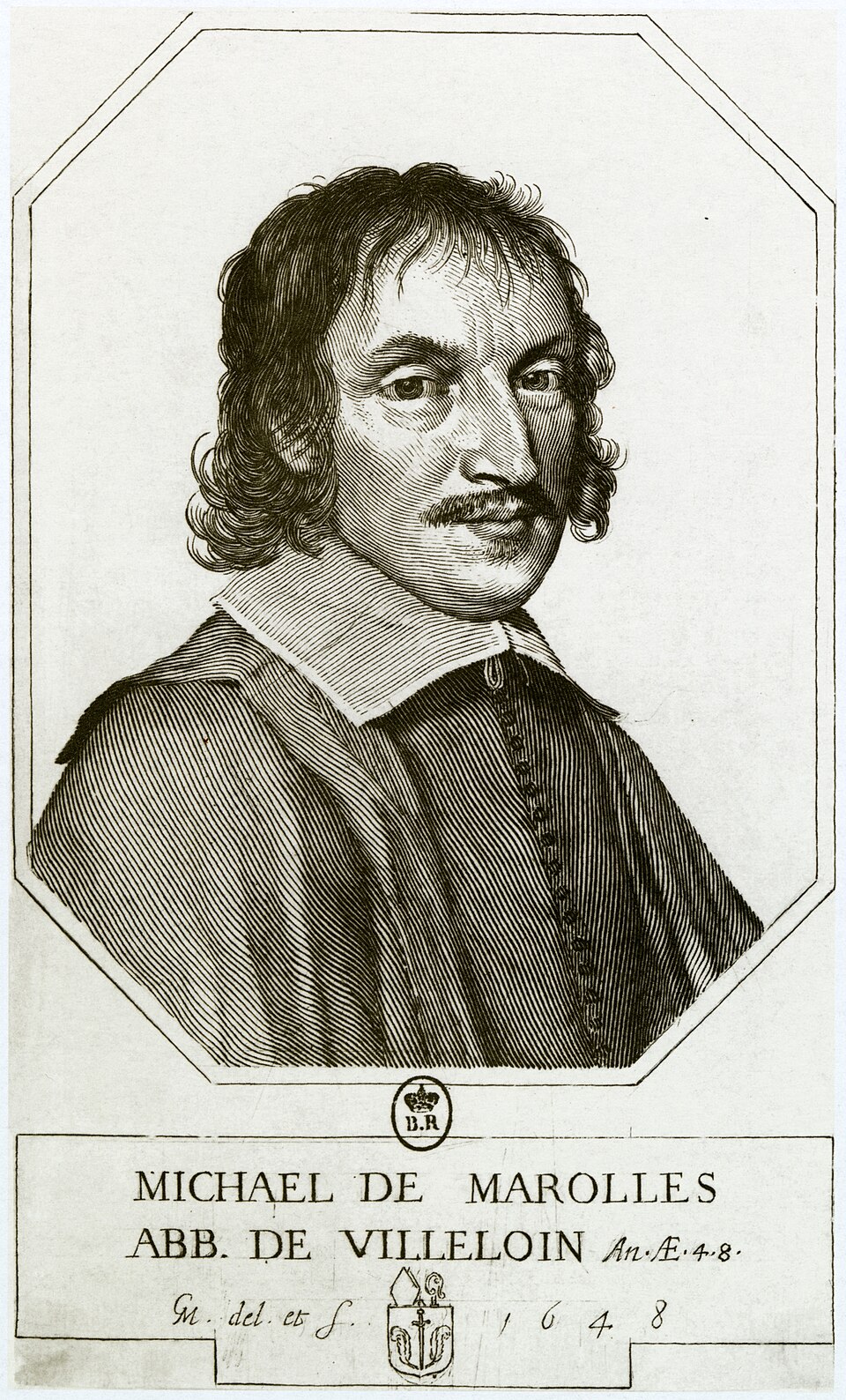
THE RULE WRITER
Michel de Marolles Claude Mellan, 1648A clergyman, translator and writer. He visited Nevers in 1637 and recorded the rules of the Tarot game played there.
Wikimedia Commons — Public domain View the image and rights statementMichel de Marolles visited Nevers in 1637. His own memoirs record that he played Tarot there with a noblewoman named Louise-Marie de Gonzague-Nevers and her companions.
She had added several changes to the game. It seems that the thought was, in effect, “These rules work well—let us write them down and print them.” Louise-Marie later became Queen of Poland.[3]
Suddenly, people from four centuries ago feel much closer. “This version is more fun.” “Then let us write it down before we forget.” Perhaps the conversation sounded something like that.
03 · ONE CARD EACH
The basic idea: everyone plays
one card at a time
So what kind of game was it?
Reduced to its simplest form: each person plays one card in turn, and whoever played the strongest card wins those cards.
It belongs to the family of games now called trick-taking games. The rules of 1637 recommend playing with three people.
Two can play, but Marolles remarks that it is not especially enjoyable with only two. Even a four-hundred-year-old rulebook makes room for a review of the player count.[2]
For example
Imagine that three people are playing. The first person leads a card from the suit of Cups.
If the next player has a Cup, that player normally plays a Cup as well. The third player does the same. The strongest card among the three wins the trick, and its player collects all three cards. Then the process begins again.
But sometimes a player has no Cup. That is when the trumps enter the game.
The Emperor. The Lovers. The Chariot. Death. The Star. The Moon. The World. In the game, these cards first functioned as specially powerful cards.
TRUMP, NOT PROPHECYNot “Death means a turning point in your life,” but
“I played Death, so I won this trick!”
At this point, it becomes much easier to feel just how different early Tarot was from Tarot today.
04 · HIGHEST AND LOWEST
The World is strong.
The Bagat is weak.
The 21 trumps have an order of strength. At the very top stands XXI, the World.
The lowest trump was called I, the Bagat. It is the card that eventually leads to the modern Magician.
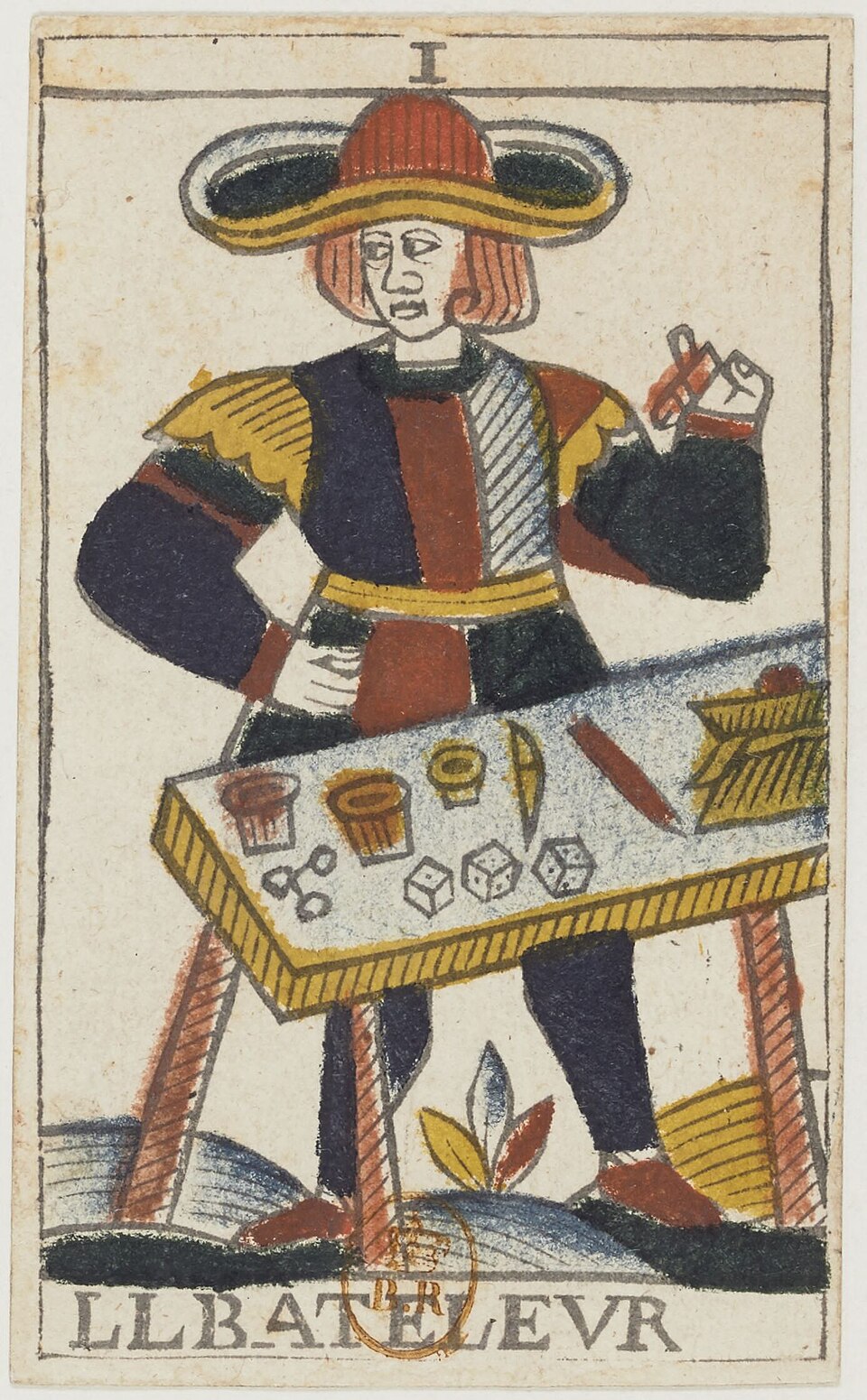
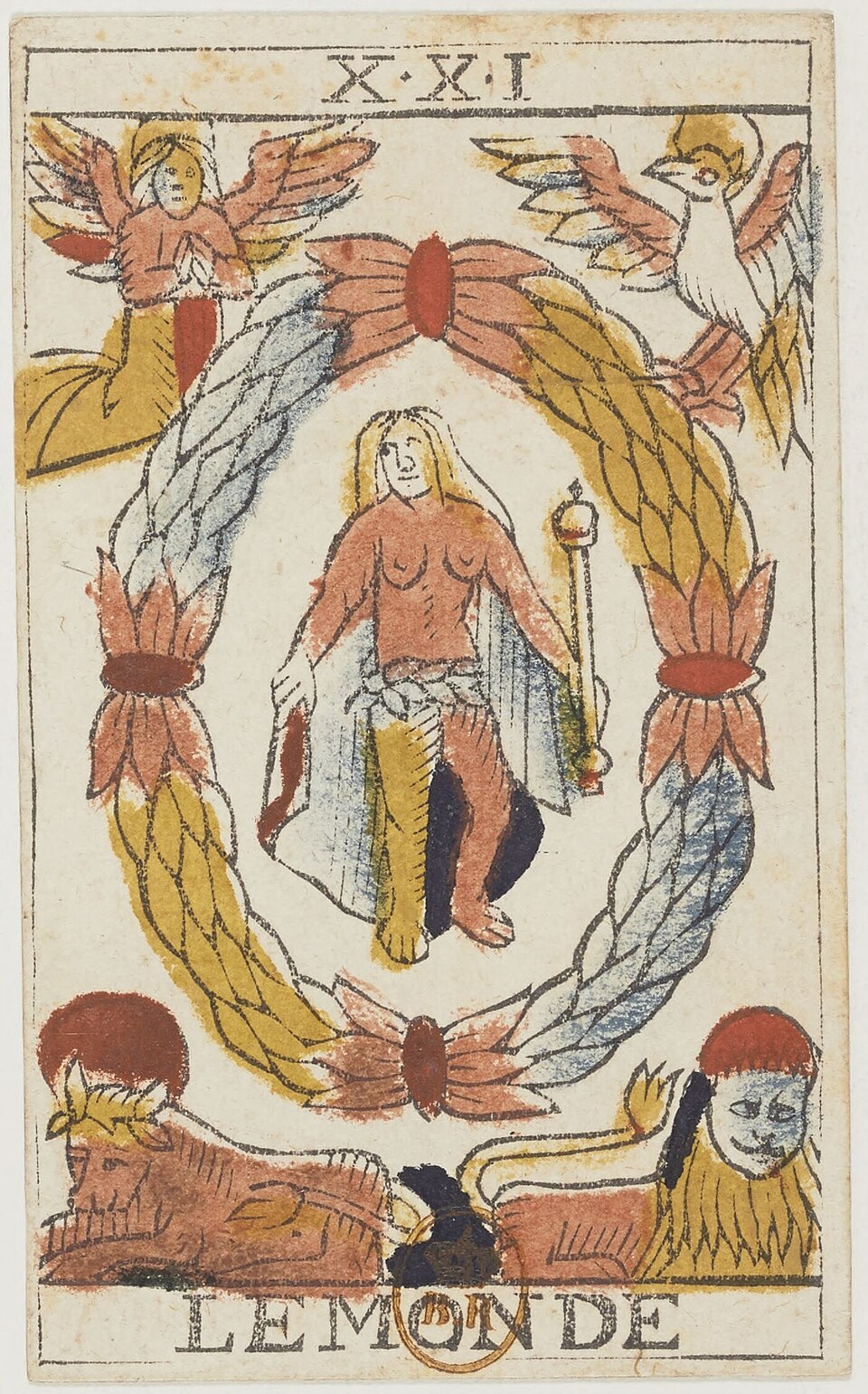
In game terms, the World was extremely strong, while the Bagat—the ancestor of the Magician—was the weakest trump. That may feel surprising if we approach the cards through modern interpretations.
Weak did not mean worthless. A player who protected the lowest trump until the final trick and used it to win that trick received a large bonus. Winning at the very end with a card that had to be guarded all the way there demanded real strategy.[2]
05 · THE ORDER
Why did the cards have
that order?
That creates another question. Why is the World at the top and the Bagat at the bottom?
The exact reason the sequence took this form is not completely known. Many early Tarot packs did not print numbers on the trumps at all, and the order differed from one region to another.
In other words, the sequence from I to XXI was not fixed everywhere from the beginning.
Even so, a broad movement becomes visible when we look across the cards.
The details vary, but the sequence can appear to rise from the familiar human world toward powers, heavens and a cosmos beyond the individual.
The card now called the Magician was not yet necessarily a mystical magician in the modern sense. In older cards, the Bagatto is a juggler, sleight-of-hand artist or street performer. In the Visconti-Sforza pack, too, the figure sits at a table and is identified as a juggler.
Seen that way, a sequence beginning with a familiar figure on earth and ending with the World feels a little easier to imagine.
But it would be too simple to claim that each card received its number because it represented one precisely defined idea. There is much more to say about the strange order of these 21 cards.
One day, we can take a slower journey through the question: why was the Magician the weakest, and the World the strongest?
And even in this sequence, one card remains peculiar. The Fool.
06 · A SHORTENED PACK
Sometimes they did not use
all 78 cards
Part 1 introduced the structure 56 suit cards + 21 trumps + the Fool = 78 cards.
The rules of 1637 also begin by describing a pack of 78 cards. For actual play, however, they recommend removing 12 cards and using only 66.
FULL PACK78cards
−REMOVE12low suit cards
=PLAY WITH66cards
Three were removed from Cups and Coins, and three from Swords and Batons. The shorter pack made the game easier and faster to play.[2]
So a 78-card Tarot pack did not mean every game had to use all 78 cards.
Players adjusted the pack to make their game work better. Once again, Tarot looks less like an inviolable sacred object and more like something people played with first.
07 · TWO DIRECTIONS
Number cards ran in opposite directions
in different suits
Here is another unusual detail.
In Swords and Batons, 10 was stronger, and the cards weakened as the number fell. In Cups and Coins, 1 was stronger, and the cards weakened as the number rose.
So the 10 of Swords was strong, but the 1 of Cups was strong. It sounds difficult to memorize.
This is far removed from looking at a Five and asking what the number five means. For these players, what mattered was whether the card was strong or weak inside the game.
08 · THE OUTLIER
And then there is
the problem of the Fool
One card has followed us since Part 1. The Fool.
We described a pack with 21 trumps and “a Fool treated somewhat differently.” Why was the Fool separated from the others?
The rules of 1637 begin to answer that question. They call the Fool Le Math. The name leads toward the “LE MAT” printed on later Marseille-style cards.
This one card performs an entirely different function from an ordinary trump.
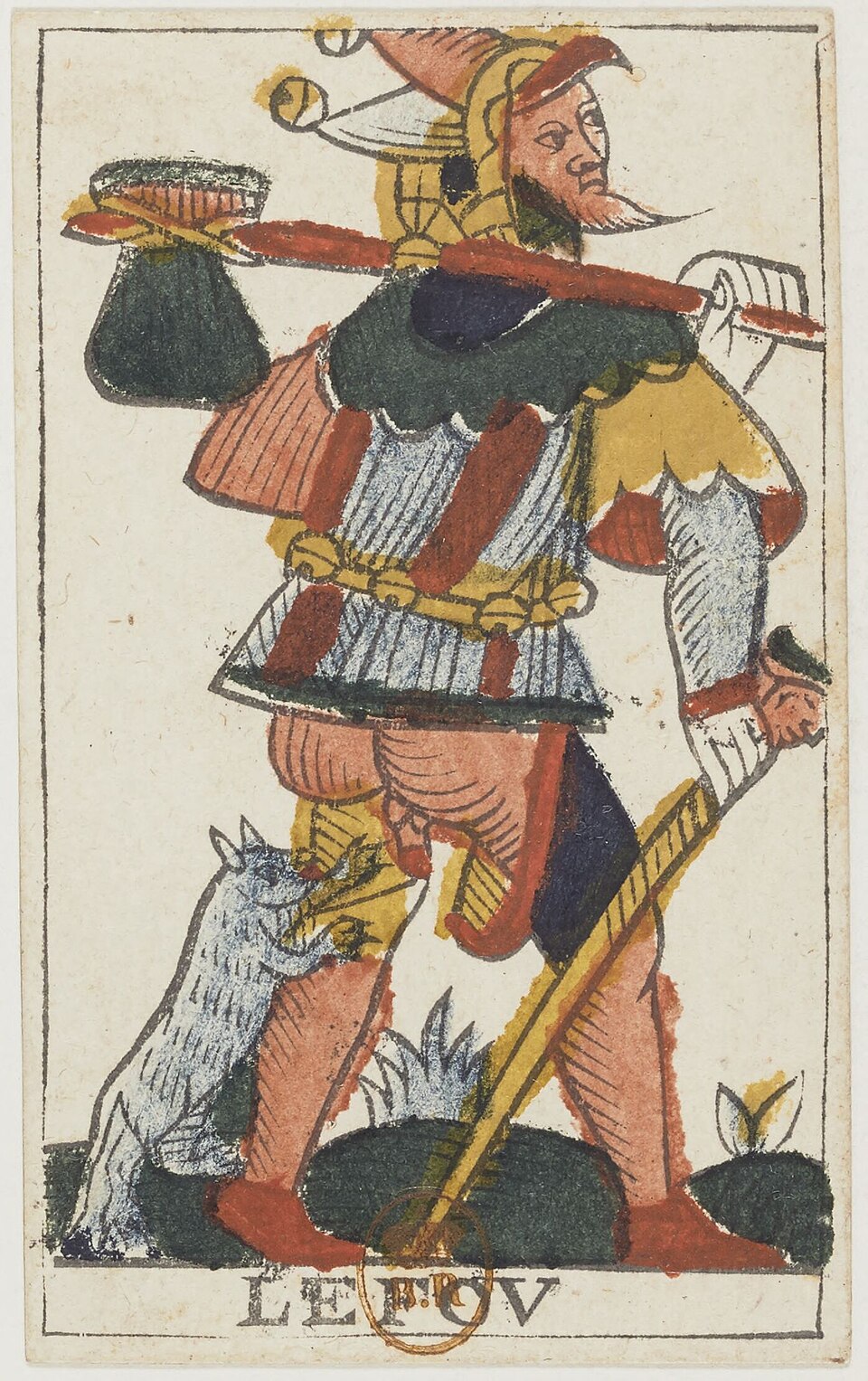
09 · NEITHER WIN NOR LOSS
The Fool does not win.
But it is not taken.
Play an ordinary card and one of two things happens: it wins the trick, or it loses and goes to an opponent. The Fool is different.
In the rules of 1637, the Fool receives special treatment: it does not take the trick, and it cannot itself be taken.
Playing the Fool does not win. But losing the trick does not hand the card to an opponent. It is shown, and when the trick is over it returns to its own player’s collected cards.[2]
01The card does not
win the trick.
02It is not normally
taken by an opponent.
The Fool participates in the trick but stands slightly outside its result.
Every other card lives in the world of winning or losing. The Fool alone occupies a place that is neither. It feels remarkably true to the card.
10 · EXCUSE ME
A card played with
an apology?
The language used for this action is just as interesting. The rules of 1637 call the act of using the Fool to step outside a trick excuse.
It belongs to the same family as the English phrase “excuse me”: something like “pardon me” or “with your permission.”
S’EXCUSERPlaying the Fool is almost like saying,
“I am stepping out of this trick.”
The tradition did not disappear. In the French Tarot game played today, the corresponding card is still called L’Excuse. The official rules of the Fédération Française de Tarot describe it as a special card that frees a player from following the requested suit or playing a trump.[4]
Nearly four centuries later, the Fool still seems to say, “Excuse me—I will not take part in this trick in the ordinary way.”
11 · WHAT IT DOES NOT PROVE
That does not necessarily explain
why the Fool means “freedom”
Here we should slow down and be careful.
Modern Tarot readings may find freedom, unconventionality, a new journey or life outside familiar limits in the Fool.
In the old game, too, the Fool alone stood outside ordinary victory and defeat. It is tempting to say, “Of course—that must be where the modern meaning came from.”
There is no evidence for such a simple direct line. Modern Tarot interpretation was shaped over several later centuries by many people and systems of thought.
We cannot say that today’s divinatory meaning came directly from the old game rule.
But this much is secure: long before Tarot became divination, the Fool was already unlike every other card. Knowing that can make the Fool look a little different when we meet it today.
They really were “trumps,” not yet a Major Arcana
The structure introduced in Part 1 now becomes much more concrete. Today we commonly group these cards together as “the 22 Major Arcana.”
From the viewpoint of the game, however, 21 trumps + the Fool tells their origin more clearly.
The 21 cards from the World down to the Bagat have a hierarchy of strength. The Fool stands outside that hierarchy altogether.
21ranked trumpsXXI World → I Bagat
+1the Fooloutside the ranking
That is why Part 1 spoke of “21 trumps and the Fool.” The very structure of the 78-card pack still carries a trace of the time when Tarot was a game.
12 · A TURN IN THE ROAD
People four centuries ago cared
about winning and losing, too
Reading the rules of 1637 changes the atmosphere around Tarot.
How many Kings do you hold? How many trumps? Which card should survive until the end? When should you use the Fool? Which trick should you fight to win? The rules even award bonuses in several places.
These people were not sitting silently before mysterious images. They were seriously playing a game.
They must have celebrated a lucky hand, groaned when an unexpected trump appeared and tried to protect the weak Bagat until the end.
The more we learn about Tarot’s history, the more the cards seem to leave the far side of the museum case and return to human hands.
But a great change is approaching
Tarot was born in fifteenth-century Italy and travelled across Europe as a game. In the seventeenth century, people were still playing it.
The pictures show Death, Fortune, stars, the Moon and the World. Yet the players were not treating them as a coded system for seeing the future.
Then, in the eighteenth century, a French scholar began to see something entirely different in the cards.
His name was Antoine Court de Gébelin.
In 1781, he proposed that Tarot might be not merely a game, but the surviving vessel of secret wisdom from ancient Egypt.
There is no historical evidence supporting an ancient Egyptian origin for Tarot. Yet this claim, and arguments made around the same time, helped turn Tarot’s history in a new direction.
NEXT: 1781Cards made for a game became
cards of mystery—and eventually, divination.
With the next part, another history of Tarot begins.
SOURCES & IMAGE RIGHTS
Sources and image rights
The bibliography of the 1637 rules was checked against the Bibliothèque nationale de France. The wording of the rules was checked against Thierry Depaulis’s transcription and the English translation and commentary by Depaulis and John McLeod. Every reproduced image is marked public domain on its Wikimedia Commons file page.
- 1
Catalogue général de la BnF
Michel de Marolles, Règles du jeu des Tarots, Nevers, 1637View the catalogue record - 2
Tarock.info — Thierry Depaulis
REGLES DV IEV DES TAROTS — transcription of the 1637 French textRead the transcription - 3
Pagat — John McLeod / Thierry Depaulis
Early 17th Century French Tarot — English translation and commentaryRead the translation and commentary - 4
Fédération Française de Tarot
Règlement officiel — official rules of modern French TarotRead the official rules - 5
Wikimedia Commons
Claude Mellan, Portrait of Michel de Marolles, 1648 — public domainView the image and rights statement - 6
Wikimedia Commons
Jean Noblet Tarot scans: the Bagat, the World and the Fool — public domainView the image category