1630s — 1700s · FRANCE
What Is the
Tarot de
Marseille?
The visual tradition came before the name.
The visual tradition came before the name.
In the previous part, we traced the beginning of Tarot back to fifteenth-century Italy.
The pack already had 56 cards divided among Cups, Swords, Batons and Coins; 21 trumps; and one Fool with a somewhat unusual role.
The outline of the familiar pack of 78 cards was already there. But it was not yet a tool for divination. People used Tarot to play a card game.
Tarot eventually travelled beyond Italy and spread across Europe. In France, one particularly recognizable form was passed from one card maker to another.
TAROT DE MARSEILLEThat tradition is called
A name for a family of images
the Tarot de Marseille.
If you have used Tarot for some time, the name may already be familiar. You may even read with a Marseille deck yourself.
Others may simply ask, “What is the Tarot de Marseille?” We will begin somewhere that works for both groups.
And even if you already know the cards, perhaps you have wondered: why is it called Marseille? Let us follow that question through history.
01 · A LIVING TRADITION
Old cards that are
still in use
First, let us locate the Tarot de Marseille in the present.
It is not merely an old pack preserved behind museum glass. People still use Marseille-style cards for divination and Tarot reading today.
They began as playing cards. During the twentieth century, however, the Marseille tradition became widely known in the world of divination and grew into one of Tarot’s major living lineages. The Bibliothèque nationale de France also describes the Marseille Tarot as becoming an archetypal divinatory object in the twentieth century.[1]
Another family that is often seen today is the Rider-Waite-Smith tradition, which appeared much later. We will examine it closely in a future part.
An old tradition of Tarot
that people still use today.
02 · NOT ONE DECK
“Tarot de Marseille” is not
the name of one product
Here we meet our first easy misunderstanding.
The name can sound as if one famous Tarot deck was designed by a particular person in the city of Marseille.
That is not what it means.
Across many years, different card makers inherited and repeated similar compositions and designs. The name refers to a pattern or family of Tarot images.
An Emperor tends to be arranged in one recognizable way. The Lovers follows another familiar composition. The World places a figure in the center, surrounded by four beings.
Details vary, but a shared understanding persists: “This card generally looks something like this.”
The Tarot made by Jean Noblet in seventeenth-century Paris is considered an important early example belonging to the visual family now called the Tarot de Marseille.[3]
03 · A NAME ON THE MAP
So was it born
in Marseille?
The obvious next thought is, “If Marseille is in the name, it must have been born in Marseille.”
This is where the history becomes both more complicated and more interesting. Current research does not support such a simple answer.
The Bibliothèque nationale de France says that the visual model now called the Tarot de Marseille probably had its birthplace in Lyon.[1]
Lyon is another French city. In other words, a tradition called Marseille may not have begun in Marseille at all.
Jean Noblet’s Tarot was made not in Marseille, but in Paris. Yet it is still treated as one of the most important early examples of the Marseille pattern.
04 · THE LATER NAME
The name “Tarot de Marseille”
came later, too
There is another surprise.
Seventeenth-century card makers were not announcing, “This is a Tarot de Marseille deck.”
The expression “Tarot de Marseille” came into use only in the nineteenth century, from the 1830s onward.[1]
The pattern existed first. Its name arrived much later.
Cards in this family were produced across southeastern France, including Marseille. As Marseille became particularly well known as a center of card production, its name became attached to the tradition.
The visual pattern
already exists
Produced widely in
southeastern France
The name “Marseille”
takes hold
It is therefore slightly misleading to say, “It is called the Tarot de Marseille because it was invented in Marseille.”
It is closer to the evidence to say that an established visual tradition was later given the name “Tarot de Marseille.”
05 · THE 1639 DISCOVERY
Then a Marseille-made pack
from 1639 appeared
At this point, one pack makes the story more complicated again.
It is a complete pack of 78 cards dated 1639. And this one really was made in Marseille.
Its existence became known when it appeared at auction in 2023. In December 2025, it entered the collection of the Bibliothèque nationale de France. All 78 cards survive, and the BnF describes it as the oldest known example of the Tarot de Marseille.[1][2]
DATE1639Dated on the Two of Coins
PLACEMARSEILLEThe maker’s activity is documented there
CARDS78A complete surviving pack
That raises an obvious question: “So does this prove that the pattern began in Marseille after all?”
No. The evidence does not take us that far. This distinction matters whenever we look at history.
“The oldest example that survives”
does not necessarily mean “the first ever made.”
Earlier cards may once have existed and been lost. Another pack may survive somewhere, still undiscovered. The design may have begun in another city and then travelled to Marseille.
Even after the discovery of Vachier’s pack, the Bibliothèque nationale de France continues to describe Lyon as the probable birthplace of the pattern.
What the Vachier Tarot shows is that cards in this pattern were already being made in Marseille by 1639. It does not prove that the pattern was invented there.
Tarot has a history almost six centuries long. New discoveries are still changing the way we reconstruct its past.
06 · SEE THE PATTERN
Look at the Marseille
pattern itself
Here we will examine the Tarot made by Jean Noblet in seventeenth-century Paris. It is a particularly useful example because it shows the visual pattern being made in another city before the name “Tarot de Marseille” had become established.
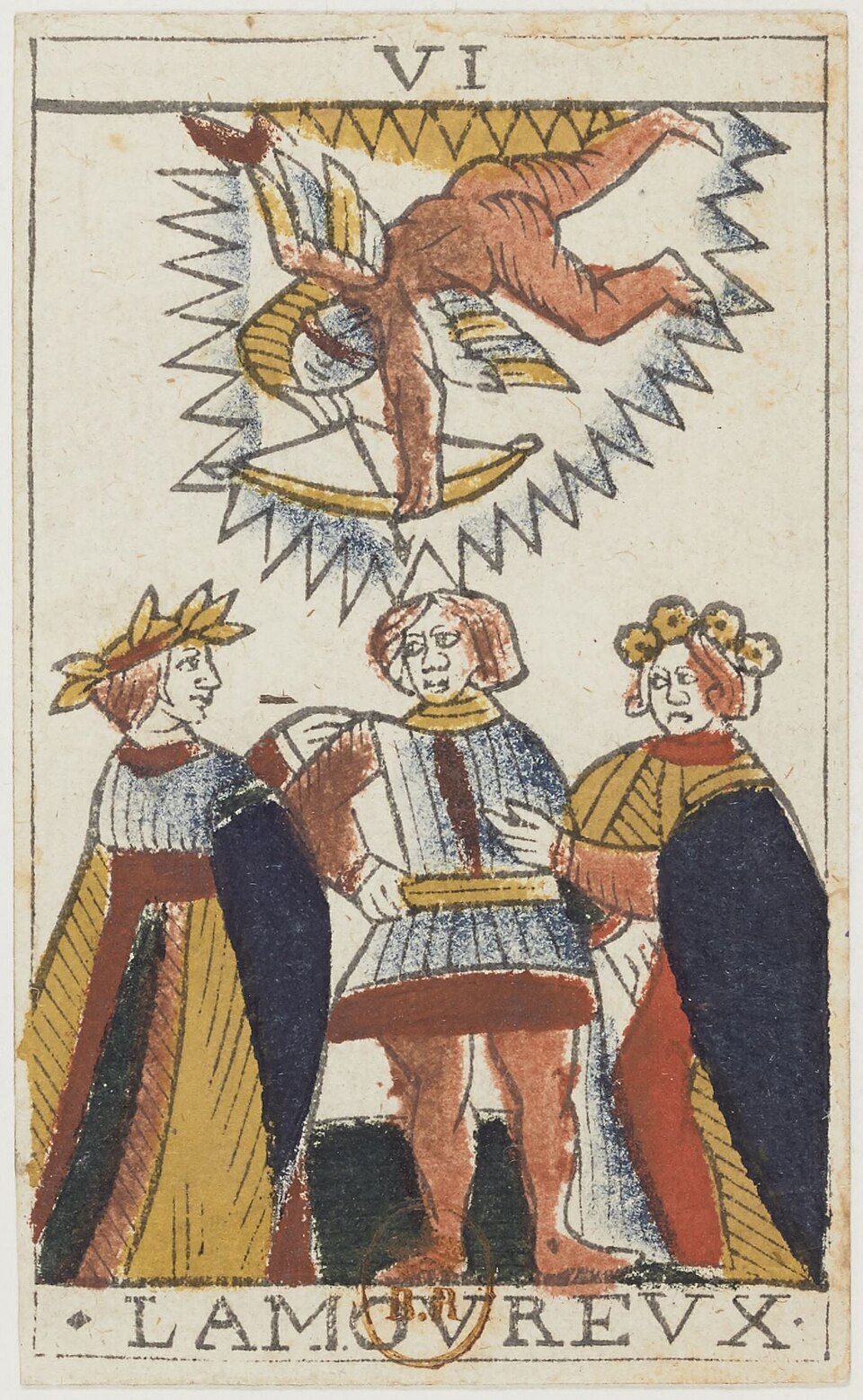
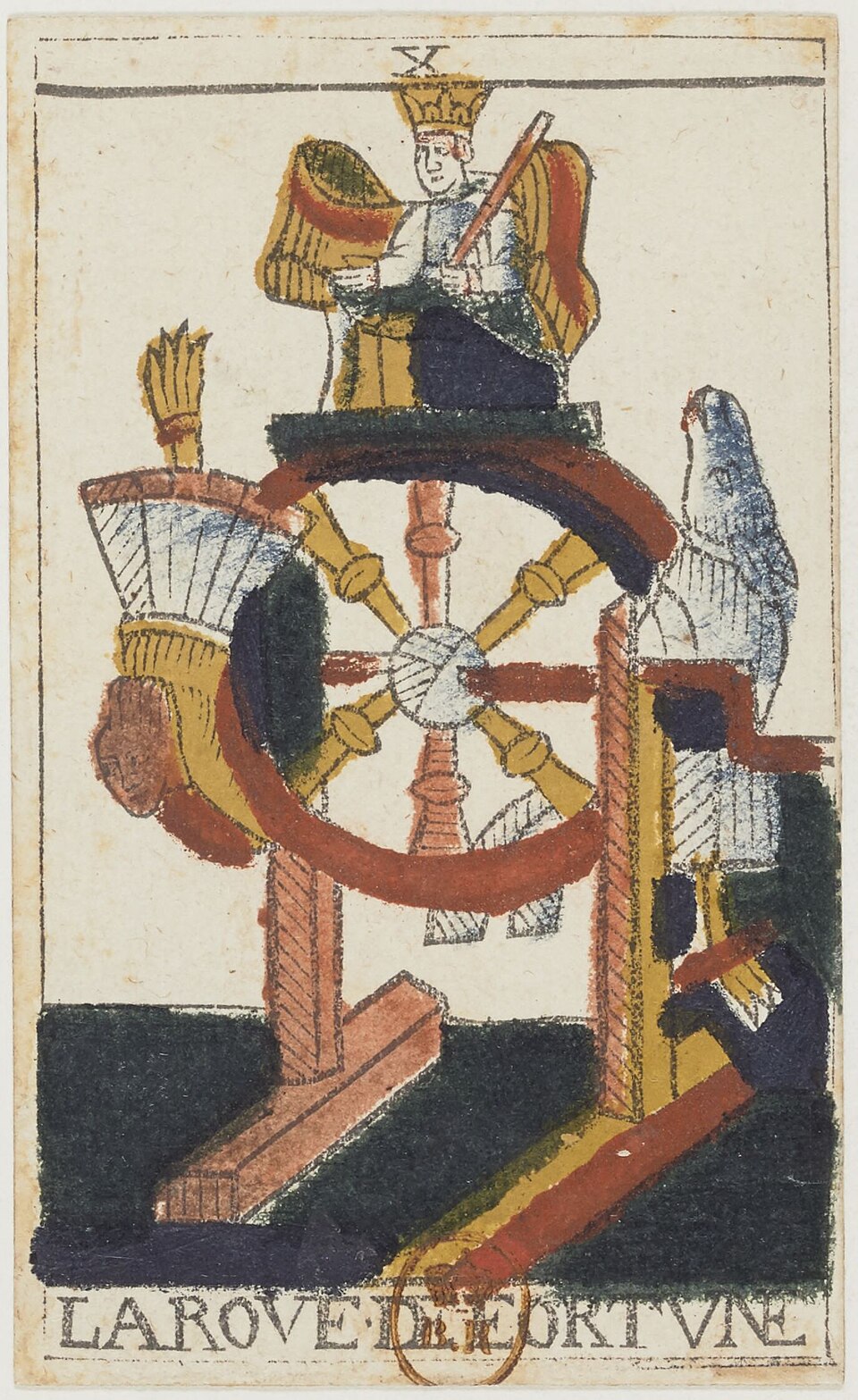
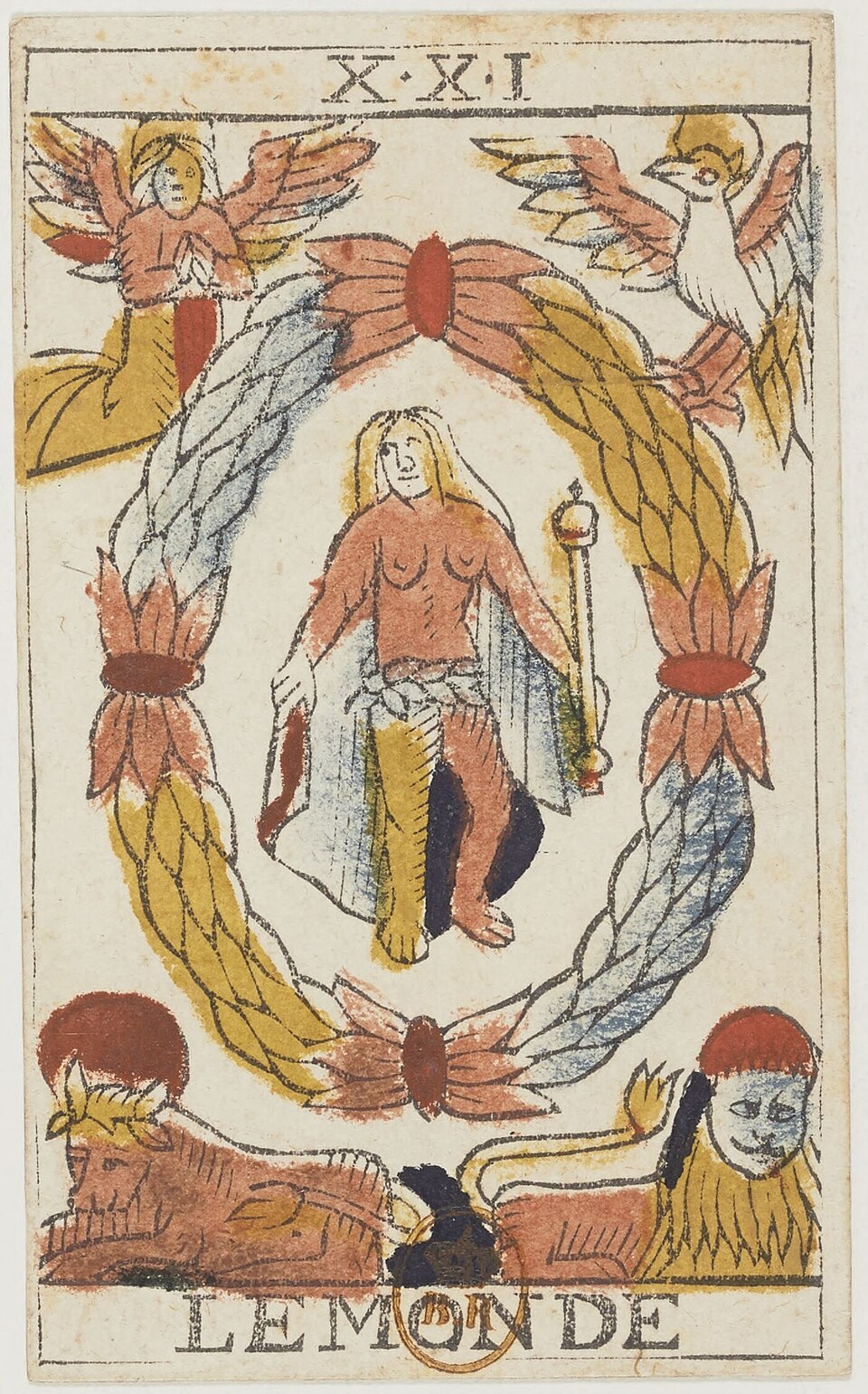
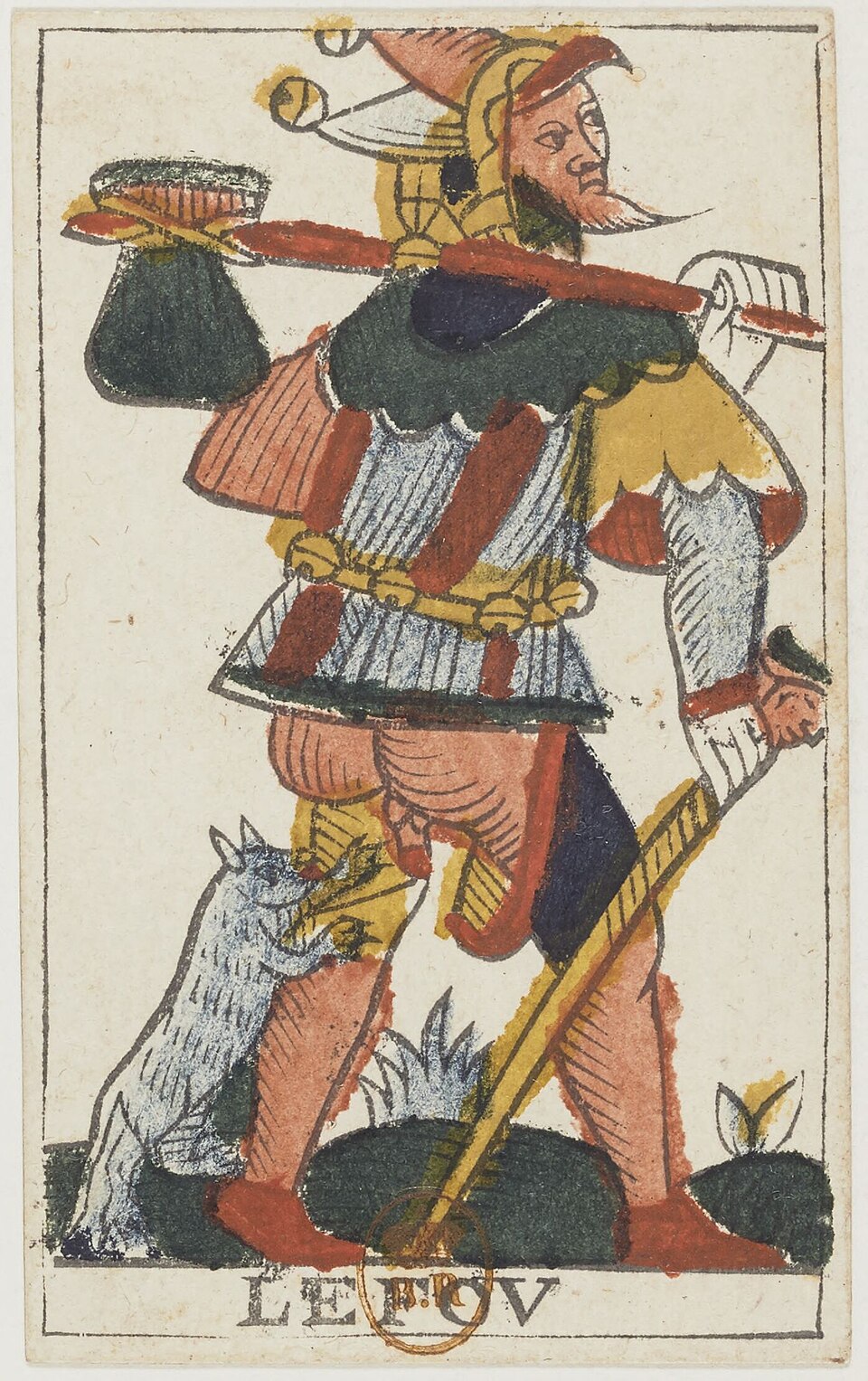
Your first impression may simply be, “These look old.” Heavy outlines. Clear reds, blues and yellows. Figures with a certain rough directness. They feel very different from the precise illustrations found in many modern decks.
The method of production helps explain the look. Older Marseille-style cards were made by carving the designs into wood, printing them on paper, and applying color through stencils: woodblock printing and stencil coloring. The Vachier pack of 1639 was made in the same way.[1]
They are very different from the Visconti-Sforza cards in Part 1, which were lavishly made one by one with gold.
Tarot was gradually changing from a luxurious work of art for a limited few into a set of cards produced so that many people could play.
The Fool.
The Popess.
The Emperor.
The Lovers.
The Wheel of Fortune.
The Hanged Man.
Death.
The Tower.
The Star.
The World.
The names and details vary. Even so, we can look at these cards and think, “Yes, this is leading toward Tarot today.”
07 · THE PIP CARDS
The Minor Arcana makes
the difference even clearer
Think back to the Five of Cups in Part 1.
The Visconti-Sforza card showed almost literally five cups. There was no person and no scene of sadness.
The Marseille tradition follows the same basic approach. Cups show cups. Swords show swords. Coins show coins. Batons show batons. The suit symbols are arranged in the number shown by the card.
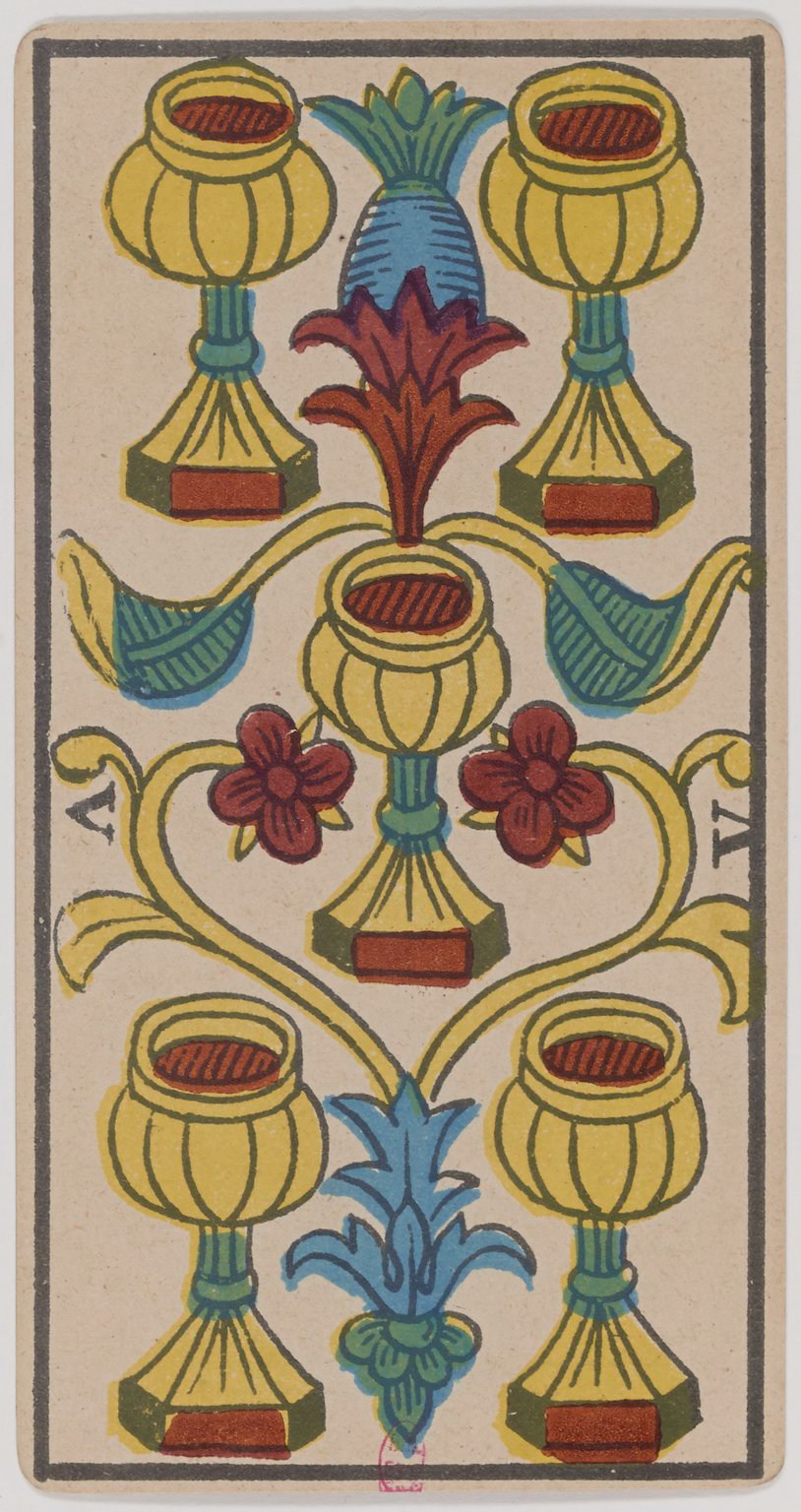
A LATER MARSEILLE EXAMPLE
Five of Cups Lequart pack, Paris, 1890This example is later than Noblet’s seventeenth-century pack, but it clearly preserves the tradition of arranging suit symbols rather than illustrating a narrative scene.
Wikimedia Commons — Public domain View the image and rights statementMany widely used Tarot decks today illustrate the Minor Arcana with people and landscapes. Their Five of Cups may show a grieving figure staring down at overturned vessels.
Marseille-style pip cards do not supply that scene. Readers may instead build meaning from the number, the suit, the arrangement of the symbols and the relationship with surrounding cards.
That creates a different kind of pleasure from reading a ready-made narrative scene. It is one reason traditional Marseille-style packs still appeal to readers today.
Part 1 left us with a question: “Who turned the Minor Arcana into story pictures?” The answer still lies ahead. When this journey reaches the twentieth century, remember this Five of Cups again.
08 · STILL A GAME
But these were still not
cards made for divination
We should take care not to mix the present with the past.
People now use the Tarot de Marseille for divination and reading. That does not mean seventeenth-century players used these cards in the same way.
Their original purpose was to play a game.
The Bibliothèque nationale de France likewise explains that the Marseille Tarot began as an object of play and only later became associated with divination and esoteric thought.[1]
Fifteenth century. Sixteenth century. Seventeenth century. The pictures move gradually closer to modern Tarot. But Tarot still does not speak about the future.
So what were people actually doing with the cards?
09 · TO BE CONTINUED
How did people play Tarot
six centuries ago?
That is where the next part will take us. Saying “it was a game” naturally leads to another question: what kind of game?
Fortunately, evidence survives. A set of printed rules for the game of Tarot from 1637 is still known in France. Written by Michel de Marolles and printed in Nevers, the eight-page work is recorded in the catalogue of the Bibliothèque nationale de France.[4]
Reading those rules brings back a card that already raised questions in Part 1.
In the rules of 1637, the card corresponding to the Fool behaves very differently from ordinary cards.
01The card does not
win the trick.
02It is not normally
taken by an opponent.
It does not win in the ordinary way. It does not lose in the ordinary way. It is almost as though it stands inside the rules of the game while remaining slightly outside them.[5]
Today, some readers associate the Fool with freedom or life outside convention.
We cannot simply declare that an old game rule became the modern divinatory meaning. But it is intriguing to learn that the Fool was already an unusual card long before Tarot became divination.
Next time we will look into the rules themselves and ask how people used all 78 cards for play before Tarot was used to read the future.
SOURCES & IMAGE RIGHTS
Sources and image rights
The historical account was checked primarily against public material and collection records from the Bibliothèque nationale de France. Every image reproduced here is marked public domain on its Wikimedia Commons file page. No image was downloaded directly from BnF or Gallica.
- 1
Bibliothèque nationale de France
Un tarot qui rebat les cartes — the new Philippe Vachier acquisition and the history of the Marseille TarotRead the article - 2
Catalogue général de la BnF
Jeu de tarot à enseignes latines, dit « de Marseille », type I / Felip. Vachie, 1639View the collection record - 3
BnF Essentiels
Tarot de Jean Noblet — 73 cards of 78, Paris, second half of the seventeenth centuryView the record - 4
Catalogue général de la BnF
Michel de Marolles, Règles du jeu des Tarots, Nevers, 1637View the catalogue record - 5
Pagat — John McLeod / Thierry Depaulis
Early 17th Century French Tarot — English translation and commentary on the 1637 rulesRead the rules - 6
Wikimedia Commons
Jean Noblet Tarot scans and public-domain statementsView the image category - 7
Wikimedia Commons
5C Tarot.png — Lequart Five of Cups, 1890, public domainView the image and rights statement - 8
Bibliothèque nationale de France
Terms for Gallica digital material and commercial reuseRead the reuse terms