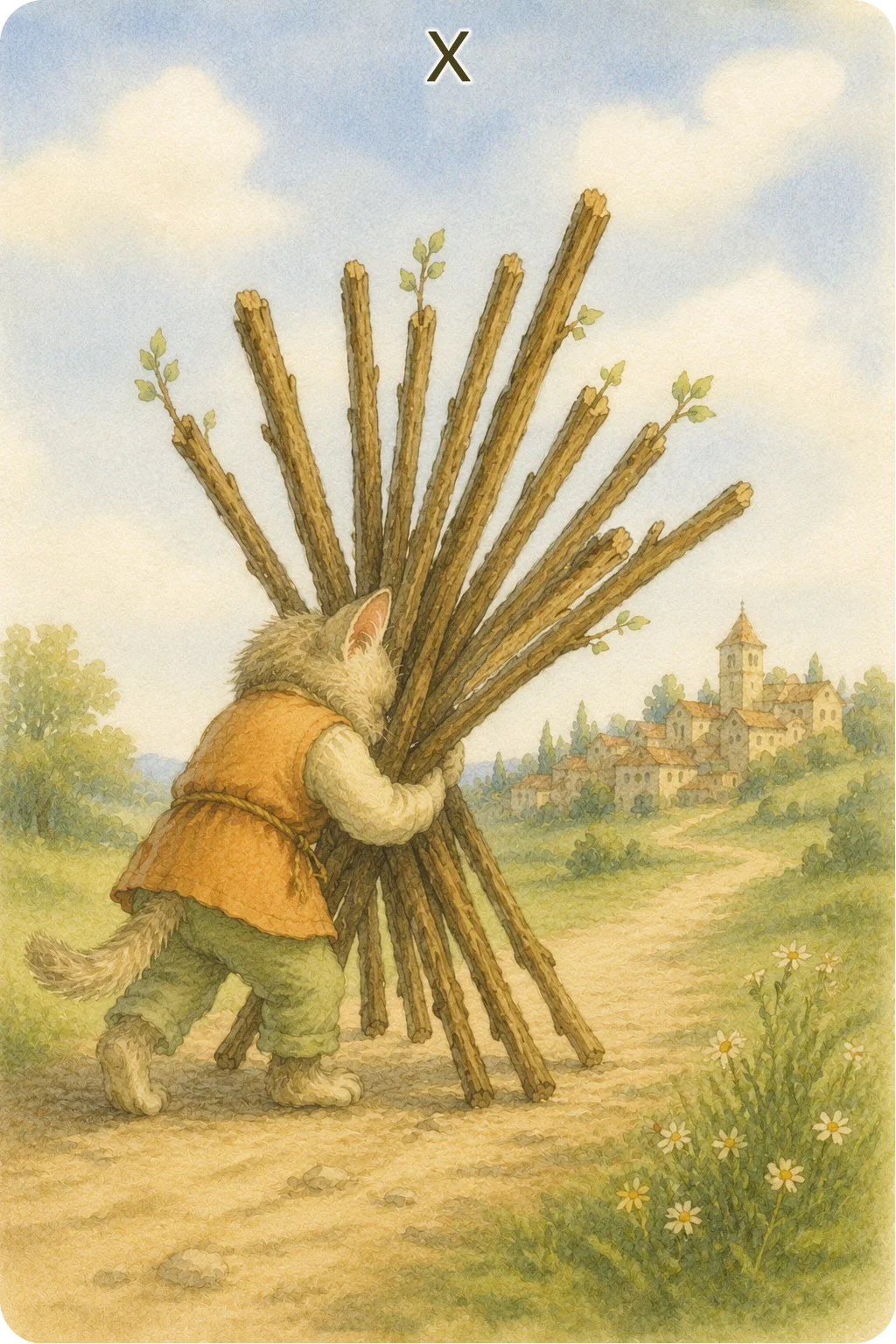
MINOR ARCANA · 10
Ten of Wands
Organize what you are carrying, and bring what truly matters all the way to the end.
- Heavy responsibility
- Burden
- The weight of achievement
- Endurance
- Taking on too much
- Fulfilling responsibilities
- Final effort
- Busyness
SYMBOL & STORY
What Ten of Wands represents
The Ten of Wands depicts a figure carrying ten wands in both arms, bent forward under their weight as he walks toward a town. He is holding many wands, which can also be seen as evidence that he has gained and accomplished a great deal. However, because he is carrying everything by himself, the burden on his body is heavy, and even the road directly ahead has become difficult to see. Wands are the suit of passion, will, action, and creativity. As the ten of this suit, this card represents a stage where one cycle has advanced toward its later phase, and what has been accumulated up to this point now appears in the form of substantial results and responsibilities. You work hard to turn a dream into reality, and as a result, your work and roles increase. You gain the trust of the people around you, and as a result, even more is entrusted to you. In this way, the things you gain can create new weight of their own. Arthur Waite named "oppression" as one of the central meanings of this card. At the same time, he also gave meanings such as fortune, gain, many kinds of success, and the oppression that can arise from those things. For that reason, the Ten of Wands is not merely a card of hardship. It can also represent a state in which success and burden are two sides of the same coin: "Because you have gained so much to get this far, you also have more to carry." Waite also listed meanings such as disguise, pretense, and perfidy. These are not always placed at the center of modern everyday readings, but they can be understood as situations where things look as though they are going well on the surface while, behind the scenes, someone is pushing themselves beyond what is sustainable. A town can be seen in the direction the figure is heading. From this image, modern readings sometimes interpret the card as meaning "the destination is near," "completion is close," or "one final push." However, Waite himself did not describe the image only as a simple scene of being just before the finish line. He also suggested that what the figure is carrying may affect the place toward which he is heading. This card can therefore be seen as asking whether it is truly wise to carry the current burden unchanged into the future. If the Nine of Wands shows someone who has been hurt but still tries to defend their position, then in the Ten of Wands that person has gone beyond that struggle and is now carrying together everything they protected, gained, and accepted responsibility for. Overcoming a challenge does not always mean that everything becomes easy afterward. Success itself can create new responsibilities. What this card asks is not only, "Can you keep trying harder?" It also asks, "Do you really need to carry all of this by yourself right now?" Fulfilling your responsibilities and carrying absolutely everything alone are not the same thing. In order to bring what truly matters all the way to its destination, you may need to reconsider how you are carrying the load.
UPRIGHT & REVERSED
Upright and reversed Ten of Wands
Compare the keywords and detailed meanings to see how the symbol changes with orientation.
UPRIGHT
Upright meaning
Organize what you are carrying, and bring what truly matters all the way to the end.
- Fulfilling responsibilities
- Final effort
- Busyness
- Pressure
- Strength to see things through
The Ten of Wands upright represents a state in which you are carrying substantial responsibility and burden while continuing toward your goal. It is difficult, but that does not mean you have gained nothing. On the contrary, because you have worked hard up to this point, the things you are carrying may have increased in the form of work, roles, results, and other people's expectations. On a psychological level, your sense of responsibility is likely to become stronger, with thoughts such as, "I have to do this," or, "I've come this far, so I want to see it through to the end." The desire not to give up can be a great source of strength, but conscientious people in particular can sometimes continue pushing themselves without noticing that they have already reached their limits. In practical circumstances, this card often appears as very real busyness: a heavy workload, a packed schedule, holding several roles at once, or carrying the expectations of the people around you. If it appears near the end of a project or long-running activity, it can also be read as, "You have reached a very demanding part of the process, but a natural stopping point is also getting closer." At the same time, there is no rule saying that you must continue carrying the same burden even after the goal has been reached. You succeed and are given even more work. You try hard to protect a relationship and end up being the one who constantly accommodates the other person. This card also has the aspect of, "Because you are capable of working hard, the burden keeps increasing." In terms of action, the key is not merely enduring, but sorting out your priorities. Delegate what can be delegated. Postpone what does not need to be done immediately. Do not demand too much perfection from yourself. By doing this, you become able to use your energy on what truly matters. For example, in a question such as, "Should I stay in my current job?" there is a strong possibility that your present burden is quite heavy. However, rather than immediately giving up, you may first need to identify exactly what has become burdensome. The problem may not be the work itself, but the amount of work or the way responsibilities are being divided. In a question such as, "Can I achieve this goal?" you have already built a great deal and still possess the strength to keep moving toward completion. However, if you try to carry everything entirely by yourself until the very end, you may become completely exhausted. It is important not to treat reaching the goal and wearing yourself down as though they were the same thing. In a question such as, "Why are my relationships so difficult?" you may be taking on too much of the other person's feelings or the circumstances around you. Even if you originally accepted those things out of kindness or responsibility, it is worth reviewing whether they have quietly become treated as something you are simply expected to carry. The Ten of Wands upright is not a card that says, "If you just work hard enough, everything will turn out well." It is a card that recognizes the strength that has brought you this far while asking you to choose where that strength should actually be used.
REVERSED
Reversed meaning
Reconsider the load you are carrying, and keep only what is truly necessary.
- Reaching your limit
- Carrying too much
- Letting go
- Avoiding responsibility
- Reassessing burdens
The Ten of Wands reversed represents a state in which the pressure carried in the upright position is approaching its limit, or a point where it has become necessary to put some of the burden down. On the other hand, it can also appear as an attempt to escape responsibility itself. For that reason, it is important to distinguish between "what should be released" and "what still needs to be faced." Waite himself associated the reversed position with conflict, difficulty, and intrigue. In modern readings, the upright theme of "oppression" is often treated as reversed, weakened, or intensified, leading to interpretations such as, "You can no longer carry everything," "You need to put the load down," "You are abandoning responsibility," or "You are being released from a burden." On a psychological level, fatigue, obligation, pressure, and a sense of burnout are more likely to appear. You may feel, "I cannot do this anymore," while still believing that you have to keep going. Conversely, your desire to escape the pressure may become so strong that you feel tempted to throw away responsibilities that you genuinely still need to face. In practical circumstances, work, relationships, household duties, and other obligations may have accumulated to the point where the old way of managing them is no longer sustainable. When this card appears, rather than asking, "How can I work even harder?" it is often more useful to ask, "What can I reduce?" "Who can I rely on?" and "What can I stop doing?" If the reversed card works in a constructive direction, it can also indicate finally being able to put down a burden that you have carried for a long time. Work may be divided more fairly, a role may come to an end, you may refuse an unreasonable commitment, or you may become freer from an excessive sense of responsibility. In this way, movement toward a lighter load can begin. For example, in a question such as, "Should I continue like this?" the card suggests that continuing in exactly the same way is becoming unrealistic. This does not necessarily mean that continuing itself is wrong. Rather, the amount, deadline, division of roles, or way you are involved may need to change. In a question such as, "Can I let this go now?" it is worth reviewing why you are continuing to carry it. The meaning changes depending on whether you simply want to escape because something is troublesome or whether your role has genuinely come to an end. What matters is considering what can be released in a way that allows both you and the people around you to continue sustainably.
LOVE
Ten of Wands in love
Upright love
When the Ten of Wands appears upright in a love reading, you may be trying very hard to value the other person or preserve the relationship, while at the same time the relationship itself is beginning to feel a little heavy. This does not necessarily mean the feelings are gone. Rather, because you care, you may be taking on responsibility, worries, and emotional labor as well. With unrequited love, you may be trying too hard to become closer to the other person. You may spend too much time thinking about what to say in a message, analyzing every reaction, or feeling that you must be the one to move the relationship forward. Before you realize it, romance may have started to feel like an assignment. Relaxing your effort slightly may make it easier to build a more natural connection. If you are already in a relationship, the burden of maintaining the relationship may have become uneven. You may be the one who constantly adjusts schedules, tries to anticipate the other person's feelings, or initiates every discussion whenever a problem arises. If you feel, "If I do not keep trying, this relationship will not continue," it may be time to review how the responsibilities between you are divided. On the other hand, you may simply be temporarily busy because the two of you are trying to build a future together, through things such as wedding preparations, moving, raising children, or balancing work and the relationship. In that case, the burden itself is not necessarily the problem. What matters is whether the two of you are actually sharing it. For reconciliation, you may strongly feel, "This time, if I just work hard enough, we can make it work." However, if you once again take the same problems entirely onto your own shoulders, the relationship may become painful in the same way. If you are considering reconciliation, it is important to look at who carried what in the previous relationship and reconsider the structure of the relationship itself. For new encounters, you may still be interested in love while already feeling completely occupied by work, family matters, or daily life. Creating a little more breathing room in your life may be part of preparing yourself to welcome a good relationship.
Reversed love
When the Ten of Wands appears reversed in a love reading, the burden of maintaining the relationship may have become too heavy. Feelings of affection may still remain, but patience, expectations, anxiety, and responsibility may have accumulated to the point where there is little room left to simply enjoy the relationship. With unrequited love, you may be exhausted from thinking too much about the other person or trying too hard to move the relationship forward entirely on your own. If you are constantly worrying about every reaction, always creating the topics of conversation yourself, or endlessly adjusting to the other person, the romance itself may have become a burden. It may be all right to relax your effort for a while. If you are already in a relationship, the burden may have become too concentrated on one person. If you are always the one who apologizes, adjusts the schedule, worries about the other person's mood, or thinks alone about future problems, it may be time to reconsider how the responsibilities in the relationship are being shared. However, the reversed position can also mean that the burden is beginning to become lighter. By talking honestly, the two of you may realize that you do not need to keep pushing yourselves so hard, or you may become able to share housework and other responsibilities more fairly. The relationship can begin changing into one where you do not have to carry everything alone. For reconciliation, you need to sort through what you carried in the previous relationship. Rather than thinking, "This time, if I change everything about myself, it will work," it is more important to identify what had become unsustainable between the two of you. If you simply take on the same role again, you may end up repeating the same pain. For new encounters, you may already have too little room in daily life. Instead of trying to increase the number of opportunities to meet people, creating more space in your schedule and your emotions may need to come first.
FEELINGS
Ten of Wands in their feelings
Upright their feelings
When the Ten of Wands appears upright as the other person's feelings, they may not be taking the relationship lightly at all. In fact, they may feel its responsibility and weight very strongly. Precisely because they want to value the connection, they may think, “I have to do this properly,” until that sense of responsibility becomes a burden. If they are already carrying a great deal through work, family, or other relationships, they may have feelings for you while still lacking the room to respond fully. Slow replies or difficulty making time to meet do not necessarily mean weak interest. They may also feel that they have to support the relationship themselves or meet certain expectations. When obligation moves to the foreground more strongly than affection, being together can begin to feel like a responsibility rather than a source of joy. When reading their feelings, it is important to separate what exactly they are carrying. Wanting to let go of the relationship is very different from wanting to preserve it while simply having no emotional room left. If some of the roles and expectations can be lightened, the feelings buried beneath the burden may become easier to see.
Reversed their feelings
When the Ten of Wands appears reversed as the other person's feelings, they may strongly want to feel lighter or put down what they have been carrying. That does not automatically mean they want to end the relationship with you. Work, family, or expectations from people around them may have piled up, leaving them tired of trying to respond properly to romance as well. In such a state, feelings may still be present even though there is not enough energy to invest in the relationship. They may also want to reconsider roles or sacrifices within the relationship that have become too difficult to sustain. This card can describe both relief that comes from setting down an unnecessary burden and the act of letting go of something that can no longer be carried. It is important to look at what they are trying to free themselves from through their actual words and behavior. If they have begun showing weakness more honestly or saying things such as, “I need this from you,” they may be trying to reshape the relationship into something they can continue rather than abandoning it. Not forcing them to carry more than they can handle may make it easier for their real feelings to come forward.
WORK
Ten of Wands in work
Upright work
When the Ten of Wands appears upright in a work reading, it represents a state in which responsibilities are increasing and the workload has become heavy. You may be relied upon, entrusted with important tasks, or asked to handle several roles at once. In some cases, you are busy precisely because your abilities have been recognized. However, when the pattern of "You're capable, so we'll give this to you too" keeps accumulating, one person can end up carrying far too much of the work. The more results you produce, the more work you are given, until you eventually have very little freedom to move. This is a classic Ten of Wands situation. Regarding goal achievement, your efforts have already accumulated and you have the ability to continue to the end. Near a deadline, before delivery, or in the final stages of a project, the card can be read as, "This is an especially demanding period." However, whether you should continue working in the same way after completion is a separate question. Once you reach a stopping point, it is better to sort out the burden before taking on the next assignment. For a job change, there is a possibility that you are carrying too much in your current workplace. However, it is important to separate whether the work itself does not suit you or whether the real issue is excessive workload or poor division of responsibilities. Rather than assuming that changing jobs will solve everything, it becomes easier to decide when you clarify what kind of working style you can sustain without pushing yourself beyond your limits. In terms of evaluation, being entrusted with responsible work can itself be a sign of trust. However, if you silently accept everything, the people around you may stop seeing how difficult the situation actually is. Communicating the support or adjustments you need is also an important skill for being able to continue working over the long term. In workplace relationships, pay attention to situations where you cannot refuse requests, constantly compensate for someone else's mistakes, or carry the coordination role alone. Helping the people around you is important, but you do not have to take responsibility for everything.
Reversed work
When the Ten of Wands appears reversed in a work reading, the amount of work and responsibility may be approaching an unsustainable limit. Even if you have managed to handle everything up to now, continuing in exactly the same way may no longer be possible. In the workplace, the burden may be uneven. You may be unable to refuse requests, carrying the work of several people, or constantly compensating for the mistakes of those around you. If you have never told anyone that you are struggling, the people around you may assume that you still have room to take on more. Regarding goal achievement, the problem may lie less with the goal itself and more with the way you are trying to reach it. Reducing the workload, changing priorities, adjusting the deadline, or delegating tasks may allow movement to resume. The card can also indicate being released from a burden by reducing your workload or handing over a role. Letting go of a responsibility is not always a failure. In some cases, it is simply an act of organization that allows you to focus on what matters more. For a job change, fatigue with the current workplace may be particularly strong. However, if you resign only under the momentum of exhaustion, you may repeat the same pattern of carrying too much in the next workplace as well. Before acting, it is useful to clarify the real source of the burden: Do you dislike the work itself? Is there simply too much of it? Is the hardest part the inability to rely on other people? At the same time, the reversed position can sometimes represent avoiding responsibility. If you keep passing unpleasant tasks to others or repeatedly abandon things at the final stage, you may need to review whether the burden truly needs to be reduced or whether this is a responsibility you still need to face.
MONEY
Ten of Wands in money
Upright money
When the Ten of Wands appears upright in a financial reading, it represents increased financial responsibility and burden. Living expenses, loans, spending for family, and preparations for the future can create a state in which you are carrying money-related obligations that are not only for yourself. In terms of income, you may be earning money in proportion to your work and effort. However, if maintaining that income requires long hours or juggling several jobs, you need to consider the balance with your physical and emotional well-being. Even if the income itself is adequate, there is still a burden that cannot be measured by money alone if your entire life is becoming difficult in order to earn it. In terms of spending, the card is more likely to represent necessary payments piling up than luxury. It may be useful to check whether there are fixed expenses that have quietly increased or costs that you are continuing to carry out of a sense of responsibility even though they do not truly need to be yours. For investments or major purchases, you need to consider whether you can safely add any more burden than you already have. Look not only at the purchase price, but also at maintenance costs, repayments, and the time and effort required to manage what you are taking on. With saving, you have the strength to build steadily. However, if the thought, "I have to save even more," becomes too intense, protecting money itself can turn into a burden. Try to find a way to value both preparation for the future and the life you are living now.
Reversed money
When the Ten of Wands appears reversed in a financial reading, it represents a state where financial burdens have become too heavy, or a need to begin reducing those burdens. Payments, debt, and expenses for family can pile up until they become an emotional burden greater than the numbers alone would suggest. In terms of income, check whether you are pushing yourself too hard in order to earn. Working more overtime or adding more side work may increase your income, but if doing so damages your health or daily life, it will be difficult to sustain. It is important to look not only at how much money you earn, but also at how much burden you are carrying in order to earn it. In terms of spending, reviewing fixed expenses and multiple ongoing payments may reduce your burden. Check for unused services, contracts you do not truly need, or expenses that continue only out of habit. For investments or major purchases, do not make decisions out of impatience. When thoughts such as, "I have to buy now," or, "I have to make back what I lost," become strong, you may end up adding even more burden. Before taking on something new, it may be better to organize what you are already carrying. Conversely, the card can also represent being released from a long-standing financial burden, such as paying off a loan, cancelling an unnecessary contract, or changing how household expenses are shared. Do not carry financial anxiety alone. If necessary, seeking help from people around you or from a qualified professional can also be an option.
RELATIONSHIPS
Ten of Wands in relationships
Upright relationships
When the Ten of Wands appears upright in a relationship reading, there is a possibility that you are carrying too much responsibility or consideration within your relationships. People may expect you to be the dependable one, the person who never refuses, or the one who keeps the whole situation organized. In friendship, you may always be the one who listens to other people's problems or adjusts yourself to their convenience, leaving you more tired than you realize. Wanting to help is valuable, but you do not need to carry another person's problems to the point where you yourself are suffering. Within the family, your role may have grown heavy in areas such as housework, caregiving, finances, or emotional support. Things you once took on because you thought, "It will be faster if I do it myself," may gradually have become fixed as responsibilities that everyone assumes are yours. At work or in a group, you may be acting as the coordinator, organizer, or person who fills in the gaps for everyone else. Even if the group runs smoothly because you keep stepping in, that pattern will eventually exhaust you. Passing some roles to other people can sometimes make the entire relationship healthier. This card is not telling you to abandon your relationships. It teaches that "caring about someone" and "carrying their share as well as your own" are different things. In order to build relationships where people can genuinely support one another, review how much you yourself are taking on.
Reversed relationships
When the Ten of Wands appears reversed in a relationship reading, it represents a state in which the burden you have carried within a relationship is approaching its limit, or where you are beginning to put some of that load down. In friendship, you may be tired of always listening to the other person's problems, always being the one to make contact, or consistently putting the other person's circumstances first. Even if you do not dislike them, there are times when you may feel, "I need a little distance." Appropriate distance does not necessarily destroy a relationship; sometimes it is necessary in order for the relationship to continue over the long term. Within the family, you may strongly feel that you are the only one carrying responsibility. Even when you want to help because they are family, you cannot solve everything by yourself. You need to separate what you can do from what you cannot. At work or in a group, you may feel ready to step down from the role of coordinator or organizer. If the relationship has depended on you always being the one to act, passing some responsibilities to other people may encourage them to begin acting for themselves. Conversely, if you are pushing your responsibilities onto someone else or avoiding difficult tasks, you may need to reconsider how you are taking responsibility. With the Ten of Wands reversed, it is important to avoid both extremes: carrying everything and carrying nothing. Relationships are not meant to function because one person carries everyone's load. Sometimes you support others; sometimes you rely on them. Aim for relationships in which that movement can go both ways.
YES OR NO
Yes or No for Ten of Wands
Upright judgment
- Judgment
- It depends
- Reason
- There is enough strength to continue toward a result, but the current burden is heavy and the way things are being sustained is difficult. It may still move toward Yes, but pushing through without changing anything risks exhaustion, so this is not a simple affirmative.
- What could change the answer
- If responsibilities can be reduced and shared more fairly, the reading moves toward Yes. If the burden keeps increasing and everything is forced forward anyway, the situation may reach its limit and shift toward No.
Reversed judgment
- Judgment
- It depends
- Reason
- Reversed, the card can show a positive release from excessive burden, but it can also show the abandonment of responsibility itself. The outcome changes greatly depending on what is being set down, so the answer cannot yet be fixed in one direction.
- What could change the answer
- If unnecessary burdens are cleared away and energy can return to what truly matters, the reading shifts toward Yes. If responsibility and commitments themselves are abandoned, it shifts toward No. The key condition is identifying what actually needs to be released.
MESSAGE FROM THE CARD
Advice from Ten of Wands
Upright
Among the things you are carrying now, some may exist precisely because of how hard you have worked to get this far. Responsibilities entrusted to you, things you want to protect, and goals that are beginning to take shape are also evidence of the path you have walked. But being able to carry a lot and being required to carry a lot are not the same thing. Is there anything you can entrust to someone else? Is there anything that does not need to be done immediately? And are there things you believe are "your responsibility" even though, in truth, you may already be allowed to let them go? You do not need to throw everything away. The point is to sort through the load so that you can carry what truly matters all the way to its destination. Protecting yourself from complete exhaustion is also an essential condition for seeing something through.
Reversed
If you feel, "I cannot carry any more," do not ignore that feeling. Enduring until you reach your absolute limit is not the only way to fulfill your responsibilities. Try imagining that you place all the things you are carrying down on the ground for a moment and sort through them. What can be entrusted to someone else? What does not need to be done right now? What have you believed was your role for a long time, even though perhaps that role has already ended? There may be something among the load that you are allowed to release. At the same time, this card does not mean that you should simply throw away everything that feels difficult. One of its most important themes is distinguishing between responsibilities that truly matter and responsibilities you have taken on beyond what is necessary. Putting down the load is not weakness. Sometimes the road becomes visible only after you become lighter. Choose what you still want to carry forward from here, and begin letting go of the rest little by little.
READ IT YOUR WAY
Let Ten of Wands lead to a reading in your own words.
Use these meanings as a guide or develop language of your own. With a custom deck, you can shape every description and image to fit your practice.