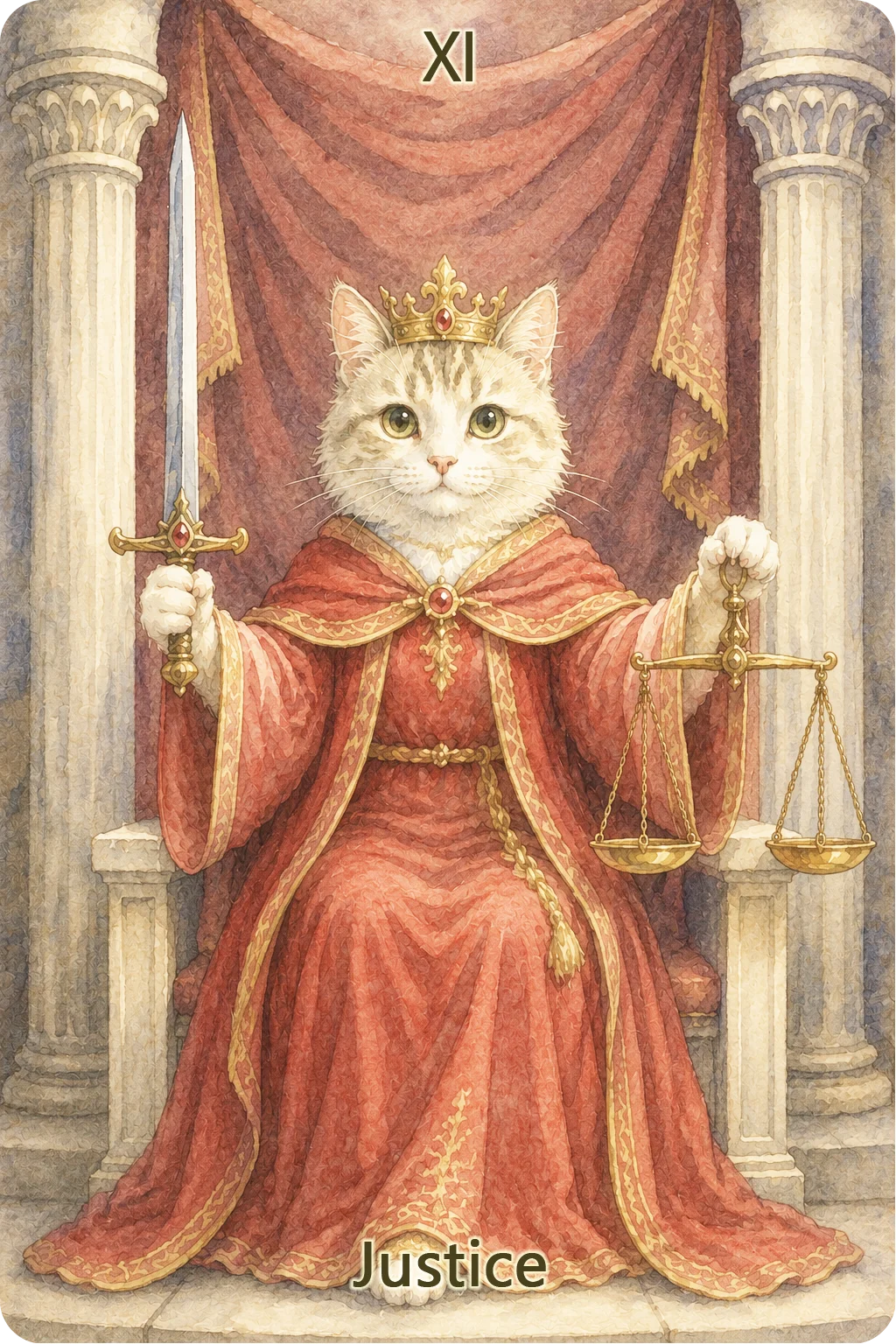
MAJOR ARCANA · XI
Justice
Choose with integrity, and turn that choice into your own strength.
- Fairness
- Judgment
- Responsibility
- Balance
- Cause and effect
- Fair judgment
- Integrity
- Fair evaluation
SYMBOL & STORY
What Justice represents
The Justice card depicts a figure sitting upright on a throne. In the right hand is an upraised sword, and in the left is a set of scales. Rather than being swept away by emotion, the figure looks directly at the facts and seeks to determine what is truly in balance. The scales represent weighing things fairly. This does not mean looking only at what is convenient for yourself, nor does it mean giving priority only to the other person's position. It means comparing both sides. The sword symbolizes the power to cut through ambiguity and ultimately make a decision. In other words, Justice is not a card of thinking forever. It includes examining things carefully, deciding, "This is what I choose," and then accepting the consequences of that choice. The "rightness" addressed by this card is not necessarily about judging someone else and deciding who wins or loses. A major theme is instead facing your own actions and words, and the results that came from them, directly and honestly. What have you chosen up to this point? How have your choices contributed to the situation you are in now? Justice is also a card of making the next choice while acknowledging such cause and effect. In the Rider-Waite-Smith deck, Justice is numbered 11. In many older tarot traditions, Justice was numbered 8 and Strength 11, but Waite exchanged the positions of these two cards. Waite himself did not explain the reason in detail. Later interpretations sometimes say the change was made to align the cards with the astrological and symbolic system used by the Hermetic Order of the Golden Dawn, but it is better not to treat that as a reason Waite explicitly stated himself. Seen within the flow of the Major Arcana, the preceding Wheel of Fortune represents changes in life that cannot be controlled by personal will alone, while Justice asks, "Within those circumstances, what will you choose?" Then, in The Hanged Man, the next card, one accepts a situation that cannot be moved by personal effort alone and changes the point of view itself. Fate moves the situation, you choose your own intention within it, and as a result you learn to see things in a new way. Justice can be read as one part of that story. Justice is not a cold card. But neither is it a card that allows you to move forward while deceiving yourself. It represents the quiet integrity of seeing both feelings and reality, both what is convenient and what is difficult to hear, and then making a choice you can accept as your own.
UPRIGHT & REVERSED
Upright and reversed Justice
Compare the keywords and detailed meanings to see how the symbol changes with orientation.
UPRIGHT
Upright meaning
Choose with integrity, and turn that choice into your own strength.
- Fair judgment
- Integrity
- Responsibility
- Fair evaluation
- A choice you can accept
Justice upright represents looking at a situation fairly and reaching a judgment you can genuinely accept. You do not need to eliminate emotion. Rather, this is a time to acknowledge your feelings honestly while not being ruled by them, and to consider the facts, the other person's position, and the future consequences as well. On an inner level, your values and standards of judgment may be becoming clearer. By asking yourself, "What do I truly want?" and "If I make this choice, will I be able to accept it?", you can begin to see an answer that feels like your own. Rather than being given the correct answer by someone else, this card shows the attitude of choosing for yourself and taking responsibility for that choice. In practical circumstances, evaluation, contracts, discussions, decisions, agreements, and rules may become important. Examples include performance reviews or contract renewals at work, conversations about where a romantic relationship is going, clearing up misunderstandings in relationships, or financial contracts. The flow is toward making something clear instead of leaving it vague. In terms of action, gather information, check the conditions, and decide in a way you can accept. However, Justice is not a card of weighing things forever. Once you have considered what needs to be considered, you eventually need to make a decision, like raising the sword. And it is important to accept the consequences of that choice as part of your own life rather than blaming someone else for them. For example, if you are troubled in love because "I do not know how the other person feels," this card encourages you to judge not only from their words but also from their ordinary attitudes and actions. At work, accumulated effort may lead to recognition, or you may need to check your treatment or contract carefully. In relationships, rather than making one person the villain, reviewing each person's position and the sequence of events can reveal what truly needs to be resolved. Justice upright does not mean that "the correct path will automatically be given to you." It represents a state in which you look at what you truly value and are able to take responsibility for your own choice.
REVERSED
Reversed meaning
Do not become trapped by the idea of being right. Bring the scales of your heart back into balance.
- Biased judgment
- Unfairness
- Excessive harshness
- Avoiding responsibility
- Inability to decide
Justice reversed represents a set of scales that has tipped too far to one side. You may be looking only at what is convenient for you, or, conversely, judging yourself or someone else far more harshly than necessary. Upright Justice compares facts and feelings and then reaches a judgment you can accept. Reversed, that balance breaks down. You may lose your calm because emotion takes over, or you may become so preoccupied with the idea that you "must be correct" that you can no longer make a realistic decision. On an inner level, you may avoid taking responsibility for your choice and feel, "I wish someone else would decide for me." On the other hand, you may believe every failure is entirely your fault and continue blaming yourself. "Everything is their fault" and "Everything is my fault" look opposite, but both are examples of the scales tipping too far in one direction. You may also be unable to decide because you are seeking a perfect answer. Every choice contains some degree of disadvantage or uncertainty, and the more you believe that "the choice must be completely correct," the harder it may become to move at all. In practical circumstances, this card can point to unfair evaluation, misunderstanding, responsibility being shifted onto someone else, unclear contracts, or promises not being kept. If a decision has been made without enough facts, or one person's claim is dominating the situation, it may be necessary to organize the facts again. Waite's reversed meanings also include not only unfairness and bias but excessive severity. For that reason, Justice reversed is not simply a card of "being too lenient." Judging yourself or others too harshly, or becoming bound by rules and ideas of correctness, can also be read as forms of imbalance. Justice reversed is not delivering the verdict, "You are wrong." It offers an opportunity to ask, "Are my scales really weighing this situation fairly right now?" Once you notice the tilt, you can rebalance them as many times as needed.
LOVE
Justice in love
Upright love
When Justice appears upright in a love reading, it becomes important to look at the relationship realistically as well as emotionally. This is a time to consider whether the relationship is sustainable for both of you—not accepting everything simply because you love the person, and not reducing the relationship to conditions alone. With unrequited love, do not draw a conclusion from one word or gesture. Look at the overall pattern of the person's behavior so far. Useful signs include not only whether they say kind things, but whether they make time for you, keep promises, and behave toward you consistently. If you are already in a relationship, this is a time to reconsider whether the partnership is truly equal. Is one of you always the one who endures? Is the burden uneven? Can both of you say what you really want to say? Calm discussion aimed at creating a form of relationship that both people can accept is well supported by this card. For reconciliation, you need to organize the causes that led to the breakup instead of returning only from loneliness or lingering attachment. The purpose is not to decide who was at fault, but to look back so that the same problem is not repeated. From there, you can realistically judge whether a new relationship can be built. If you are looking for a new connection, this card may point toward a sincere and stable relationship. Rather than overwhelming excitement, what matters may be whether your values are compatible, whether the person keeps promises, and whether you can talk things through with them calmly.
Reversed love
When Justice appears reversed in a love reading, you may no longer be viewing the other person or the relationship fairly. Anxiety may lead you to focus only on negative interpretations, or hope may make you pick out only the parts that suit what you want to believe. With unrequited love, do not decide the entire answer from a single reaction. A slow reply does not automatically mean they dislike you, and kindness does not automatically mean they have special feelings for you. Looking at the person's behavior over a period of time will give you a better sense of their actual stance. If you are already in a relationship, you may have begun weighing love itself in terms of exchange: "I do this much for you, so you should give me the same amount back." You do not need to accept a relationship where only one person sacrifices. But fairness in love does not always mean returning everything in exactly equal amounts. People differ in what they are good at and what they can offer. On the other hand, this card can also appear when the relationship truly has become one-sided. If you are always the one who contacts the other person, always the one adjusting your schedule, or always the one enduring, then that burden needs to be reconsidered. For reconciliation, you may be too focused on deciding who was at fault in the past. You may be unable to forgive the other person, or unable to forgive yourself. If reconciliation is being considered, you need a perspective that goes beyond assigning blame and asks, "How could this relationship be changed from here?"
FEELINGS
Justice in their feelings
Upright their feelings
When Justice appears upright as the other person's feelings, they may be considering the relationship with you not only emotionally, but realistically and sincerely. Rather than simply thinking, "I like you, so I want to get closer," they may be asking whether this relationship can be treated with care and shaped into something fair and sustainable for both of you. Even if affection is present, they may not decide quickly how to act. They could be watching whether your words and actions match, whether your values are broadly compatible, and whether they could take responsibility for moving the relationship forward. That caution does not necessarily mean their feelings are weak. Their feelings may show through clear forms of sincerity: keeping promises, behaving consistently, and avoiding giving you expectations they do not intend to fulfill. Even without dramatic displays, a willingness to face important matters properly can suggest that they are taking the relationship seriously. Justice is less a card that measures the intensity of emotion than one that shows how a person chooses to handle it. Instead of counting affectionate words, notice whether they respect you as an individual and try to treat you fairly. That often reveals the quality of the feeling more clearly.
Reversed their feelings
When Justice appears reversed as the other person's feelings, emotion and judgment may not be working together very well. They may care about you yet be unable to decide because they are too concerned with circumstances or position. Or anxiety and assumptions may be making it difficult for them to see the relationship fairly. They could be caught between what they genuinely want and what they believe they are supposed to do. The opinions of people around them, a workplace relationship, past promises, or other responsibilities may make it harder for them to express what they feel honestly. In behavior, this can appear as words and actions not matching, attitudes changing from day to day, or decisions being repeatedly postponed. They may also become so focused on justifying their own position that they fail to fully consider how you feel. There is no need to label them dishonest from this card alone. Their own judgment may simply be unsettled right now. Pay more attention to consistent behavior than to isolated words, and if the ambiguity continues, remember that how long you are willing to wait also matters.
WORK
Justice in work
Upright work
When Justice appears upright in a work reading, effort and results are more likely to receive appropriate evaluation. It can also appear when you need to review your working conditions or the way you work with a calm and objective eye. If you are changing jobs, compare conditions rather than deciding from momentum alone. Salary, working hours, job content, commute, workplace atmosphere, and future prospects can all be placed on the scales. Clarifying what you most want to prioritize will help. Rather than searching for a perfect workplace, it is more important to know what you are willing to accept and what you cannot compromise on. In the workplace, a fair attitude builds trust. Do not judge from rumors or one-sided claims alone; check the facts. If conflict arises, organizing what actually happened rather than emotionally taking one side can make a solution easier to find. When pursuing a goal, accuracy and responsibility lead to results. By following rules and steadily completing what is necessary, outcomes are more likely to follow. If you want your work to be recognized, it is also important to show concretely what you have done. If you face a major decision about work, consider not what is "generally considered the right choice," but whether you can accept responsibility for the result yourself. Justice encourages a decision you can personally stand behind rather than one based only on other people's standards.
Reversed work
When Justice appears reversed in a work reading, dissatisfaction with evaluation or conditions, a sense of unfairness, or errors in judgment may become important themes. You may feel that your efforts are not being evaluated properly, or that responsibility is distributed unevenly. However, it would be too quick to conclude, simply because this card appears, that "the workplace is wrong." Your understanding and someone else's understanding may not match. It is important to organize exactly what you are dissatisfied with and what facts support that feeling. If you are changing jobs, be careful not to overlook important conditions. Looking only at salary or working hours, or rejecting an option because of one single flaw, can both cause you to lose sight of what actually suits you. Seeking a perfect workplace can also make the decision harder. When pursuing a goal, you may be unable to move because you are thinking, "I must not fail" or "I have to do it the correct way." Planning matters, but allowing yourself to make adjustments while moving forward can help the situation begin to change. In workplace relationships, be cautious of a tendency to place all responsibility on one person. At the same time, check whether you yourself are taking on too much. Enduring unfairness in silence is not the same thing as being fair.
MONEY
Justice in money
Upright money
When Justice appears upright in a financial reading, balancing income and expenses is important. Reviewing what you want versus what you need, and the money you use now versus the money you preserve for the future, can lead toward greater stability. In terms of income, the card can indicate receiving fair compensation or proper payment for your work. If there is an issue involving salary, fees, invoices, refunds, or other payments, it is more useful to check the contract and conditions than to think about it only emotionally. With spending, rather than deciding impulsively, consider whether the price and value are in balance. Do not assume that something is a bargain just because it is cheap, or that it must be high quality just because it is expensive. What matters is whether it is something you genuinely need. For investments or major purchases, you need to look at risk as carefully as you look at potential profit. Confirm the contract details, fees, deadlines, and other conditions. Avoid putting money into something on impulse if you do not understand it. For saving, practical rules you can actually maintain are better than excessively harsh restraint. The purpose of managing money is not to make yourself suffer, but to create enough room that you can make choices with greater peace of mind.
Reversed money
When Justice appears reversed in a financial reading, your judgment about money may be leaning too far in one direction. You may prioritize desire too strongly, or anxiety may make you manage money so severely that you become afraid to spend even a single yen. With spending, check whether purchases are increasing under excuses such as "only this once" or "since I have the chance." On the other hand, if you are making daily life inconvenient by refusing even necessary spending, that too is a form of imbalance. In terms of income or compensation, you may feel that you are not receiving fair value for your work. In that case, rather than carrying emotional dissatisfaction indefinitely, review the contract or pay structure and, if necessary, turn that into a specific negotiation. For investments or major purchases, do not believe only the information that supports what you want to hear. Conversely, fear of risk may also make you avoid choices that are actually reasonable. You need to look at both potential return and risk. With Justice reversed, it is also important not to become too attached to the idea of the "correct way to use money." What people need and what they value differ from person to person. Look for a balance that fits your own life and future, rather than someone else's standard.
RELATIONSHIPS
Justice in relationships
Upright relationships
When Justice appears upright in a relationship reading, equality and sincerity become especially important. Rather than a relationship in which one person gives continuously or one person alone endures, it is important to create a distance and balance that both sides can accept. In friendship, basic integrity—keeping promises, listening to the other person, and also expressing your own thoughts—builds trust. Always adapting yourself to the other person is not the only form of kindness. Saying what you think when necessary is also important for maintaining a relationship over time. Within the family, it may become necessary to reconsider roles and burdens. Check whether responsibility has become concentrated on one person simply because "that's what family does." In groups such as the workplace, avoid judging people from rumors or impressions alone. Before deciding that someone is at fault, look at what each person was thinking and what sequence of events led to the current situation. You may see the matter differently once the full context is considered. Justice does not define fairness as treating every person in exactly the same way. Understanding each person's circumstances and finding a reasonable distance and role for each of you can also be a form of fairness.
Reversed relationships
When Justice appears reversed in a relationship reading, some imbalance may have developed in the relationship. One person may be enduring everything, or responsibilities and burdens may have become concentrated on one side. In friendship, you may be exhausted from adapting too much to the other person, or you may be asking them too strongly to accept what you believe is right. Once the relationship becomes a contest over "who is right," it can become difficult to see the connection itself, which was originally what mattered. Within the family, fixed ideas such as "family members should do this" can become a problem. Beliefs such as "because we are family, I should endure it," "a parent should behave this way," or "a child should obey" may be making someone suffer. It may be worth reconsidering whether those ideas of correctness still serve the people involved. At work, be careful not to label someone based only on rumors or impressions. And if you yourself are being treated unfairly, silently enduring it will not change the situation. Organize the facts and communicate them to the appropriate person when necessary. Justice reversed can also ask you to reconsider whether this is someone you should distance yourself from or someone you should talk things through with. Rather than making an extreme decision such as "I have to get along with them" or "I have to cut them off," look for a distance at which you can relate without unreasonable strain.
YES OR NO
Yes or No for Justice
Upright judgment
- Judgment
- Yes
- Reason
- Justice upright shows the ability to examine the conditions fairly and reach a decision you can genuinely accept. If you confirm the facts and responsibilities instead of relying on emotion alone, the card leans toward Yes.
- What could change the answer
- The reading changes if important facts are hidden or if the arrangement places an unfair burden on one side. Yes depends on having enough information and creating conditions that are fair to everyone involved.
Reversed judgment
- Judgment
- Unclear
- Reason
- Reversed Justice shows a situation in which incomplete information, biased thinking, or unclear responsibility makes a fair conclusion difficult. It is too early to decide in black-and-white terms from a passing mood or a single piece of information.
- What could change the answer
- The reading becomes clearer when the facts are confirmed and you can step back from assumptions or personal interests. A neutral outside perspective or objective information may also help restore balance.
MESSAGE FROM THE CARD
Advice from Justice
Upright
Right now, rather than asking someone else to decide the answer for you, it may be time to look for an answer you yourself can accept. Put both feeling and reason on the scales instead of relying on only one. Once you choose, a new result will follow from that choice. Every path will probably have both advantages and difficulties. That is why, rather than searching for an answer that guarantees you will never fail, it is important to choose a path whose consequences you feel you can take responsibility for. And once you have thought things through carefully, you also need the courage to decide. A path you chose honestly and with integrity can become a source of support later, even when you face uncertainty again.
Reversed
The scales in your heart may be leaning a little right now. But once you notice that, the process of rebalancing has already begun. Are you blaming someone too much? Or are you passing an excessively harsh judgment on yourself? Also reconsider whether the idea that "this is the right thing to do" is making either you or someone else suffer. It is difficult to make everything perfectly fair. In life, there are situations where every choice requires letting go of something. That is why, rather than looking for a perfect answer, try to find "the choice I can accept and take responsibility for as I am now." It can help to write down feelings and facts separately. What actually happened? How did you feel about it? And what do you truly want now? Thinking about these separately can gradually bring the tilted scales back toward balance.
READ IT YOUR WAY
Let Justice lead to a reading in your own words.
Use these meanings as a guide or develop language of your own. With a custom deck, you can shape every description and image to fit your practice.