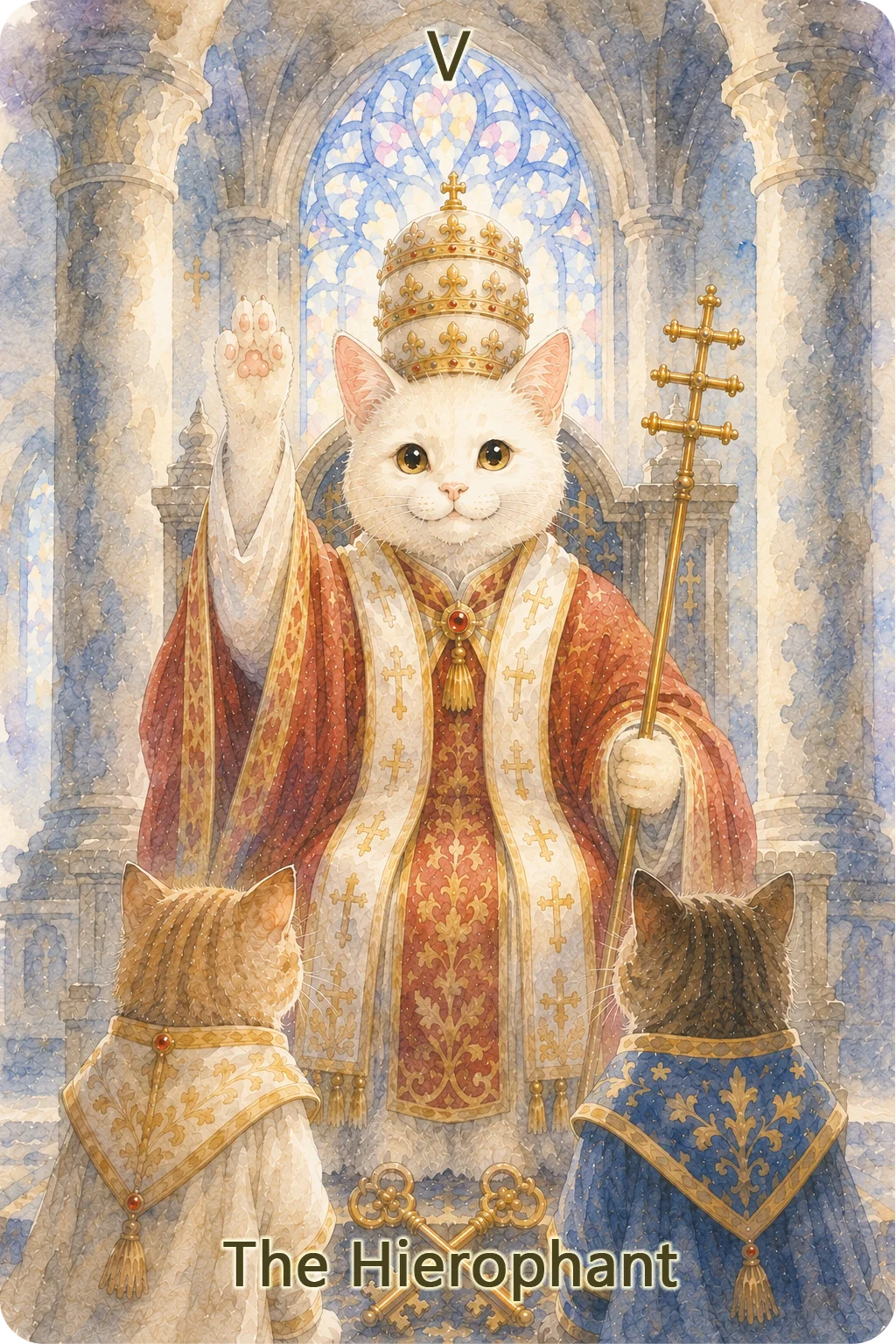
MAJOR ARCANA · V
The Hierophant
Turn trustworthy guidance into a source of strength you can truly call your own.
- Teaching
- Trust
- Tradition
- Values
- Community
- Learning
- Commitment
- Integrity
SYMBOL & STORY
What The Hierophant represents
The Hierophant card depicts a religious figure wearing a triple crown, seated upon a throne, while two people kneel before him. The Hierophant holds a staff topped with a triple cross and raises his other hand in a distinctive gesture. At his feet lie two crossed keys. Arthur Waite describes the Hierophant as the keeper of religious and institutional teachings expressed in the outer world, in contrast with the High Priestess, who symbolizes personal and inward mystery. If the High Priestess is one who quietly knows within herself, the Hierophant can be seen as one who passes down inherited wisdom to others through words, ritual, education, and institutions. Regarding the raised hand gesture, Waite explains it as distinguishing between teachings that are openly revealed and those that remain concealed. In other words, the Hierophant is concerned with more than simple "common sense." His domain also includes things that may only be understood through instruction from another person, as well as meanings that lie beneath the surface of words. In later interpretations, the crossed keys at his feet are also sometimes seen as symbols of an entrance to spiritual understanding and hidden knowledge. The fact that two figures kneel before the Hierophant is also important. This card contains the idea of knowledge being passed "from one who knows to one who is about to learn." It can therefore relate to relationships such as teacher and student, master and apprentice, senior and junior colleague, or expert and client. In divination, the Hierophant can represent social rules, education, qualifications, organizations, marriage, contracts, tradition, and trustworthy advisers. However, the "right path" shown by the Hierophant does not mean blindly following someone else. What matters is learning from the wisdom of those who came before and from the structures of society, while discovering within them what you yourself can genuinely believe in. Waite also includes meanings corresponding to "bondage" and "servitude" alongside "marriage" and "alliance" among the upright meanings of the card. This suggests that the promises and communities represented by the Hierophant also bring responsibilities. Belonging to something can offer protection, but it can also create limits on what you are free to do. Is this still a commitment you are willing to accept? The Hierophant asks you to consider the value found within that commitment.
UPRIGHT & REVERSED
Upright and reversed The Hierophant
Compare the keywords and detailed meanings to see how the symbol changes with orientation.
UPRIGHT
Upright meaning
Turn trustworthy guidance into a source of strength you can truly call your own.
- Learning
- Trust
- Commitment
- Tradition
- Integrity
The Hierophant upright represents receiving trustworthy teaching or advice and using it to build a solid foundation. Rather than searching for every answer entirely on your own, you may discover a path you could not see before by learning from experienced people, specialists, or methods that have been passed down over time. On a mental and spiritual level, this is a time when your values may begin to settle into clearer form. Instead of following something simply because people around you say you should, understanding its meaning for yourself and finding something you can genuinely believe in can make it easier to make decisions without constantly wavering. In practical circumstances, the card may point to schools, companies, qualifications, training, contracts, marriage, or other social institutions and formal procedures. A teacher, supervisor, senior colleague, specialist, or another person you can consult may also play an important role. At the same time, the reassuring structure represented by the Hierophant comes with responsibility. Entering a formal agreement creates promises that must be kept, and belonging to an organization usually means following certain rules. Even if your freedom becomes somewhat narrower, the trust and stability gained in return may still be valuable. In terms of action, it is important to review the basics before trying an unconventional method. Ask honestly when you do not understand something, learn from people with experience, and follow established procedures carefully. Actions that seem plain or unremarkable can sometimes prove to be the surest shortcut. However, there is no need to think, "An important person said it, so it must be right." The Hierophant's deeper lesson begins after you receive a teaching and then make the effort to understand its meaning for yourself.
REVERSED
Reversed meaning
Choose for yourself what to carry forward and what to let go.
- Freedom from convention
- Excessive conformity
- Reexamining values
- An independent path
- Uncertain judgment
The Hierophant reversed represents a time to reconsider your relationship with teachings, society, community, and established rules. However, it is not simply a card of breaking rules. Sometimes leaving an existing framework helps you discover an answer that feels genuinely your own; at other times, you may have prioritized harmony with others so much that you have lost touch with your own thoughts. Among the reversed meanings given by Waite are society, good understanding, and concord, along with meanings corresponding to overkindness and weakness. For that reason, the reversed card can be read in two ways: a gentle side in which people understand one another beyond formal conventions, and another side in which you adjust yourself too much to others and lose yourself in the process. On a mental and spiritual level, you may be beginning to question ideas such as "This is what people normally do" or "This is how things have to be." That is not necessarily a bad thing. This can also be a period in which you move away from answers you were taught and begin forming your own values. On the other hand, the card can appear in the opposite kind of situation as well. Perhaps you are trying too hard to meet the expectations of others, accepting a consultant's words without question, or agreeing to everything because you do not want to be disliked. If so, you need to check whether harmony has turned into excessive conformity. You may also become too strongly opposed to old methods. If your attitude becomes "I do not want anyone to teach me" or "Only my way is right," you may push away advice that could actually help you. For this reason, the Hierophant reversed is not a simple choice between obeying and rebelling. Keep what is worth carrying forward, and reconsider what no longer fits who you are now. This card asks you to make that selection through your own will.
LOVE
The Hierophant in love
Upright love
When the Hierophant appears upright in a love reading, sincerity, trust, commitment, and giving the relationship a clear and dependable form become important themes. Rather than describing a romance driven only by excitement, this card is well suited to relationships in which trust is built gradually over time. If your feelings are one-sided, it may be better to value courtesy and a sense of safety rather than rushing to close the distance. From the other person's point of view, the impression that you are "someone I can trust" or "someone who will face things sincerely" may become an important key to nurturing the relationship. If you are already in a relationship, you may begin thinking about taking it one step deeper. The card is associated with topics that give a relationship a more formal shape, such as being introduced to family, living together, engagement, or marriage. However, giving the relationship a formal structure is not the goal by itself. What matters is whether both of you can understand and willingly accept the commitment involved. For reconciliation, it is important to learn why the relationship broke down rather than returning to the old form simply out of loneliness. If both of you can learn a different way of building the relationship, there may be room to rebuild trust from the beginning. When seeking a new connection, the card can indicate meeting someone through a community or established group, such as the workplace, school, lessons or classes, introductions from friends or family, or a local community gathering.
Reversed love
In love, the Hierophant reversed can represent a relationship that does not fit conventional ideas about romance or marriage. Rather than following social expectations such as "A couple should do this" or "At this age, you should be getting married," the two of you may be searching for a form of relationship that feels comfortable and sincere to you. For that reason, there is no need to immediately interpret the reversed Hierophant as "marriage is impossible" or "this relationship is insincere." Even if your relationship looks different from those around you, it is still a valid form of connection if both people understand it and treat each other honestly. With unrequited feelings, differences in position, age, circumstances, or concern about how others will see the relationship may make it difficult to act naturally. Conversely, letting go of the assumption that "it has to look like this to count as love" may allow the relationship to grow from a more natural distance. If you are in a relationship, this may be a time to think about marriage, family, or the kind of relationship others expect you to have. It is important to separate what the two of you truly want from what people around you are asking of you. For reconciliation, there is no need to treat "going back to how things were" as the correct answer. What matters is whether you can create a new form of relationship that suits both of you. If old patterns can be changed, there may be room to rebuild the connection in a different way.
FEELINGS
The Hierophant in their feelings
Upright their feelings
When the Hierophant appears upright as the other person's feelings, they may feel trust and respect toward you and want to relate to you sincerely. Rather than intense excitement alone, this card often shows a calm kind of affection: "I can talk safely with this person," "our values may be compatible," or "I want to treat this person properly." In romance, it can connect with a desire for a relationship that is serious rather than casual. If the other person values marriage or long-term partnership, they may be thoughtfully considering whether you are someone whose values fit that kind of future. Their feelings may appear less through dramatic gestures and more through courtesy, keeping promises, offering advice, or being comfortable introducing you naturally to people around them. Because they want to be trustworthy, they may prefer to let the relationship develop step by step rather than close the distance all at once. At the same time, the Hierophant also represents social norms and established values. The other person may place too much weight on an idea of how a relationship "should" look. Checking whether their sincerity also fits what you yourself want can help the relationship grow in a healthier way.
Reversed their feelings
When the Hierophant appears reversed as the other person's feelings, they may be attracted to the relationship yet conflicted between what they truly feel and the expectations or frameworks around them. What they think they "should" do may not match what their heart wants. For example, they may suppress their feelings because of differences in position or age, the workplace, or family values. In the opposite direction, they may strongly want freedom from fixed labels and therefore avoid formal promises or commitment. They may also be adapting themselves too much because they do not want you to dislike them, leaving their real feelings unspoken. Even if everything appears calm on the surface, they may be thinking internally, "This is not quite what I really want." With this card, the important question is not only whether affection exists, but what form the other person wants that affection to take. Going against convention is not automatically wrong. If the two of you can talk about rules that genuinely work for both of you, a relationship that once felt restrictive may find a new shape.
WORK
The Hierophant in work
Upright work
In work matters, following the fundamentals, learning from experienced people, and building trust within an organization become especially important. Rather than relying completely on your own original method, you are more likely to achieve results by first learning established practices and then adapting them. You may receive helpful advice from a supervisor, senior colleague, or specialist. Asking questions when you do not understand something is not a weakness. The willingness to learn correctly can itself earn the trust of the people around you. This is also a favorable card for earning qualifications, taking training, studying, and gaining specialized knowledge. When pursuing a goal, building up the basics step by step may be a faster route than trying to leap directly to success. In a job change, you may have a connection with workplaces that have strong training systems, long-established organizations, or jobs where specialized knowledge can be put to use. At the same time, entering an organization may place some limits on your freedom. Consider how much you value stability and growth, and how much you want the freedom to work in your own way. In workplace relationships, courtesy and keeping promises matter. This does not mean obeying every word of a superior without question. It is important to respect the accumulated wisdom of the organization while still thinking for yourself about why its practices exist.
Reversed work
In work matters, you may be questioning old practices within your company or industry. Systems that continue only because "we have always done it this way" may begin to feel uncomfortable, and you may want to try a new approach. This is not necessarily a bad sign. Reviewing unnecessary customs or finding a way of working that suits you better can lead to real improvement. In a job change, the card can also suggest choosing an environment that fits you rather than chasing titles or social prestige. However, it is also important not to reject established methods out of simple resistance. Fundamentals often exist because they have proved useful over time. If your own method is not working, returning to an experienced person or a manual and relearning the basics may solve the problem. Conversely, you may be exhausted because you are adapting too much to the people around you. Perhaps you obey every opinion from your supervisor, cannot refuse requests, or take responsibility far beyond your own job. In that case, it may be time to reconsider the boundary between cooperation and self-sacrifice. In evaluations and workplace relationships as well, do not force yourself to be "the good person" all the time. Cooperating with others while appropriately expressing your own views and limits helps create healthier relationships that can be sustained over the long term.
MONEY
The Hierophant in money
Upright money
In financial matters, it is more important to develop sound knowledge and manage money steadily than to chase spectacular profits. If there is something you do not understand about money, learning from reliable professionals or official sources can make it easier to judge what to do. Regarding income, qualifications, specialized knowledge, and experience you have built over time may eventually translate into earnings. Even if they do not produce a large result immediately, credibility and skill can become valuable later. For spending, expenses related to education, qualifications, and tools needed for work can be viewed positively when they contribute to your growth. However, it is worth checking whether you are spending money merely to maintain appearances or meet social expectations. With investments or major contracts, do not rely on your own assumptions alone. Make sure you understand how the arrangement works, and consider consulting a specialist. Even then, trusting someone is not the same as handing all responsibility for the decision over to them. For saving and household budgeting, creating rules that suit you can help produce greater stability. A system that is not flashy but can be maintained for a long time will gradually bring a stronger sense of security around money.
Reversed money
In financial matters, this is a time to reconsider common assumptions about money and values you have learned from other people. Ask whether standards such as "You should own this kind of thing" or "By this age, you should have saved this much" truly fit the life you are living now. There is nothing wrong with changing to a method that suits you better. If conventional budgeting methods never last, creating a system adapted to your own lifestyle may actually bring greater stability. At the same time, be careful not to trust someone too completely. It is useful to refer to professionals, acquaintances, or information on the internet, but avoid handing over your judgment with the thought, "If this person says it, it must be right." Your spending may also increase if you place too much priority on social relationships. Check whether kindness is becoming a burden on you through things such as being unable to refuse requests, shopping simply to fit in with others, or overextending yourself on gifts. For investments and major purchases, you need both the flexibility to question conventional wisdom and the caution to confirm basic knowledge. Do not follow something simply because it is conventional, and do not reject it simply because it is conventional. Understand it for yourself and then make your decision.
RELATIONSHIPS
The Hierophant in relationships
Upright relationships
In relationships, trust, courtesy, advice, and mutual support are central themes. Rather than carrying a problem alone, talking with someone you trust may help you organize both your feelings and the situation itself. In friendships, relationships in which you can share not only enjoyable moments but also serious conversations and worries may deepen. You may become the person someone else turns to for advice, or you may be the one who receives valuable guidance. Within family relationships, long-standing values and customs may come into play. You may find meaning in inheriting them, or you may sometimes experience them as restrictive. Rather than either obeying everything or rejecting everything, it is important to choose which parts you personally want to preserve. In the workplace or another group, understanding the rules and roles of that environment can help relationships proceed more smoothly. If there is conflict, consulting a trustworthy third party or mediator may reveal a way to begin a constructive conversation. The Hierophant teaches that deep trust is not created by a single event. It grows through small acts of sincerity repeated day after day.
Reversed relationships
In relationships, balancing "adapting to others" with "remaining yourself" becomes important. The reversed Hierophant can describe understanding another person beyond differences in status or formal convention, but it can also describe adjusting yourself too much to the other person. In friendships, you may be able to create an equal relationship without worrying about age, position, or other social distinctions. Removing assumptions about "how friends are supposed to interact" can sometimes make the relationship feel more natural. On the other hand, if you accept every request whenever someone seeks your help, or swallow your feelings because you do not want to hurt the other person, you should be careful. Kindness matters, but it is not the same as continually sacrificing yourself. Within the family, it may be necessary to step back slightly from values or roles that have been passed down for a long time. This does not mean rejecting your family. Creating a boundary such as "I will carry this part forward, but from here I will decide for myself" can also be a form of growth. In the workplace or another group, you may feel uncomfortable with unspoken rules. Before rebelling against them, first find out why those rules exist. If they still seem unnecessary after you understand their purpose, you can calmly suggest another approach. Having ideas that differ from other people's is not the same as being isolated from them. One mature expression of the reversed Hierophant is finding relationships in which differences can remain while mutual understanding is still possible.
YES OR NO
Yes or No for The Hierophant
Upright judgment
- Judgment
- Yes
- Reason
- The Hierophant upright represents reliable methods, sound advice, and socially stable structures. Rather than looking for an unconventional shortcut, following the fundamentals makes a good outcome more likely, so this card leans toward Yes.
- What could change the answer
- The condition is making use of established rules or expert guidance while still confirming that they fit your actual situation. If you preserve the form but lose sight of the underlying purpose, the reading weakens.
Reversed judgment
- Judgment
- It depends
- Reason
- The Hierophant reversed points to a mismatch between conventional methods and the actual situation, or between social expectations and personal truth. This is not necessarily a situation where following the standard answer is best, so the result can shift toward either Yes or No depending on the question.
- What could change the answer
- The reading becomes clearer when you ask what is genuinely necessary for the people involved rather than only what is considered normal. Reconsidering an outdated rule may open the way forward, while neglecting essential fundamentals may mean the situation needs rebuilding first.
MESSAGE FROM THE CARD
Advice from The Hierophant
Upright
You do not have to think through everything entirely by yourself. The experience of someone who has walked a little farther down the road than you, or wisdom that has been passed down over a long period of time, may contain something that can help you now. Begin by listening. Then, rather than accepting the teaching exactly as it is, ask yourself, "Why is this so?" What you can truly understand and agree with will eventually stop being a borrowed answer and become part of your own values. Also, deciding that something is important may bring a certain amount of restriction or responsibility. Yet if it is a promise you genuinely want to keep, its weight may become not only a restraint but also a foundation for your life.
Reversed
Something you were taught was "right" may no longer fit who you are now. Realizing that is neither a mistake nor an act of rebellion. The time may have come to take what you have learned into your own hands and ask whether you truly need it. However, you do not need to throw everything away. Old wisdom can still contain things that remain useful today. Someone else's advice may also offer a perspective you would not have discovered alone. What matters is neither obeying everything nor rejecting everything. Choose for yourself what you will accept, and quietly let go of what no longer fits. And if you have been making yourself smaller in order to preserve harmony with other people, listen a little more carefully to your own voice as well. A genuinely healthy relationship exists where you can respect the other person without ceasing to respect yourself.
READ IT YOUR WAY
Let The Hierophant lead to a reading in your own words.
Use these meanings as a guide or develop language of your own. With a custom deck, you can shape every description and image to fit your practice.