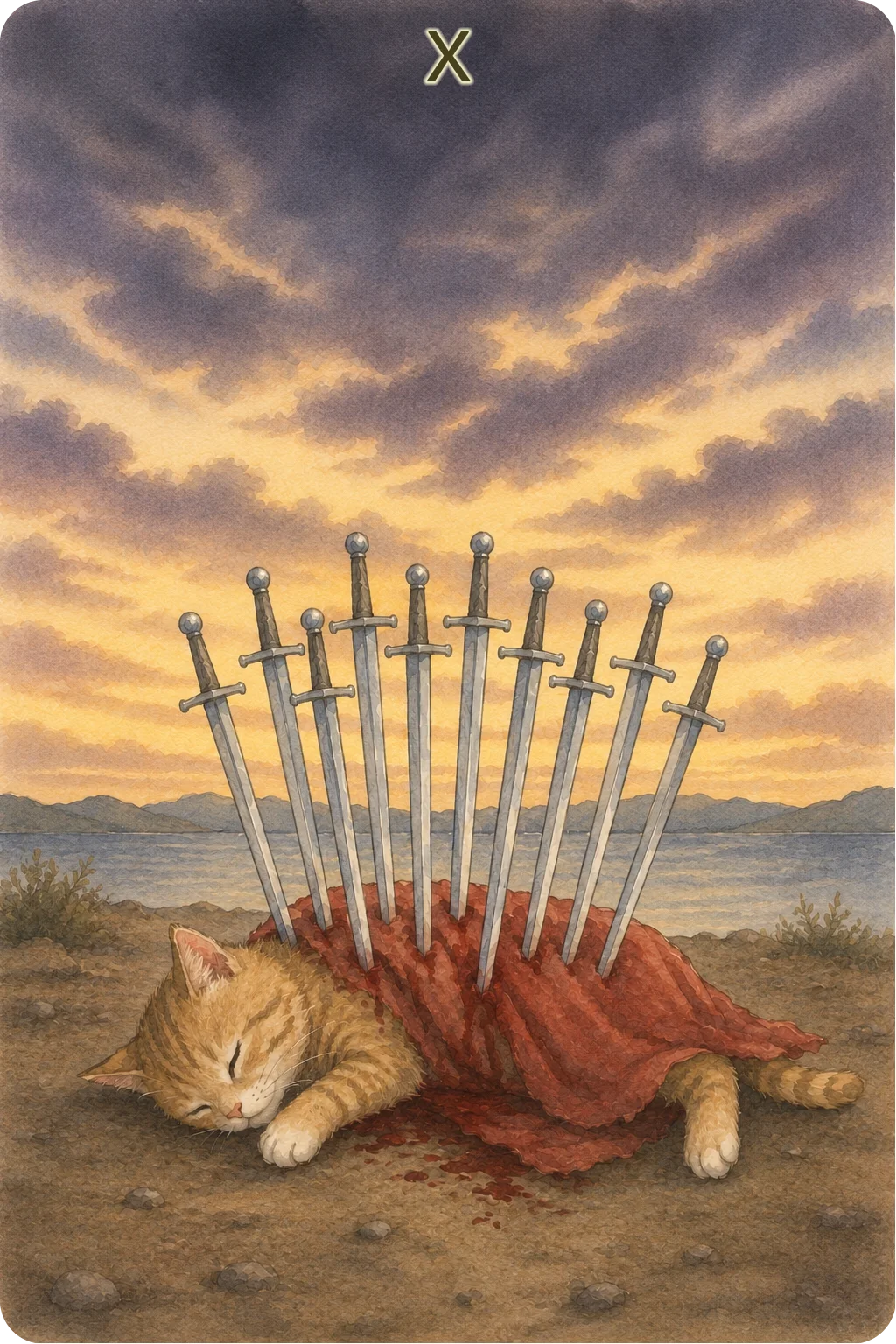
MINOR ARCANA · 10
Ten of Swords
Accepting the ending becomes the first step toward what comes next.
- Ending, limit, defeat, acceptance, turning point
- Ending, limit, hitting bottom, acceptance, before a new beginning
- Recovery, rebuilding, unfinished ending, attachment, recovery process
SYMBOL & STORY
What Ten of Swords represents
The Ten of Swords represents a situation that has progressed to its limit and reached the point of, "This cannot continue any longer." In the Rider-Waite-Smith deck, a person lies on the ground with ten swords piercing their back. It is one of the most shocking images in the Minor Arcana, but the card does not represent only misfortune or ruin. Swords are the suit associated with human mental activity such as thought, words, judgment, and conflict. In this card, all ten swords have been used, showing a state in which thinking, enduring, and struggling have been carried to the extreme. Something has reached the point where it must end before you can move forward. Arthur Waite gave this card severe meanings such as pain, ruin, grief, and finality. At the same time, a yellow sky appears on the distant horizon beyond the darkness. The interpretation of this light as "dawn" or "a sign of recovery after the worst has passed" became widely used in later tarot traditions. Waite himself did not explicitly explain the light as a symbol of hope, but the image as a whole can still be read as suggesting that another period of time will begin after this ending. In the latter half of the Swords suit, suffering deepens step by step. The Eight of Swords shows the mental restriction of feeling unable to move. In the Nine of Swords, anxiety and regret expand inside the mind. Then, in the Ten of Swords, that painful flow itself reaches its limit and finally comes to an end. In a sense, because things have reached the point where "they cannot get any worse in the same way," the card also contains the possibility of moving into a new phase. There are similarities with Death in the Major Arcana. Both deal with endings and change, but Death more broadly symbolizes natural transformation and major turning points in life, while the Ten of Swords places stronger emphasis on "an ending brought about by reaching the limit" after mental pain and conflict have accumulated. When this card appears, rather than trying to force what has ended back into its former shape, it is important to acknowledge, "This is as far as it could go." Admitting defeat, failure, or limitation is not necessarily the same as giving up. Letting go of what you no longer need to carry can become the turning point that allows you to move into the next stage.
UPRIGHT & REVERSED
Upright and reversed Ten of Swords
Compare the keywords and detailed meanings to see how the symbol changes with orientation.
UPRIGHT
Upright meaning
Accepting the ending becomes the first step toward what comes next.
- Ending, limit, hitting bottom, acceptance, before a new beginning
The Ten of Swords upright represents a situation reaching its limit and coming to an end. Long-standing hardship, endurance, conflict, or overthinking may have reached a peak, creating the feeling, "I cannot continue like this any longer." Mentally, the card shows a state of complete exhaustion. You may think about the same thing repeatedly without finding an answer, replay unpleasant events again and again, or be unable to get someone's words out of your mind. The mental burden associated with Swords may have accumulated to the point where what is needed now is not more effort, but recognition that you have reached your limit. In practical circumstances, a relationship, job, plan, role, way of thinking, or something else that has continued for a long time may reach a conclusion. It may not be the ending you wanted. However, by bringing something unsustainable to an end, new options may begin to appear. In terms of action, rather than becoming frantic with the thought, "I have to get things back to the way they were," it is important first to accept what has ended. Admitting defeat, recognizing failure, stopping a method that no longer works, or leaving a relationship that continues to hurt you can all become steps toward the next stage. For example, if you have experienced a major failure at work, this card does not necessarily mean that "everything is over." It may mean that the particular method or plan had reached its limit. In love, the relationship itself may end, but the card can also appear as, "We cannot continue relating to each other in the same way we have until now." It is all right if you cannot immediately imagine a bright future. The Ten of Swords is not a card that forces suffering into a positive story. But neither does the painful flow continue forever. Because one chapter has reached its end, space is created for another story to begin.
REVERSED
Reversed meaning
As you let go of the past, it is time to rise again little by little.
- Recovery, rebuilding, unfinished ending, attachment, recovery process
The Ten of Swords reversed can be read in two major directions. One is "having passed through the worst and gradually beginning to recover." The other is "being unable to bring an ending to the suffering that should already have ended, and prolonging it instead." In modern tarot interpretation, the reversed figure is sometimes imagined as beginning to rise again after lying face down in the upright card. From that image come common readings such as "recovery after hitting bottom," "starting over," and, "signs of emerging from hardship." At the same time, the reversed meanings recorded by Waite include profit, success, favor, and advantage, suggesting temporary improvement. However, there is also an implication that such improvement may not necessarily last. For that reason, rather than treating the reversed position simply as "better than upright," it is more useful to read it as the stage when signs of improvement begin to appear within a difficult situation. Mentally, energy may be starting to return little by little. Perhaps your heart feels slightly lighter than yesterday, or you no longer think about unpleasant things as constantly as before. Small signs of recovery may already have begun. Conversely, you may be replaying an event that is already over and continuing to blame yourself with thoughts such as, "If only I had done that differently." By repeatedly reliving a finished problem inside your mind, you can pull yourself back into the painful state again. In practical circumstances, the peak of the problem may have passed while cleanup and reorganization still remain. Trouble at work may be settling, a wound from a breakup may be healing little by little, or you may be beginning to rebuild after financial difficulty. The card can appear as "being in the middle of recovery." On the other hand, it can also appear as being unable to leave a job even though you know you have reached your limit, repeatedly returning to a relationship that has already ended, or repeating the same problem—situations where "something that needs to end has not been allowed to end." When the Ten of Swords appears reversed, ask yourself, "Am I moving toward recovery now, or am I prolonging an ending that has already come?" That question often makes the card's message easier to understand.
LOVE
Ten of Swords in love
Upright love
When the Ten of Swords appears upright in a love reading, it suggests that the relationship as it has existed until now, or the way you have been carrying your feelings, is approaching its limit. It can appear as separation or heartbreak, but it does not always mean "the end of love itself." It can also be read as a need to end the current form of the relationship. With unrequited love, you may be exhausted from continuing to think about the other person or hurt by the gap between expectation and reality. If you keep repeatedly analyzing their reactions and suffering because of it, this may be a time to organize your feelings. Giving up is not the only possible answer, but it is important not to continue a form of waiting that keeps hurting you. If you are already in a relationship, accumulated endurance, misunderstandings, or hurtful words may have brought the relationship close to its limit. The card can also appear after a major argument or disappointment. However, whether what ends is "the relationship itself" or "the way the two of you have related until now" depends on the surrounding cards and the actual situation. If the relationship continues, you will likely need to create a different way of relating rather than trying to restore everything exactly as it was. For reconciliation, trying to restore the relationship while leaving the pain of the past and the cause of the breakup untouched may lead to the same problems repeating. More important than the possibility of reconciliation itself is understanding why the earlier relationship ended. The key is whether you can rebuild the connection as something different rather than simply reviving the old one. If you are looking for a new relationship, wounds and disappointment from the past may still remain in your heart. Rather than forcing yourself to search for a new romance immediately, taking time to sort through your feelings can create the emotional room needed to receive a new connection.
Reversed love
When the Ten of Swords appears reversed in a love reading, it represents either gradually recovering from a painful relationship or still being unable to let go of a connection that has already ended. With unrequited love, attachment to a love that has not been returned may be weakening little by little, and you may be becoming less controlled by the other person's reactions. On the other hand, even while you know, "It may be better to let this go," you may keep repeating the same expectations and continue suffering. If you are already in a relationship, this can represent trying to rebuild after a major argument or painful event. Rather than pretending the past never happened, reviewing what made the relationship so difficult can create the possibility of building something different from before. However, if the same problem keeps repeating, caution is needed. Ask yourself whether you are returning to the same suffering again and again while telling yourself, "This time things will change." For reconciliation, the card shows a state of wavering between attachment to the past and recovery. Reconciliation itself is not necessarily negative, but simply "returning to the same relationship as before" may lead to the same problems repeating. If you rebuild the connection, you will need different rules, boundaries, or ways of relating than before. With new encounters, there may be signs that you are gradually recovering from a past heartbreak and becoming able to turn your attention toward someone new. However, rushing into the next romance only to fill loneliness can leave your feelings behind.
FEELINGS
Ten of Swords in their feelings
Upright their feelings
When the Ten of Swords appears upright as the other person's feelings, they may feel mentally exhausted by the relationship or by everything they have been thinking about it. They may be reaching a point of, “I cannot think about this anymore,” or, “I need to let something end so I can rest.” This does not necessarily mean all affection has disappeared. Sometimes the situation or the mental burden has reached its limit more than the feeling itself. After thinking about the same issue repeatedly, they may simply have no energy left to keep processing it. After a breakup or major conflict, they may be trying to accept what happened as a dividing line. Even when the ending hurts, they may feel that something must be acknowledged as over before they can move forward. At the same time, the Ten of Swords also contains the idea of bottoming out. Once the worst of a cycle has been reached, the next phase can gradually begin. Rather than trying to force the relationship back into its old form, it may be more important to acknowledge what has reached its limit. From there, you can see whether a genuinely different way of relating still has room to emerge.
Reversed their feelings
When the Ten of Swords appears reversed as the other person's feelings, they may be beginning to come out of a very heavy period. Regarding you, they may still carry pain or exhaustion while starting to think about how life or the relationship could be rebuilt from here. If there has been a major conflict or breakup, they may not have completely released what happened. Even so, they may be less overwhelmed by it than before and becoming able to see the situation more calmly. The reversed card can also show someone unable to accept an ending and repeatedly returning to the same pain. Intellectually they may know something is over while emotionally they are not yet ready to let go. For reconciliation, there may be room to think about the relationship again. However, simply restoring the old form is not enough. Something must change so the same problem is not repeated. The key is whether they are genuinely recovering or simply remaining attached to the ending. If their life and behavior are beginning to show constructive change, it is easier to read the card toward healing.
WORK
Ten of Swords in work
Upright work
When the Ten of Swords appears upright in a work reading, it suggests that the way you have been working or a plan you have continued until now may have reached its limit. Overwork, concentrated responsibility, interpersonal stress, or effort that does not bring results may have been accumulating. Regarding your current job, rather than thinking, "If I just work harder, I can somehow get through this," it may be necessary to review what is draining you. Reducing your workload, asking for a change in responsibilities, or consulting the people around you may be part of finding a different method. For a job change, you may be feeling a strong sense of limitation in your current environment. The card does not necessarily mean you must resign immediately, but it is worth asking whether continuing the same situation by force is truly necessary. Beginning practical preparations—such as checking living expenses or researching other jobs—can increase your options. Regarding goal achievement, a plan may not proceed as hoped and may need to be reset. Rather than continuing a method that has already failed, it may be better to bring it to an end once and consider another way. In evaluation and workplace relationships, you may experience a harsh result or disappointment. However, such experiences can also make problems that were previously difficult to see become clear. Understanding "what you should no longer continue" can become valuable material for thinking about how you want to work next.
Reversed work
When the Ten of Swords appears reversed in a work reading, it represents signs that you are gradually recovering from a difficult situation and beginning to rebuild. If you have experienced a major failure, overwork, or exhaustion from workplace relationships, the worst point may be passing. You may begin to regain the ability to think, "Maybe I can try a little longer," or, "Perhaps there is another way." For a job change, this is the stage of beginning to think about the next path while still feeling the limit of your current workplace. Concrete preparation—such as researching job openings, checking necessary qualifications, and calculating living expenses—can make it easier to change the situation. On the other hand, this card can also appear when you keep forcing yourself to continue with thoughts such as, "Just a little longer," even though you already feel you have reached your limit. It does not automatically mean you should resign, but it does mean you need to check your burden objectively. Regarding goal achievement, you may have a chance to try again after a failed plan. However, rather than repeating exactly the same method as before, it is important to analyze why it failed and change your approach. In the workplace environment, a major problem may be calming down while fatigue or distrust still remains. Rather than trying to restore everything immediately, accumulating small improvements can support a more realistic recovery.
MONEY
Ten of Swords in money
Upright money
When the Ten of Swords appears upright in a financial reading, anxiety or burden around money may be approaching a limit. Large expenses, reduced income, overlapping payments, failed investments, or disappointing purchases may have left you mentally exhausted. This card does not mean that your financial luck will remain bad forever. Rather, it indicates that the problem should no longer be postponed and that the situation needs to be organized clearly. With income and expenses, it is important to check the flow of money each month in concrete terms. Cancel services you no longer use, review fixed costs, reorganize payment methods, and rebuild things from small, practical areas. With investments, avoid making a large risky move simply because you want to recover a loss. Rather than continuing a method that has failed, pause and look back at why you made the original decision. With shopping, be careful of impulsive spending used to distract yourself from stress. Right now, ask not only, "Do I want this?" but also, "Do I genuinely need this in my present situation?" With savings, even if the amount has fallen sharply, that is not the end. By understanding where you are now and beginning to build again from even a small amount, you can gradually restore a state in which you feel more secure.
Reversed money
When the Ten of Swords appears reversed in a financial reading, it suggests that rebuilding may be beginning after a difficult financial situation. If expenses have continued for some time, spending may gradually settle down, or you may begin to see a clearer outlook for income. Rather than every major problem suddenly disappearing, this is the stage where you begin finding ways to prevent the situation from getting worse. In terms of income, there may be small signs of recovery through a new job, additional income, or improved conditions. However, do not become too reassured by a temporary improvement alone; it is also important to check whether the change can lead to long-term stability. With spending, you may be able to review wasteful habits or unsustainable patterns. If stress-related shopping has continued, organizing the source of that stress may also help your spending calm down. With investments, be careful of becoming impatient to recover losses. Even if you see a temporary profit, it may be too early to decide that the entire trend has completely changed. Prioritize rules and risk management over emotion. With savings, this can be a time to start again even from a small amount. Rather than blaming yourself for past mistakes, rebuild within the range you can manage now. However, if you are postponing problems such as debt or payments with the thought, "Somehow it will work out eventually," you may be prolonging something that should already be resolved. Confirm the actual situation, and if necessary, consulting people around you or a professional can itself become part of the rebuilding process.
RELATIONSHIPS
Ten of Swords in relationships
Upright relationships
When the Ten of Swords appears upright in a relationship reading, it represents a relationship in which you have endured for a long time, or hurtful interactions that have finally reached their limit. In friendship, you may be exhausted from constantly adjusting yourself to the other person, or you may have been deeply hurt by words. You do not necessarily need to end the relationship completely, but continuing at exactly the same distance as before may be difficult. Within the family, dissatisfaction or problems that have existed for many years may come to the surface. Rather than trying to solve everything, it is important to consider, "How much of this is actually my responsibility?" and, "What do I no longer need to carry?" At work, the card can indicate mental strain caused by gossip, misunderstanding, blame being shifted onto you, or words that wound. The belief that, "If I just endure it, everything will be fine," may itself have reached its limit. This card is not demanding that you cut every connection. At the same time, you do not need to continue a state in which you are constantly being hurt. Taking some distance, speaking with someone you trust, or creating clearer boundaries may all be necessary ways of protecting yourself.
Reversed relationships
When the Ten of Swords appears reversed in a relationship reading, it represents either gradually recovering from a wounded relationship or still carrying a problem that has already ended. In friendship, you may be becoming able to sort through past misunderstandings or hurtful words little by little. You may think about the other person less often than before, or become able to maintain the distance you need. On the other hand, you may continue replaying an argument or event that is already over and thinking, "I still can't forgive that." You do not have to force forgiveness, but it is worth checking whether the past event is still controlling your present. Within the family, you may begin to see a way to create distance from a problem that has continued for years. Rather than trying to solve everything, it is important to decide what you can realistically take responsibility for. In workplace relationships, the atmosphere may gradually settle after a major problem. However, even if things appear to return to normal on the surface, it may take time for trust to fully recover. For someone who has been isolated, this card can also become a sign of reconnecting with people. Rather than trying to return to a large group immediately, begin with small exchanges, such as a short conversation with someone around whom you feel safe.
YES OR NO
Yes or No for Ten of Swords
Upright judgment
- Judgment
- No
- Reason
- The Ten of Swords shows the current path reaching its limit and one cycle coming to an end. Continuing the same method or situation is unlikely to produce the desired result, so the answer is No.
- What could change the answer
- The answer may change only after what needs to end is accepted and a genuinely new method or relationship begins. Trying to return to the old pattern strengthens the No.
Reversed judgment
- Judgment
- Not yet
- Reason
- The Ten of Swords reversed suggests that the worst may be passing and recovery is beginning, but pain and unresolved issues are still present. Possibility is returning, yet this is not the stage to demand a completed answer.
- What could change the answer
- The reading can move toward Yes once the old ending is accepted and a restart becomes possible without repeating the same problem. If attachment to what has already ended continues, it moves back toward No.
MESSAGE FROM THE CARD
Advice from Ten of Swords
Upright
Among the things you have continued until now, there may be something that you are allowed to bring to an end. Admitting failure, defeat, or limitation is not weakness. If you force something that has already ended to return to its old form, you may only exhaust yourself further. Instead of asking, "How can I make everything go back to the way it was?", try asking, "What do I no longer need to carry from here?" An ending does not immediately become hope. Sadness and frustration may remain. Even so, because one story has ended, there is now empty space in which another story can eventually be written. You do not need to rush to find the next answer. First, acknowledge what has ended and allow yourself to rest a little. When your strength returns, you will be able to make a different choice next time.
Reversed
You may now be beginning to move little by little away from a place that was painful. Even if the wound still hurts and even if you cannot feel completely well right away, that does not mean you are failing to move forward. Feeling slightly better than yesterday, or forgetting for a while something that used to occupy your thoughts constantly—changes like these are also part of recovery. There is just one thing worth checking. Are you repeatedly replaying inside your mind something that has already ended? Continuing to think, "If only I had done that," or, "If only I could go back once more," can pull you back into the past. You do not have to forget the past. Failure and pain can become experiences that help you make different choices in the future. It is all right for something that has ended to remain ended. Little by little, rise from that place and begin turning your attention toward what you want to choose from here.
READ IT YOUR WAY
Let Ten of Swords lead to a reading in your own words.
Use these meanings as a guide or develop language of your own. With a custom deck, you can shape every description and image to fit your practice.