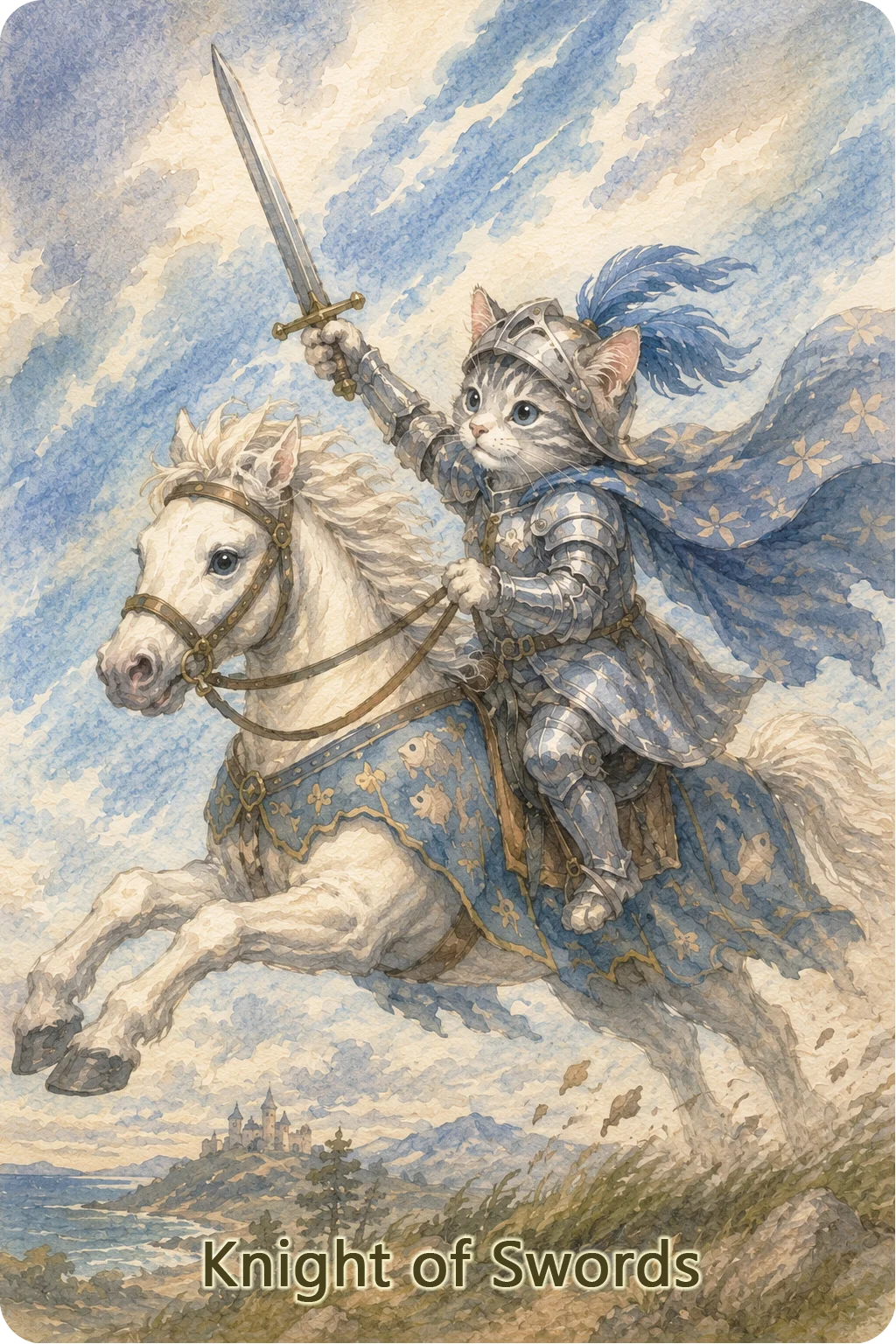
COURT CARD · KNIGHT
Knight of Swords
Choose the path you believe in, cut through hesitation, and move forward.
- Charge, decision, intellect, conviction, words
- Swift action, decisiveness, breakthrough power, strong conviction, initiative
- Impatience, recklessness, running out of control, inadequate preparation, wasted energy
SYMBOL & STORY
What Knight of Swords represents
The Knight of Swords is depicted as a young knight riding through powerful winds with a sword raised high. Fast-moving clouds fill the sky, and the trees are bent strongly by the wind. Rather than calmly heading toward a destination, the scene looks as though the knight is charging forward with enough force to stir up the very air around him. Swords symbolize thought, words, judgment, information, and reason. The Knight is a figure who directs that power outward into the world. For that reason, the Knight of Swords represents "the moment when thoughts and convictions turn directly into action." Arthur Waite associated this card not only with courage, skill, ability, and swift action, but also with hostility, anger, conflict, resistance, and destruction. In other words, this is not simply "a person with strong initiative." It is a card filled with enough mental force to charge forward without hesitation toward what the person believes to be right. That strength can be a powerful weapon when breaking through a difficult situation. However, when you become too certain of your own thinking, you may move ahead without fully checking the feelings of the people around you or the circumstances you are in. A sharp sword can cut open a path, but depending on how it is handled, it can also wound someone. The difference becomes clearer when compared with the Knight of Wands. If the Knight of Wands is someone who runs because "I want to do this," the Knight of Swords is someone who runs because "I believe this is what should be done." More than passion, it is thought, conviction, a sense of justice, and a conclusion that drive him forward. Likewise, if the Ace of Swords represents the beginning of truth or a new idea, the Knight of Swords can be seen as the one who takes that sword in hand and actually rides out into the world. By the time we reach the King of Swords, mature judgment and objectivity have become stronger than momentum. The Knight is still at a stage where, rather than questioning whether his own sense of rightness may be incomplete, he is more likely to become absorbed in carrying it out. When this card appears, events may begin moving rapidly. Sudden contact may arrive, a discussion may begin, a decision may be demanded, or a matter that had been stalled for a long time may suddenly move forward all at once. However, having momentum and moving in the right direction are not the same thing. The Knight of Swords is not a card that simply says, "Go." It asks, "What do you believe is right, and how far are you prepared to run for it?"
UPRIGHT & REVERSED
Upright and reversed Knight of Swords
Compare the keywords and detailed meanings to see how the symbol changes with orientation.
UPRIGHT
Upright meaning
Choose the path you believe in, cut through hesitation, and move forward.
- Swift action, decisiveness, breakthrough power, strong conviction, initiative
The Knight of Swords upright represents the power to cut through hesitation and act quickly toward a goal. Rather than only thinking about something, this is a time when you can judge, "Now is the time to act," and actually take the first step. Mentally, your thinking becomes quicker and your own ideas are easier to clarify. You may begin to see what the real problem is and what needs to be done, making you want to bring even ambiguous situations to a conclusion. Your courage to put your own opinion into words is also likely to increase. In practical circumstances, developments may suddenly accelerate. A matter that had been on hold may suddenly begin moving, contact may arrive, a discussion may start, or you may be asked to make a decision. It is a card that often brings a strong wind into a previously quiet situation. In terms of action, rather than continuing to stand still in uncertainty, you may need to make a certain level of commitment and move ahead. However, momentum itself does not guarantee that the direction is correct. Before you act, it is important to confirm what you are acting for. Even upright, the Knight of Swords has an aggressive side. The stronger your sense of justice becomes, the more you may want to point out another person's mistakes or force your own view through. Even when what you are saying is correct, it can be useful to check whether defeating the other person has begun to become the real purpose. For example, if the question is, "Should I contact them boldly?", the card gives support to taking action itself. However, rather than simply throwing all of your feelings at the other person, it is important to choose words they can actually receive. If the question is, "Should I begin looking for another job?", the card can be read as a time to move into concrete action such as researching, applying, or speaking with someone. However, rather than quitting your current job on momentum alone, you will feel safer if you gather the necessary information before making the final decision. If the question is, "I want to solve this problem," then rather than continuing to tolerate an unclear situation, organizing the issue and initiating the necessary discussion or action can become the breakthrough. The Knight of Swords has a powerful ability to turn thought into reality. Depending on where that power is directed, it can become a force that breaks through stagnation—or a cause of conflict.
REVERSED
Reversed meaning
Do not rush forward blindly; check the direction of your words and actions.
- Impatience, recklessness, running out of control, inadequate preparation, wasted energy
The Knight of Swords reversed represents a state in which the speed, intelligence, and initiative of the upright card are no longer being controlled well. Rushing too much, allowing your thinking to run ahead of reality, using strong words, or acting before you are properly prepared can all cause momentum to spin its wheels. Arthur Waite associated the reversed position with meanings such as recklessness, incapacity, and extravagance. In modern readings, these ideas can be developed into interpretations such as, "There is plenty of drive, but no clear direction," "ability or preparation has not caught up with the action," or, "energy is being wasted on unnecessary conflict or argument." If the upright knight is imagined charging toward a destination with sword raised, then reversed he may be pictured swinging the sword wildly while no longer knowing where he is actually going. Mentally, your mind may be becoming too busy. The more you think, "I have to decide quickly," or, "I need to do something right now," the more difficult calm judgment can become. Conversely, you may genuinely have both ideas and ability, yet overthinking prevents you from acting. It can appear as a state in which you have fought the same battle countless times inside your mind while nothing has actually moved forward in reality. In practical circumstances, sudden schedule changes, crossed messages, arguments, and communication errors are more likely. Even if things appear to be moving quickly, an important confirmation may have been skipped. In terms of action, you do not necessarily need to stop completely. However, direction matters more than speed right now. Instead of thinking, "I have to do something, anything," ask, "What will this action actually lead to?" You may also be hiding anger or anxiety behind forceful words. Sometimes a person becomes aggressive because they do not want to admit that they are actually frightened, hurt, or impatient. When this card appears reversed, your power to act has not disappeared. If anything, it may be precisely because the force is so strong that you now need to correct where it is being directed.
LOVE
Knight of Swords in love
Upright love
When the Knight of Swords appears upright in a love reading, the relationship may begin moving rapidly. Contact, confession, discussion, and confirmation of feelings can all create a flow in which something that had remained ambiguous becomes clearer. With unrequited love, rather than waiting passively, the relationship is more likely to move if you create an opportunity for conversation or send a message yourself. However, if you try to close the distance all at once, the other person may become guarded. The speed at which you want to move forward is not necessarily the same as the speed that feels comfortable to them. If you are already in a relationship, a frank discussion may become necessary. Speaking clearly about dissatisfaction or the future that had previously been left vague can move the relationship forward. However, if the conversation becomes focused on deciding "which one of us is right," conflict is more likely. Try to make the goal understanding each other's thoughts rather than defeating the other person. For reconciliation, the desire to contact the other person may become stronger. If there is something you want to say, it is better to begin with brief, sincere words rather than releasing all of your emotions at once. Do not try to solve every problem from the past in a single conversation; leave room to see how the other person responds. With new encounters, this card can indicate a connection with someone quick-thinking and stimulating to talk with. It may also describe someone who actively tries to close the distance. However, the faster the relationship develops, the more reassuring it is to take some time to observe the depth of their feelings and their sincerity. In love, the Knight of Swords is not a card of keeping feelings locked inside the heart. But the willingness to listen to the other person's words is just as important as the courage to speak your own.
Reversed love
When the Knight of Swords appears reversed in a love reading, impatience and the force of words can easily affect the relationship. Precisely because feelings exist, you may want a result quickly, but the other person has a pace of their own. With unrequited love, be careful about increasing the number of messages too much or acting immediately every time you overinterpret the other person's response. Even if you want to close the distance, leaving a little space right now may help the other person feel more comfortable. If you are already in a relationship, arguments and verbal misunderstandings may occur more easily. Even when you believe you are saying something correct, the other person may experience it as blame. When your opinions differ, instead of pressing them with, "Why don't you understand?", try putting your own feelings into words: "This is how I feel." The purpose is not to win, but to understand one another. For reconciliation, contacting the other person in a rush may actually widen the distance. Even if there is a great deal you want to say, you do not have to say everything at once. If they do not reply, rather than sending repeated follow-up messages immediately, give them time to think. Rebuilding a relationship in which you can speak safely comes before trying to restore the relationship quickly. With new encounters, caution may be needed around someone who tries to close the distance very quickly. Momentum is not the same thing as being able to build a sincere relationship. Look not only at their words, but also at their behavior over time. Rather than asking for an immediate conclusion, it may help to remember that the other person also needs time to sort through what they feel.
FEELINGS
Knight of Swords in their feelings
Upright their feelings
When the Knight of Swords appears upright as the other person's feelings, their attention may be strongly focused on you. Rather than quietly thinking about you, they may feel a strong urge to talk, ask questions, clarify something, or move the relationship forward. If affection is present, they may want to contact you, meet, or speak openly about what they think. On the other hand, the intensity can also come from having something important to say or needing to resolve an issue, not only from romance. They may be rehearsing conversations in their mind, thinking, “I should say this,” or, “I need to ask that.” Once they decide to act, developments can happen quickly. With unrequited feelings, a sudden increase in contact or conversation from them may be possible. In an existing relationship, they may want a direct discussion about the future or about a problem that has been left unresolved. However, the Knight of Swords moves fast. Strong attention does not necessarily mean that stable love has fully matured. Look at whether they can also listen to your side rather than simply rushing ahead with their own conclusions.
Reversed their feelings
When the Knight of Swords appears reversed as the other person's feelings, they may be thinking about you intensely while their emotions and thoughts are poorly organized. They may have a lot to say but not know how to say it, so their feelings come out as impatience or confusion. Even if affection is present, they may want an answer too quickly or expect you to understand them without enough explanation. The opposite is also possible: they overthink so much that nothing is actually said. If their attitude suddenly becomes forceful and then distant, their emotions and reasoning may not be working together smoothly. Strong words spoken in the moment may not be their final, settled conclusion. In an existing relationship, they may regret something said during an argument or feel frustrated because they cannot express what they really mean in a constructive way. With this card, do not measure the strength of their feelings by the intensity of their behavior alone. What matters is whether the same intention remains after the urgency has settled and whether they can also make room for your perspective.
WORK
Knight of Swords in work
Upright work
In work, the Knight of Swords represents fast-moving developments, decisions, negotiations, and problem-solving. This is a time when situations are more likely to change through your own initiative, such as proposing an idea, pointing out a problem, or beginning a new task. Your thinking becomes quicker, making it easier to identify the key point within a complicated problem. You are especially likely to perform well in work that requires logical thought and quick judgment, such as gathering information, analysis, writing, negotiation, sales, or system improvement. Regarding goal achievement, there is a strong sense of moving forward while thinking rather than waiting until every detail has been resolved. Instead of waiting for perfect preparation, you may get better results by taking action once you are sufficiently prepared and adjusting along the way as needed. For a job change, this can be read as the right timing to begin concrete actions such as researching, applying, and interviewing. Even if dissatisfaction with your current job is strong, it is better to clarify what you are looking for next rather than leaving only because you want to get away from where you are now. In the workplace environment, discussion may become more active. Your opinion may help solve a problem, but the more strongly you push a correct argument, the more the other person may feel attacked. In terms of evaluation, your initiative, decisiveness, and speed may be appreciated, while a lack of consideration for the people around you can make you seem forceful or impatient. Choose words not to win, but to move the work forward. That is the key to using the Knight of Swords effectively in your career.
Reversed work
In work, the Knight of Swords reversed represents impatience, communication mistakes, forceful progress, and insufficient preparation. You may have plenty of motivation, yet rushing can create failures that otherwise could have been avoided. Regarding goal achievement, the amount of activity may be increasing without producing corresponding results. If you take on too many things or move ahead without deciding priorities, your energy can become scattered. Pause and organize what matters most. Deciding what not to do is also an important judgment for moving work forward. For a job change, dissatisfaction with your current position may make you want to quit on momentum. You do not need to stop the job search itself, but it is safer to decide only after carefully checking the duties, compensation, working conditions, future prospects, and other details. In the workplace environment, be careful of verbal conflict. In meetings, emails, and chat, strong wording can make the phrasing itself become the problem rather than the content you were trying to communicate. You may also take on work beyond your current capacity simply because of momentum. Admitting that you cannot do something is not weakness. If necessary, asking for help or securing time to learn is also important. In terms of evaluation, the concern may be less your ability itself and more the impression that you move too quickly or fail to look around you. Rather than stopping your initiative, increasing confirmation and information sharing can help your real strengths come through more clearly.
MONEY
Knight of Swords in money
Upright money
In financial matters, the Knight of Swords represents a time to make quick judgments and take action to improve the situation. You may be able to change the flow by researching ways to increase income, comparing conditions, or reviewing unnecessary contracts. In terms of income, new possibilities may appear when you act on your own initiative, such as beginning side work, selling a skill, or negotiating better compensation. Rather than only waiting for an opportunity, actively searching for information and going after possibilities can help. With spending, you may decide quickly once you believe something is necessary. That speed can sometimes work in your favor, but check that you are not deciding only from the feeling, "I'll lose out if I don't buy it now." For investments and major contracts, quick research and judgment can be useful. However, do not make speed itself the goal. It is important to confirm the numbers and conditions properly before you act. With saving and household finances, you have the ability to analyze the current situation and carry out improvements. Looking at the actual numbers rather than relying only on intuition can reveal unnecessary expenses and areas that can be adjusted. If you are uncertain about money, begin by organizing the information. Rather than looking only at what is profitable or unprofitable, ask whether the choice actually fits your purpose.
Reversed money
In financial matters, caution is needed around rushed decisions and impulsive spending. The stronger the feeling, "I have to buy this now," or, "I need to increase my money quickly," the easier it is to lose your calm judgment. In terms of income, do not jump into unfavorable work or a side job that does not suit you simply because you want results quickly. Check not only how fast you can earn money, but also the safety and sustainability of the opportunity. With spending, this can indicate purchases or contracts made on impulse. The more you are pressured by words such as "sale," "limited," or "only a few left," the more useful it can be to wait a little before deciding. For investments, you may be easily swayed by information. If you make decisions based only on someone's forceful opinion or dramatic news, you may take risks that do not suit you. It can also appear as a form of "wasted energy" in which impatience for profit causes you to trade repeatedly or keep changing your decisions, increasing fees or losses in the process. With saving and household finances, small expenses may be accumulating. Rather than aiming for perfect frugality, begin by checking what you are actually spending money on. The more money causes anxiety, the narrower your field of view can become. Rather than producing an immediate answer, calmly checking the numbers and conditions will help protect you.
RELATIONSHIPS
Knight of Swords in relationships
Upright relationships
In relationships, the Knight of Swords represents direct conversation and sudden developments. Situations may move through words, such as saying something you were previously unable to express, discussing a misunderstanding, or clarifying a relationship that had remained vague. In friendship, it is important not to hold back so much that your own opinion disappears. At the same time, if you say exactly what comes to mind without filtering it, your words may sound much stronger than you intended. Because the content may be correct, thinking about how you phrase it can make all the difference. Within the family, you may face a problem that has been left untouched for a long time. Rather than leaving it vague, organizing the issue and discussing it can become a step toward resolution. However, it is also important not to try to settle everything in a single conversation. In workplace relationships, the exchange of opinions and discussion may increase. Your words may change the situation, but you can often reach a better answer by listening to the other person to the end rather than deciding what they mean halfway through. This card can also represent the courage to stand up to someone who is behaving unfairly. You do not need to accept unreasonable treatment in silence. Even so, remember what you are trying to protect or achieve rather than making defeating the other person the goal.
Reversed relationships
In relationships, verbal misunderstandings, arguments, and miscommunication are more likely during this period. If you say whatever comes to mind immediately, your words may reach the other person with more force than you intended. In friendship, an ordinary comment can create awkwardness. If the other person's reaction bothers you, rather than leaving it at, "I didn't mean it that way," it may be better to calmly check in with them. Within the family, closeness can make you less restrained with your words. Before explaining what you believe is correct, try listening first to what the other person is feeling. That can keep the conversation from becoming more tangled. At work, differences of opinion can develop into conflict. Discussion itself is not a bad thing, but if all of your attention goes toward persuading the other person, you may lose sight of the problem you originally wanted to solve. Reversed, the card can also show that you are moving too quickly on your own and creating distance from the people around you. Precisely when you feel, "Why doesn't anyone understand me?", review both the way you are explaining things and the speed at which you are trying to move. Conversely, you may be unable to express your own view because someone else's forceful words are overwhelming you. You do not have to match their intensity. Calm down, think for yourself, and recover your own words.
YES OR NO
Yes or No for Knight of Swords
Upright judgment
- Judgment
- Yes
- Reason
- The Knight of Swords represents decisive action, speed, and the determination to break through hesitation. When the question is whether to move or act, it is strongly affirmative.
- What could change the answer
- The Yes remains constructive when speed is balanced with calm judgment and consideration for others. If haste, aggression, or one-sided thinking takes over, the situation can shift toward the difficulties of the reversed card.
Reversed judgment
- Judgment
- No
- Reason
- The Knight of Swords reversed shows haste, scattered direction, poor preparation, or action that becomes reckless. Moving now is more likely to create conflict or wasted effort, so the answer is No.
- What could change the answer
- The reading can change toward Yes once the pace slows, the goal and method are clarified, and other people's perspectives are considered. Pushing ahead while still impatient makes the No stronger.
MESSAGE FROM THE CARD
Advice from Knight of Swords
Upright
Right now, you have the power to turn what you are thinking into reality. Rather than remaining uncertain indefinitely, there may be things that become visible only after you decide and begin moving. You do not have to understand everything perfectly first, but once you have confirmed the information you need, try taking a step forward. However, the sword this knight holds is extremely sharp. Your thoughts and words have that kind of power as well. Believing that you are right is different from believing that only you can be right. If you act, do not forget what you are acting for. If you put something into words, use them not to defeat someone, but to open a path. If you do not lose sight of your purpose, your intelligence and courage can become a powerful force for moving a stagnant situation significantly forward.
Reversed
Right now, you may strongly want to reach an answer as quickly as possible. But the stronger the wind becomes, the more important it is to check the direction of the sword and the ground beneath your feet. Your thoughts and words have power. That is precisely why, rather than using that power for impatience or conflict, try directing it toward the place you truly want to reach. It may help to ask yourself once, "Why am I in such a hurry?" Slowing down slightly does not mean that progress has stopped. On the contrary, confirming your direction can help you avoid unnecessary detours. You do not need to swing the sword wildly. What do you want to protect? What do you want to communicate? Where do you want to go? Once those answers become clearer, your strength can begin moving straight ahead again.
READ IT YOUR WAY
Let Knight of Swords lead to a reading in your own words.
Use these meanings as a guide or develop language of your own. With a custom deck, you can shape every description and image to fit your practice.