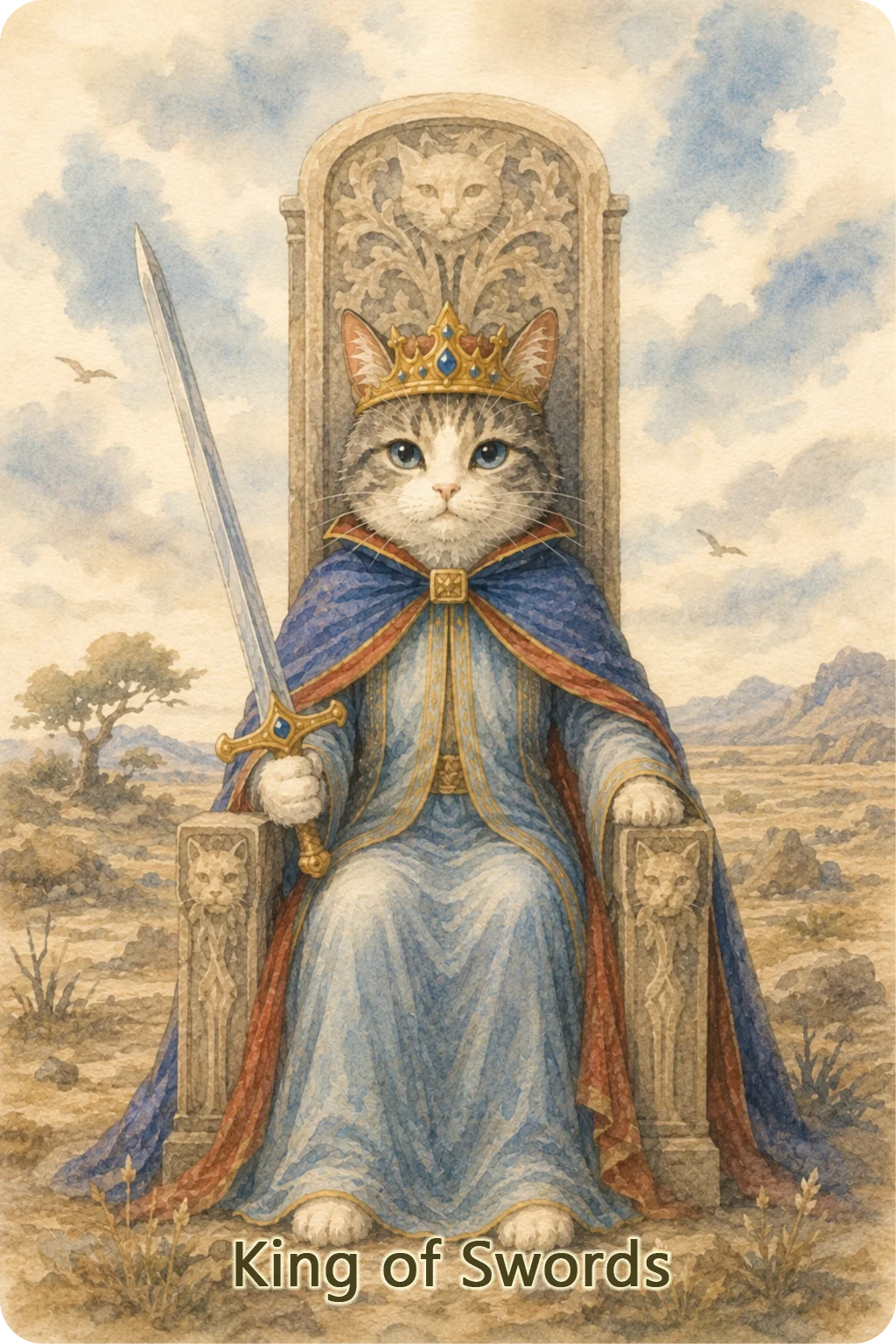
COURT CARD · KING
King of Swords
See the facts clearly and choose a responsible judgment.
- Reason
- Judgment
- Authority
- Fairness
- Power of words
- Calm judgment
- Intellectual decision-making
- Responsible words
SYMBOL & STORY
What King of Swords represents
The King of Swords represents the power to use intellect and words to make responsible judgments. Swords symbolize thought, judgment, language, truth, and decision-making. As the King of this suit, this figure is not simply intelligent. He is in a position to organize the information he has gathered, avoid being overly swayed by emotion, and reach a final conclusion. In the Rider-Waite-Smith deck, the King sits on a stone throne holding an unsheathed sword upright. His gaze faces directly forward, as though he is confronting the situation without trying to escape from it. Clouds float in the sky behind him, but the atmosphere is not as stormy as in many other Swords cards. He can be seen as someone who has gained composure after experiencing many conflicts and periods of intense thought. The throne contains decorations reminiscent of butterflies and birds, which can evoke the workings of the mind and spirit. The sword is held at a slight angle, and this is sometimes interpreted as symbolizing flexible judgment that can respond to the complexity of reality. However, some of these detailed symbolic meanings were developed through later tarot interpretation. Arthur Waite described this King as a figure who sits as though passing judgment. He also said that the figure recalls Justice from the Major Arcana. In divination, Waite associated the card with judgment, power, command, authority, intellectual force, law, and related themes. For that reason, if Justice in the Major Arcana represents the principle of fairness and correct judgment itself, the King of Swords can be seen as the person who applies that principle in the real world. He gathers facts, accepts responsibility, and makes the decisions that need to be made. Looking at the other Swords court cards, the Page gathers information and learns, the Knight quickly turns thought into action, and the Queen sees through to the truth through experience. The King integrates those qualities further and reaches the stage of taking responsibility for his own judgment. When this card appears, you may be asked to look not only at "how you feel," but also at "what is actually happening." There is no need to deny your emotions. However, if you are making an important decision, it can help to organize the facts, words, promises, rules, and other concrete elements first.
UPRIGHT & REVERSED
Upright and reversed King of Swords
Compare the keywords and detailed meanings to see how the symbol changes with orientation.
UPRIGHT
Upright meaning
See the facts clearly and choose a responsible judgment.
- Calm judgment
- Fairness
- Intellectual decision-making
- Responsible words
- Expertise
The King of Swords upright represents a state in which you can organize the situation through calm thought and make a responsible judgment. Mentally, you are able to step back and look at things without being swept away by emotion. Even if you have anxiety or expectations, you are capable of avoiding a conclusion based on those feelings alone and distinguishing between "what is fact" and "what is my imagination." In practical circumstances, the card can indicate situations that require a clear judgment, such as decisions, reviews, contracts, rules, negotiations, or interviews. It may also appear as a person who possesses knowledge or authority, such as a supervisor, manager, specialist, legal professional, or teacher. In terms of action, it becomes important to organize your thoughts and put them into words rather than remaining vague. Instead of accepting everything, it can also be necessary to clearly say "yes" or "no" when needed. For example, this card can appear when you are comparing options you have been uncertain about and making a decision, deciding on boundaries in a relationship, or being entrusted with a position of responsibility at work. When this card appears as "the other person's feelings," it may indicate that they are carefully assessing the situation rather than strongly expressing passion. That does not necessarily mean they have no feelings. On the contrary, they may be seriously considering how they should relate to you without acting rashly. What this card teaches is not to become cold. It is to value emotion while not allowing emotion alone to make the decision, and to use reason as a tool.
REVERSED
Reversed meaning
Do not use correctness as a weapon; choose judgment with compassion.
- Arbitrary judgment
- Cruelty
- Abuse of authority
- Biased judgment
- Pressure through words
The King of Swords reversed represents a state in which the calm judgment and authority of the upright card are being used in a distorted way. In some cases, reason is not functioning well and you are uncertain about what to decide. In others, you may be clinging too strongly to logic or to being right. Mentally, the card can appear as a tendency to overthink, doubt too much, or become overly critical. You may believe you are thinking calmly while actually using logic to justify anxiety or anger. With this card, the way intelligence itself is being used can become the problem. Knowledge and words can help people. Reversed, however, intelligence or authority may be turning into tools of control—for example, using correct arguments to silence someone, creating logic that conveniently favors yourself, or using position and power to force people to comply. Arthur Waite's reversed meanings include very strong ideas such as cruelty, injustice, and malice. In an actual reading, the card does not necessarily indicate a dangerous person. However, it can be read as a sign to check whether "rightness" or power is being used in an unhealthy direction. In practical circumstances, the card can indicate unfair judgments, an excessively strict supervisor, an intimidating person, or a decision made without enough information. In terms of action, care is needed with how words are used. Even when the content is correct, phrasing that is too sharp can hurt the other person. It is also possible that you are being overwhelmed by someone's forceful words and are losing your own ability to think. When this card appears reversed, rather than looking only at "who is right," it is important to review questions such as, "Is this judgment actually fair?" and, "What are these words being used for?"
LOVE
King of Swords in love
Upright love
When the King of Swords appears upright in a love reading, it becomes important to build trust and sincere communication rather than moving forward only on emotional momentum. With unrequited love, the other person may not be the type to reveal their feelings immediately. Even if they are interested in you, they may be calmly observing your personality, your way of thinking, and whether the circumstances are appropriate for moving the relationship forward. For that reason, you do not need to conclude immediately that there is no romantic potential simply because their reactions are restrained. By continuing natural conversation and sincere interaction, their true attitude may gradually become clearer. If you are already in a relationship, this is a time to put the relationship into practical order. You may find yourselves discussing somewhat serious topics such as the future, daily life, work, money, or personal boundaries. Rather than emotionally demanding, "I want you to understand me," it may be easier to deepen mutual understanding if you organize your thoughts and say, "This is how I feel," and, "This is what I am thinking about for the future." For reconciliation, rather than returning to the relationship out of loneliness alone, it is necessary to calmly review the problems of the past. What caused the breakup, and what would need to change so that the same thing does not happen again? Those questions matter. With new encounters, the card can indicate a connection with someone intelligent, calm, responsible, or serious about their work. Rather than becoming an intensely passionate romance from the beginning, the relationship may grow gradually through conversation and trust.
Reversed love
When the King of Swords appears reversed in a love reading, logic may be coming too far ahead of emotion. With unrequited love, you may be deciding, "They don't like me," or, "They must think this way," before actually confirming how the other person feels. When anxiety is strong, people tend to analyze the other person's feelings repeatedly inside their own minds. However, those thoughts are not necessarily facts. It is important to watch the other person's words and actual behavior over time. If you are already in a relationship, be careful of arguments based on who has the stronger logic. The more you think, "I'm the one who's right," or, "Normally, anyone would do this," the more difficult it can become for the other person to express their feelings. Solving the problem matters, but if you first ask how the other person feels, the atmosphere of the conversation may change. If one person is trying to control the other through forceful words or logic, the balance of the relationship may also need to be reviewed. For reconciliation, the card can appear as continuing to put the past on trial. Simply handing down a verdict of, "They were at fault," or, "I was at fault," may leave the same underlying problem untouched. If you are considering reconciliation, it is often more helpful to organize why the relationship did not work than to decide who was to blame. With new encounters, you may be judging people too much by conditions, status, or titles. Rather than looking only at whether someone matches your ideal criteria, also pay attention to whether you feel safe and at ease when you are actually together. However, there are also cases where the other person prioritizes only their own thinking and makes little effort to hear how you feel. It is important to judge not only from their words, but also from their actual behavior.
FEELINGS
King of Swords in their feelings
Upright their feelings
When the King of Swords appears upright as the other person's feelings, they may be taking their emotions toward you seriously and trying not to handle them casually. Even when affection exists, they may prefer to understand the situation logically rather than act only from impulse. They may be considering your character, your compatibility, and what kind of relationship could realistically be built. Their thinking may be less, “I like them, so I must act now,” and more, “What would it mean to build something real here?” Their feelings may show through reliability rather than dramatic romance: keeping promises, discussing important matters properly, or avoiding ambiguous behavior. Someone who is not naturally expressive may show care mainly through consistency and responsibility. In an existing relationship, they may be thinking seriously about the future, responsibilities, or how to solve practical issues together. Because they often focus on solutions more than emotional sharing, they can sometimes seem cooler than they actually feel. Rather than measuring affection by sweet words, look at whether they treat you as an equal and respect your judgment. Stable respect and responsible behavior can be this card's clearest expression of mature interest.
Reversed their feelings
When the King of Swords appears reversed as the other person's feelings, they may be suppressing emotion strongly or becoming fixed in their own way of thinking. They may be conscious of you while avoiding showing what they truly feel. Even when affection exists, they may create distance because they do not want emotion to control them. As a result, they can appear colder than necessary or try to explain everything through logic. Another possibility is that they are prioritizing their own conclusions over your feelings. They may try to define the relationship unilaterally, control the conversation through words, or decide what should happen without listening enough to you. In an existing relationship, the problem may be too much focus on solving issues and not enough empathy. They may actually feel insecure but respond by becoming stricter or more controlling. Not expressing emotion does not automatically mean there is no affection. Still, affection without equality or consideration is difficult to turn into a healthy relationship. Look at both what they say and whether their behavior respects your autonomy.
WORK
King of Swords in work
Upright work
In work, this card tends to highlight judgment, expertise, and the ability to explain things logically. Rather than proceeding only by intuition, you are more likely to achieve results by checking documents, numbers, evidence, and rules before acting. When a problem occurs, instead of focusing on who is to blame, organizing the cause and searching for a solution is likely to be more productive. In the workplace, the card can indicate involvement from someone who has decision-making authority, such as a supervisor, manager, or specialist. You may receive a strict opinion from that person, but the content itself may still contain something useful to learn from. If you yourself are appearing as the King of Swords, you may find that people rely on you more or ask you to make decisions. In that case, it is important to use fair standards rather than judgments based on personal likes and dislikes. For a job change, do not decide only from your impression of the company. It is important to check the actual duties, salary, working conditions, contract terms, future prospects, and other concrete factors. In an interview, rather than saying only, "I am motivated," you are more likely to be evaluated positively if you explain in a logical way what experience you have and how you can contribute. For goal achievement, it is useful to organize the plan and decide priorities. Rather than simply "working hard," clarify what you will do, by when, and what state you want to reach. That can reduce uncertainty.
Reversed work
In work, this card calls for caution around biased judgment and the way authority is used. In the workplace, it can represent a strict supervisor, an autocratic manager, or an environment where people's opinions are not heard. If things are being decided not because of the rules themselves but simply because "the person above said so," you may feel that the workplace is somewhat oppressive. On the other hand, if you yourself are in a position of responsibility, check whether you are proceeding only according to your own judgment without hearing the opinions of the people around you. In the way work is handled, there is also a possibility of making poor decisions because of insufficient information or assumptions. The more experienced someone is, the more easily they can cling to an old method with the thought, "This worked before." If circumstances have changed, it may also be necessary to take in new information. For a job change, it is important not to decide from anger or dissatisfaction with your current workplace alone. The stronger the feeling, "I just want to escape from here," the more likely you may be to choose the next workplace without carefully checking the conditions. Calmly confirm concrete details such as the duties, salary, contract, and working hours. Regarding evaluation, it is also important not to treat someone's harsh words as the whole measure of your worth. If there is something useful within the criticism, take that part in. You do not need to carry the rest more heavily than necessary.
MONEY
King of Swords in money
Upright money
In financial matters, calm management and judgment lead toward greater stability. In terms of income, the knowledge, experience, and specialized skills you have developed may become more directly connected with earnings. Gaining qualifications, improving your skills, or negotiating conditions can also be useful. With spending, rather than buying something simply because you want it, it becomes important to ask, "Do I really need this?" and, "Is it worth the price?" For expensive purchases or long-term contracts, read the explanations carefully and ask about anything you do not understand. Calmly comparing the numbers and conditions can reduce regret. For investments and asset management, it is important not to be swept along by rumors or temporary excitement. Research the information and make decisions only within areas you understand. With saving, creating a system—such as deciding a monthly budget or target amount—can make your finances more stable. Understanding your money in concrete numbers rather than managing it by feel can help bring your financial situation into better order.
Reversed money
In financial matters, caution is needed around biased judgment and insufficient information. In terms of income, you may not be evaluating your own abilities accurately. You may be undervaluing yourself so much that you cannot negotiate better conditions, or, conversely, you may be expecting a high income without enough basis. It can help to organize your experience and skills objectively. With spending, you may be using logic to justify purchases by telling yourself, "I need this." Take some time to consider whether it is genuinely necessary or whether the spending is intended to distract you from anxiety or stress. For investments and contracts, it is important not to be carried along by someone's forceful words or highly technical explanation. You do not need to pretend that you understand something when the explanation is difficult. If there is something you do not understand, ask about it. It is perfectly valid to postpone a decision until you are satisfied. For expensive contracts, loans, investments, and similar commitments, review the numbers and conditions once more. With saving, the management may also have become too strict. If you feel guilty about spending money at all and are denying yourself even things you need, it may be worth reconsidering the balance. Protecting money and enjoying your life can coexist.
RELATIONSHIPS
King of Swords in relationships
Upright relationships
In relationships, fairness and appropriate distance become important themes. Strong empathy with someone is valuable, but you are also being asked not to decide based only on one person's side of the story and to look at the whole situation. In friendship, you may find yourself in the role of adviser. While staying close to the other person's feelings, you may be able to help by offering a calm perspective such as, "The situation may actually look like this." However, sometimes the other person is not looking for a solution and simply wants someone to listen. Before trying to produce the correct answer, remember to hear how the other person feels as well. Within the family, it may become necessary to discuss roles or rules. Organizing issues that have remained vague can actually make the relationship calmer. At work or in a group, confirming facts instead of being guided by rumors or personal likes and dislikes helps build trust. This card also emphasizes appropriate boundaries. Caring about someone is not the same as accepting everything. Drawing lines that protect you—such as refusing unreasonable demands—can also be necessary.
Reversed relationships
In relationships, sharp words and imposing your values on others can easily lead to misunderstanding. In friendship, check whether you are giving solutions every time someone comes to you for advice. What the other person may need is not the correct answer, but simply to have someone listen and say, "I see—that is how you feel." Within the family, assumptions such as, "Normally people should do this," or, "If we're family, they should understand," can lead to conflict. Even in close relationships, values are not necessarily the same. Asking again what the other person thinks can reduce misunderstanding. At work or in a group, the opinions of someone with a strong voice may dominate the discussion. If you feel the situation is unfair, organizing the facts and records before speaking is more likely to change the situation than confronting the person emotionally. This card can also represent isolation. You may be trying to decide everything alone and have reached a point where you cannot consult anyone. Talking with someone you trust may help you notice a perspective that was invisible to you before. If you are struggling with distance in a relationship, taking some space may sometimes be necessary. However, creating distance and rejecting the other person completely are not the same thing. Protect your heart while leaving enough room to talk again if needed.
YES OR NO
Yes or No for King of Swords
Upright judgment
- Judgment
- Yes
- Reason
- The King of Swords represents intelligence, responsibility, and objective judgment. When there is enough information to make a clear and fair decision, the answer leans toward Yes.
- What could change the answer
- The Yes remains stable when facts, rules, and consequences are considered responsibly and fairly. If logic becomes rigid authority or other people's circumstances are ignored, the reading can shift toward the reversed side.
Reversed judgment
- Judgment
- No
- Reason
- The King of Swords reversed can show biased judgment, authoritarian behavior, or logic used without fairness. The current approach lacks flexibility and balance, so the answer is No.
- What could change the answer
- The reading can change toward Yes if other perspectives are heard and decisions become more balanced, taking both facts and feelings into account. Insisting that only one person's logic is correct strengthens the No.
MESSAGE FROM THE CARD
Advice from King of Swords
Upright
You do not need to decide the answer based only on your feelings right now. First, try organizing the information you already have. What is actually happening? What are you imagining? And what do you truly want to protect? You have the ability to understand the situation clearly. Kindness does not mean accepting everything. Communicating what needs to be said, refusing when necessary, and protecting yourself or someone important to you are also forms of kindness. You do not have to choose between emotion and reason. Use reason to think about how you can protect your feelings. Do not rush the answer. Look at the facts and choose a judgment that you yourself can accept. That attitude will help make the next path clearer.
Reversed
You do not need to rush to decide the correct answer right now. Even when you believe you are thinking calmly, fatigue or anxiety can sometimes make your judgment a little rigid. First, try separating what is fact from what is imagination. And when you think about the words you are about to say, ask yourself, "Are these words meant to defeat the other person?" or, "Are they meant to improve the situation?" Words are like swords. They can cut open a path, but depending on how they are used, they can also hurt both the other person and yourself. You do not need to throw away the sword. What is needed is to add a little kindness to your intelligence and judgment. A problem that could not be solved through correctness alone may reveal a new answer when you also consider the other person's position and your own true feelings.
READ IT YOUR WAY
Let King of Swords lead to a reading in your own words.
Use these meanings as a guide or develop language of your own. With a custom deck, you can shape every description and image to fit your practice.