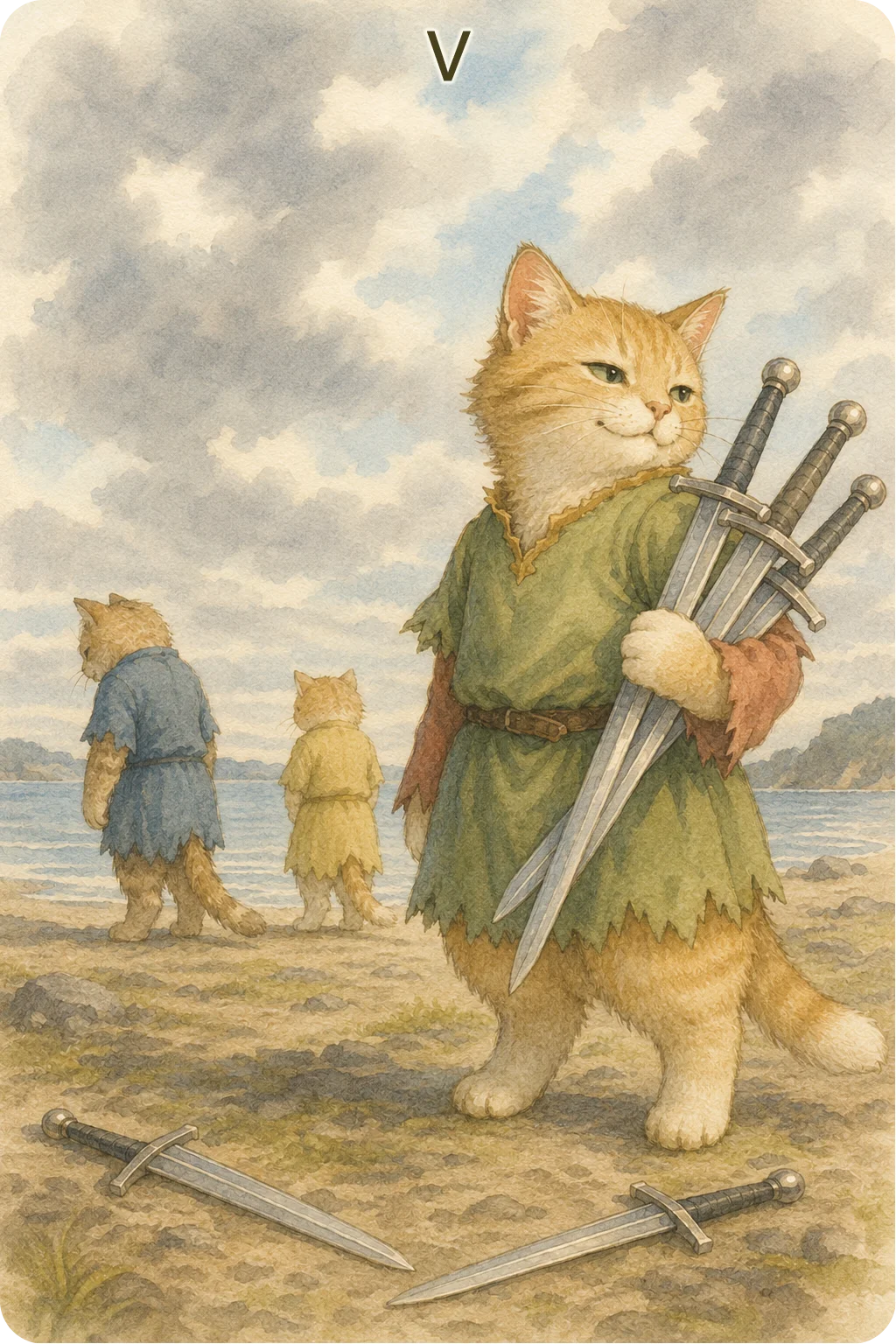
MINOR ARCANA · 5
Five of Swords
Look beyond winning, and consider what you want to remain afterward.
- Conflict
- The cost of victory
- Dishonor
- Tension
- Attachment to winning and losing
- Argument
- Self-protection
- Uneasy atmosphere
SYMBOL & STORY
What Five of Swords represents
The Five of Swords is a card that looks at what remains after conflict. It appears that there is a winner and there are losers, but this card asks whether the victory was truly worth what it cost. In the Rider-Waite-Smith deck, the figure in the foreground holds three swords while two other figures in the background leave their swords on the ground and walk away. The person in front appears to be the victor, yet there is something cold and self-satisfied in the expression. The two who are leaving look dejected, and uneasy clouds move across the sky. Even if the battle has been decided, there is no sense of clear and joyful triumph. Arthur Waite described the foreground figure as someone who looks contemptuously at the two retreating people, and he listed severe divinatory meanings such as degradation, destruction, reversal, dishonor, and loss. For that reason, Waite himself did not treat this as a simple card of "victory." In later tarot interpretation, the image came to be widely read as "winning but losing something important," "defeating someone in an argument but damaging the relationship," or, "the more you become attached to winning and losing, the harsher your heart becomes." From there, modern readings often approach this card through themes such as hollow victory, the cost of conflict, and knowing when to walk away. Swords symbolize thought, judgment, words, and communication. Therefore, the conflict shown by this card does not necessarily have to be a dramatic fight. It can appear in everyday life as verbal clashes, stubbornness, sarcasm, competition, or an attitude focused on deciding who is right. If the numbered Swords are read as one continuous story, the pain experienced in the Three of Swords is followed by the Four, where distance is taken and rest becomes necessary. Then, in the Five, tension and conflict with other people rise to the surface again. Here, the possibility is included not only that you may be the one being hurt, but also that without realizing it, you may be the one hurting someone else. The Five of Swords is not asking only, "Who won?" It asks, "What was gained, and what was lost, through that conflict?" There are times when protecting what is right matters. But if protecting pride or stubbornness also means losing precious trust, there may be room to choose another path.
UPRIGHT & REVERSED
Upright and reversed Five of Swords
Compare the keywords and detailed meanings to see how the symbol changes with orientation.
UPRIGHT
Upright meaning
Look beyond winning, and consider what you want to remain afterward.
- The cost of victory
- Argument
- Self-protection
- Uneasy atmosphere
- Attachment to winning and losing
The Five of Swords upright represents a state in which attention has become overly focused on winning and losing within conflict or competition. You may be able to force your opinion through, defeat the other person in an argument, or protect your position. However, it is necessary to ask whether trust or a sense of security has been damaged as a result. On a mental level, feelings such as, "I don't want to lose," or, "I don't want people to think I'm wrong," can become especially strong. You may genuinely want to be understood, yet instead of expressing that honestly, use sharper words. Past experiences of being hurt can also lead you to become suspicious first, or to protect yourself before someone has the chance to attack. In practical circumstances, this can appear as arguments, clashes of opinion, competition, sarcasm, cutting remarks, or a tense workplace atmosphere. Even if someone appears to have won on the surface, dissatisfaction or an unpleasant aftertaste may remain around them. In terms of action, rather than trying to win every conflict, it is important to ask, "Is this truly something I need to fight about?" If it concerns a boundary you must not give up, then you may need to defend your position. But if the conflict is continuing only because of pride, choosing to step away can also be a form of strength. For example, you may prove that you were right in an argument with your partner yet leave the atmosphere between you cold. At work, you may force your opinion through but find it harder to gain cooperation afterward. You may answer a friend sharply and feel satisfied in the moment, only to regret it later. These are situations in which this card can be especially easy to recognize. The Five of Swords is not saying, "You must never win." It is asking you to discern what you are fighting to protect, and what you may lose in exchange for that victory.
REVERSED
Reversed meaning
End the conflict, and gradually release the wounds that remain in your heart.
- End of conflict
- Regret
- Lingering resentment
- Reconciliation
- Dragging conflict on
The Five of Swords reversed represents both a movement away from conflict and a state in which a conflict that should already be over is still continuing inside the heart. Waite himself treated the reversed position as largely similar to the upright meaning, while adding associations with burial and funerals. In modern practical readings, these are not usually taken literally as events. Instead, they may be understood symbolically as the sense of loss that remains after a conflict, or the process of accepting something that has already ended. While the upright card tends to focus attention on winning or protecting one's position, the reversed position can bring out the feeling, "I don't want to fight anymore." You may apologize, try to reconcile, take some distance, or let go of the need to win—movements toward putting the sword down. On the other hand, the argument may be over on the surface while still continuing inside you. You may repeatedly think, "They said that to me," "I was the only one who lost," or, "I really wanted to say something back," and continue carrying anger and frustration. This card can also appear when the same argument repeats again and again. If you reconcile only to clash over the same issue once more, it may be necessary to look beyond the argument itself and toward the anxiety or dissatisfaction underneath it. In practical circumstances, the card may be read as signs of reconciliation, the ending of conflict, or withdrawal from a fight. It may also indicate a cold war, superficial reconciliation, or resentment that has not disappeared. The surrounding cards and the question will help determine which direction is stronger. The reversed Five of Swords is not simply saying, "You should make up." True laying down of the sword comes from carefully looking at what still remains inside you after the conflict is over.
LOVE
Five of Swords in love
Upright love
When the Five of Swords appears upright in a love reading, it represents a state in which stubbornness and miscommunication can easily arise between two people. Precisely because you care, there may be something you cannot easily give up. Or because you do not want to be hurt, you may take a strong stance first. With unrequited love, you may be relying too much on tactics in order to test the other person's feelings. Acting deliberately distant, testing their reactions, hinting that other romantic interests exist—if too much attention goes toward trying to provoke a response, your genuine affection can become harder to communicate. A more straightforward exchange is likely to nurture the relationship more effectively. If you are already in a relationship, this is a time to be careful about arguments over who is right. Discussion itself is not a problem, but if the goal becomes persuading or defeating the other person, the conversation can move away from what would actually make the two of you happier. It is important to ask yourself, "After I say this, what will happen to our relationship?" For reconciliation, past wounds and dissatisfaction may still remain. If the process focuses only on deciding, "You were the one at fault," the same conflict may repeat. If you are considering reconciliation, it is necessary to look beyond who won or lost in the past and consider whether the two of you can respond differently if the same problem appears again. With new encounters, you may be highly cautious about romance. Careful judgment is important, but if suspicion becomes a habit, it can push away good connections as well.
Reversed love
When the Five of Swords appears reversed in a love reading, a desire to end the arguments and stubborn standoffs between the two of you may be growing. This is a time to shift your attention away from who was right and toward what you want the relationship to become. With unrequited love, you may be tired of tactics designed to test the other person's reactions. Acting cold to attract attention, trying to make them jealous, or refusing to move until they come to you may all be forms of stubbornness that can be released so the relationship becomes more natural. On the other hand, past experiences of being hurt may still be making it difficult to trust the other person, leaving you suspicious inside. If you are already in a relationship, reconciliation is possible. If both of you feel, "I want this argument to end," the relationship can begin to rebuild. However, if you apologize only on the surface and avoid the actual issue, the same conflict may repeat. It is important to explain what hurt you without turning it into blame. For reconciliation after a breakup, how much the old wounds have been processed matters. If both of you can look back on the past and have changed enough not to repeat the same problem, there may be room to talk again. But if either person still carries strong resentment or a sense of defeat, it may be better to prioritize emotional processing rather than rush back into the relationship. With new encounters, there is a possibility that you may project wounds from a past relationship onto someone new. Caution is not a bad thing, but it is also important not to decide in advance, "The same thing will happen again."
FEELINGS
Five of Swords in their feelings
Upright their feelings
When the Five of Swords appears upright as the other person's feelings, defensiveness may be stronger than affection at the moment. They may be thinking, “I do not want to lose,” “I do not want to be hurt,” or, “I need to protect myself.” Even when they care, they may feel that showing it puts them in a weaker position. This can lead to coldness, arguments, testing your reactions, or trying to stay one step ahead. If there has already been conflict, they may still be caught up in what happened. They may insist to themselves that they were right, or they may secretly regret what they said while still finding it difficult to admit. With unrequited feelings, romance can begin to feel like a contest or a strategic game. They may be conscious of you while still not being emotionally ready to build the relationship calmly. The important question is not only whether affection exists, but what they are trying to protect themselves from. When the relationship becomes safe enough for honesty, the feelings hidden behind the defensiveness may become easier to see.
Reversed their feelings
When the Five of Swords appears reversed as the other person's feelings, they may want to end the tension or awkwardness between you. They may regret harsh words or simply be tired of conflict. Rather than wanting to cut the relationship off completely, they may be thinking, “How can we talk normally again?” If their attitude has softened, that can be read as an early sign of reconciliation. At the same time, conflict can end on the surface while hurt remains underneath. They may still feel dissatisfied but decide that continuing the argument is not worth the effort. In an existing relationship, they may be tired of repeating the same fight and want to change the way the two of you handle disagreement. What matters is whether that feeling becomes apology, accountability, or concrete change. With this card, “the fighting has stopped” and “the problem is resolved” are not necessarily the same thing. Genuine repair becomes more likely when they can also acknowledge their own part in what happened and work toward a safer relationship.
WORK
Five of Swords in work
Upright work
When the Five of Swords appears upright in a work reading, it represents a situation in which competition or clashes of opinion are intensifying. You may find yourself in a position where you feel you must compete with someone over results or evaluation. You have the ability to push your point through, but you need to pay attention to how you communicate and proceed. Even if your criticism is correct, ignoring the other person's position can create resistance. If you achieved the result you wanted but the team atmosphere has become cold, it may be worth reviewing not only what you achieved, but also how you achieved it. In the workplace environment, factions, gossip, blame-shifting, or competitiveness may be present. You do not need to participate in every conflict. Keeping your distance from disputes that do not directly concern you can also be an important judgment for continuing your work. For a job change, you may be tired of workplace relationships or competition. The feeling, "I don't want to keep fighting here," may be one reason you are thinking about leaving. If so, rather than quitting only on impulse, it is better to organize what you want to get away from and what you want to value in your next workplace. That makes your direction easier to see. Regarding goal achievement, you do have the strength to survive competition. However, a structure in which you can cooperate with the people around you is likely to produce results that are easier to sustain than a situation in which only one person wins.
Reversed work
When the Five of Swords appears reversed in a work reading, it represents a movement away from competition and conflict in the workplace. A tense atmosphere may gradually settle, creating opportunities for discussion or relationship repair. In interpersonal matters, this can be read as a sign of improvement: you may gradually become able to speak normally again with someone you previously clashed with, or conflict within the team may begin to ease. However, even if the problem looks solved on the surface, someone may still be carrying dissatisfaction. Rather than forcing everyone to act as though, "It's over now," it is better to calmly confirm whatever still needs to be addressed. Conversely, this card can also appear when the same conflict keeps repeating. If blame-shifting, gossip, or factional disputes do not end, do not try to solve everything through individual effort alone. It may be necessary to improve the structure itself, for example by consulting a supervisor or clarifying roles. For a job change, the feeling, "I don't want to keep fighting in this environment," may be growing stronger. That is not necessarily weakness. However, if you move on without organizing what was painful, you may face the same issue again in a similar situation. It is better to think about what you want to value in your next workplace as well. Regarding evaluation or goal achievement, this is a time to shift attention away from defeating someone else and back toward steadily fulfilling your own role. Stepping out of competition can sometimes make it easier to demonstrate your real ability.
MONEY
Five of Swords in money
Upright money
When the Five of Swords appears upright in a financial reading, your awareness of winning, losing, profit, and loss may become especially strong. Thoughts such as, "I want to gain even a little more," or, "I want to recover what I lost," can cloud calm judgment. In terms of income, negotiation or competition may bring financial benefit. However, overly forceful negotiation or methods that benefit you only by placing the loss entirely on the other side can affect trust later. It is important to consider both short-term profit and the long-term relationship. With spending, be careful of thoughts such as, "It's cheap, so I'm getting a bargain," or, "If I don't buy it now, I'll lose out." You may believe you have gained something through a sale while actually increasing your spending by buying things you did not need. With investments, be especially careful of the urge to win back a loss. Trying emotionally to recover a single loss can lead to an even larger mistake. Rather than focusing only on profit and loss, you are more likely to remain stable if you follow the standards you decided in advance. This card can also appear when you are comparing yourself too much with other people financially. Instead of trying to have more than someone else, bring your attention back to creating a financial situation that feels safe and sufficient for you.
Reversed money
When the Five of Swords appears reversed in a financial reading, you need to let go of anxiety around money and an excessive attachment to winning and losing. If you regret a past purchase or investment, repeatedly thinking, "If only I had done things differently," does not change the loss itself. What matters is not blaming yourself for the mistake, but creating rules that help you avoid making the same decision again. With investments, this can be a time to move away from trying too hard to recover losses. Pausing trades for a while or reviewing how your funds are allocated can help restore calm judgment. On the other hand, you may remain attached to an old loss and continue postponing necessary decisions. You need to identify exactly what you are still holding onto. With spending, the theme is reviewing impulse buying and the feeling, "I have to get a bargain." If you regret a purchase, creating a specific habit—such as waiting overnight before buying—will help more than continuing to criticize yourself. If there is a financial dispute, it is important to avoid emotional arguments and instead record the amounts, conditions, deadlines, and other details so that the issue can be discussed based on facts. Money is not a tool for proving who has won. It is a tool that supports your life. Recovering that sense is the first step toward putting the situation back in order.
RELATIONSHIPS
Five of Swords in relationships
Upright relationships
When the Five of Swords appears upright in a relationship reading, misunderstandings in words and clashes of opinion are more likely. Someone's remark may bother you more than usual, and you yourself may also find it easier to respond sharply. In friendship, a joke may unintentionally hurt the other person, or you may interpret what they say as malicious even when it was not intended that way. Words can become especially sharp right now, so simply taking a moment before responding can reduce unnecessary conflict. Within the family, closeness can reduce restraint, making it easier to throw correct arguments at one another. Even if the content is right, it may not communicate if the other person is not in a state where they can receive it. How you say something matters just as much as what you say. At work or in a group, someone may be trying to seize control—or you yourself may be doing so. Rather than trying to defeat everyone, the relationship becomes more stable when you decide what boundaries you truly need to protect. This card teaches that "winning" and "staying connected" are not necessarily the same thing. If the emotional distance grows wider after you have defeated someone in words, there may be room to lower the sword once.
Reversed relationships
When the Five of Swords appears reversed in a relationship reading, it represents both the possibility of ending a conflict and the state of still carrying a past conflict with you. In friendship, this can be read as a sign of repair: you may become able to speak again with someone you argued with, or gain an opportunity to clear up a misunderstanding. Even saying something brief such as, "I went too far the other day," may be enough to get a stalled relationship moving again. On the other hand, you may behave normally on the surface while still being unable to forgive something the other person said in the past. You do not need to force yourself to forget. It may help to ask whether this is someone you still want in your life and what level of distance would allow you to feel safe. Within the family, the theme may be ending arguments that have repeated many times. Trying to decide who is at fault tends to bring you back to the same place, so discussing, "What do we do from here?" is more likely to help you move forward. At work or in a group, this card can represent stepping away from factions or disputes. Even if someone pressures you to take a side, you do not need to become involved in every problem. Creating enough distance to protect your own work and daily life also matters. If you have become isolated, an opportunity to reconnect with someone may appear. However, returning to the exact same relationship as before is not the only correct answer. Based on what you learned from the past, reconnecting at a healthier distance can also be a meaningful form of repair.
YES OR NO
Yes or No for Five of Swords
Upright judgment
- Judgment
- No
- Reason
- The Five of Swords represents conflict in which even winning can come with a cost. Continuing with the current approach is likely to damage trust or relationship quality even if the immediate goal is achieved, so the answer is No.
- What could change the answer
- The answer can change when the need to win is released and the approach shifts toward an outcome both sides can accept. Continuing the conflict only strengthens the No.
Reversed judgment
- Judgment
- It depends
- Reason
- The Five of Swords reversed can show a desire to end conflict, but resentment may still remain. There is room for improvement, yet the result depends on whether the issue is genuinely being repaired or merely avoided.
- What could change the answer
- The reading shifts toward Yes when apology, conversation, and changed behavior begin rebuilding trust. If only the surface is smoothed over while the underlying problem remains, it moves toward No.
MESSAGE FROM THE CARD
Advice from Five of Swords
Upright
Perhaps there is something you feel you cannot give up right now. There are situations where protecting yourself requires strong words or where you need to stand firm so that you are not defeated. But think about one thing. At the end of this fight, will what you truly want still remain? Strength is not only defeating the other person. Choosing your words even when you could say something harsher, stepping away from a conflict that will no longer produce anything, and protecting the relationship rather than the win when the other person matters to you—these are also real forms of strength. If you are fighting for something that genuinely needs to be protected, state your position clearly. But if you realize you are still holding the sword only because of pride or frustration, it is all right to loosen your grip a little. More than what you win, value what you want to remain when the conflict is over.
Reversed
Are you still continuing an argument inside your heart even though it has already ended outside? The things that frustrated you, the ways you were hurt, the words you never got to say back—you do not have to forget them easily. But if remembering them again and again means that you continue hurting yourself, it may be time to begin preparing to put the sword down little by little. If an apology would help you move forward, you can be the one to offer the words. If distance from the other person would make things more peaceful, it is also all right to choose separation. Reconciliation does not always mean returning to the exact relationship you had before. What matters is not deciding who won, but understanding what you learned from the experience and what kind of relationship you want to choose from here. Putting down the sword is not defeat. It is the choice to redirect the strength you were using for conflict toward what you want to protect next.
READ IT YOUR WAY
Let Five of Swords lead to a reading in your own words.
Use these meanings as a guide or develop language of your own. With a custom deck, you can shape every description and image to fit your practice.